
Following Your Passion Won’t Lead To Work You Love
The dream job formula has three ingredients — passion isn’t one.

According to a survey by The Conference Board, 53% of people are unhappy at work.
If you take into account many people spend an average of 8.5 hours per day at the office, this is not only shocking but seems downright wrong. You shouldn’t spend a large part of your life in misery, wasting your potential. Instead, you should find work you enjoy.
Looking at the numbers, finding your dream job isn’t easy — but it’s almost impossible if you take popular advice.
“Follow your passion and success will follow you.”
It’s obvious why this suggestion has spread into even the most remote corner of LinkedIn and career advice blogs. It seems reasonable and easy to follow. After all, passion leads to motivation and that means you’ll get good at something. But does it really? Passion leads to many things, but usually, a fulfilling career isn’t one of them. I’ve experienced this first-hand and there’s a bunch of data to back it up.
But if passion isn’t the key to work you love — what is it then?
The myth of following your passion — and why it doesn’t hold up to reality
I’ve often followed my passions and while it was fun, it never led to work I loved.
I’m passionate about fitness, but there’s no way I’ll get a bunch of certificates, take lots of good-looking and highly-edited photos, and compete for less-than-motivated clients in an oversaturated market.
I’m passionate about numbers, but crunching them in business case after business case quickly got dull and after a while, even free coffee at the office kitchen didn’t cut it anymore.
In both cases, a steady stream of cold, hard reality washed away my passion.
“People usually can’t differentiate what they really love and what they love the idea of” — Brianna Wiest
This applies to your career, people you meet at the bar, and certain lifestyles. Once you get into them you realize they aren’t what they seemed to be.
Even data shows the whole follow your passion myth can’t be true.
It originated in the 1970 book What Color is Your Parachute and lay dormant until 1990, when it spread through all kinds of literature.
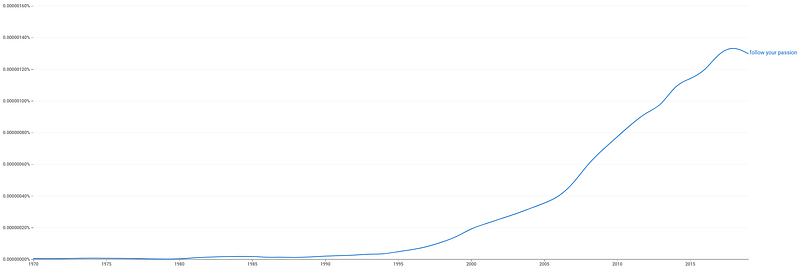
The idea and its spreading seem random — because they are. The inherent problem with following your passion is another one though.
Most of your passions aren’t related to any careers in the first place.
In a study, 539 Canadian university students answered questions about their passions. Most of them were into dance, hockey, skiing, reading, and swimming. Less than 4% of their passions were in any kind related to work and education. I don’t want to be a party pooper but there aren’t nearly enough jobs in dance, hockey, skiing, reading, and swimming for everyone.
If passion is out of the question, what should you focus on instead? Cal Newport has dedicated his entire book So Good They Can’t Ignore You to the answer.
Passion is the result, not the starting point
Most people think passion means you’ll become great at what you do.
It seems obvious. If you’re passionate, you’ll be motivated and keep going until you’ve made it. Unfortunately, that isn’t how it works.
When I started writing, I wasn’t overly motivated or passionate. I wrote to try it, and my first articles sucked. It was only once my skills improved that I felt more confident and like I was onto something. I became passionate. But I had to learn how to write consistently, improve my texts, and edit my work first.
Skills lead to passion and allow you to choose the work you love.
As a writer on Medium, I’m now in the unique position to work at any time from anywhere. Not because I’m passionate about writing but because I have built the necessary skills and can now cash them in for unique perks.
As an average programmer, you compete with a bunch of other people for a limited number of jobs. But if you’re an expert in a niche, there will be less competition, your work will be more valuable, and you can choose your projects and request more money, free time, or home office in return.
If you want to become passionate and choose work and perks you enjoy, build your skills.
However, skills are only one part of the dream-job-formula.
What can you do for the world?
Even if you become the very best at what you do and can choose all the perks you want, your work will get dull if don’t feel like you’re making a difference.
This seems like a luxury problem for anyone just trying to pay the bills but if you want fulfilling work, it’s what you have to go after.
What do Elon Musk, Sarah Blakely, and Al Capone have in common?
Elon Musk wants to make humanity an interplanetary species. Sarah Blakely wants to support female business owners to make the world a better place. Al Capone, the legendary gangster who organized gambling and prostitution and supplied Chicago with alcohol during the prohibition, said:
“I have spent the best years of my life giving people the lighter pleasures, helping them have a good time.”
Can you see the commonalities now?
They all burn for their work. They all thoroughly enjoy what they do. And they all have a mission that involves others.
If you aren’t making a difference in the world or someone else’s life, your work will always feel meaningless.
That doesn’t mean you have to become the next Elon Musk. A friend of mine makes others’ lives better by baking delicious and richly-decorated birthday cakes. The moment she sees their eyes light up when they first look at the cake is what fulfills her.
If you want meaningful work, contribute to a better world.
3 questions to find your mission
There are millions of things you can do to make the world a better place. Ask yourself these three questions to become clear on what you want to do:
1. What do you think is wrong with the world that you care enough about to change it?
2. Whom or what do you want to help?
3. What’s the end result?
I do coaching for ambitious men who want to live a more authentic life, let go of the expectations of society and instead do what fulfills them. This was important to me since I had been running in the hamster wheel for years, without a clear plan of how to get out and create the life I want to live. So, I set out to help men create a clear, authentic vision for the life they want, take action, and drive results.
Your answers to these questions will be different.
Maybe you care about old people and want to help them live better lives or be less lonely. Maybe you care about the environment and want to reduce plastic usage. Maybe you care about students and want to help them pay their crippling debts off quickly.
Whatever it is, align your job with your mission. Stand behind what you do every day. Contribute to the world.
If you want to matter, do something that matters to you.
There’s more to work than just work
Even the best job in the world will suck like a Dyson vacuum if your boss or coworkers are idiots.
Humans are social animals. The people you surround yourself with have a huge impact not only on your character but also on your mood and daily life. And this is where it gets tricky.
Human relationships aren’t predictable. You can’t predict if you’ll get along well with your team members. But you can set the right course.
First, understand your relationships with others significantly determine your happiness. You’ll spend around eight hours of your day with these people, so don’t skimp in favor of a better salary or free coffee.
You aren’t your job — you are a human. And as such, you interact with all the humans around you, so make sure these are people you enjoy being around.
Second, choose a company that aligns with your values because it says a lot about the people who work there. If self-expression and flat hierarchies are important to you, don’t choose an ultra-conservative behemoth of a company where “things are done as they’ve always been done” and you need to age, not work, your way up. This sounds obvious, but looking at my first few jobs I was blind to the fact, so don’t make the same mistake.
The Dream Job Formula
“Follow your passion and success will follow” is a myth. If you want to find work you love and excel at, consider these factors instead.
Skills x Mission x People = Dream Job
Your skills are the seed of passion and allow you to choose your work and the perks that come with it.
Your mission is the driving force behind what you do and essential for meaningful work.
Your relationships have a huge impact on your time at work, mood, and everyday life.
On average, you’ll spend around 90,000 hours of your life at work. Make sure you enjoy it so you don’t end like the 53% who don’t.
Sign up for the PGSG Side-Hustle Summit, March 9–12
29 interviews, with 25+ hours of expert insight on everything from Freelancing and Medium to Bookkeeping, Dropshipping and Growing your own Wordpress site.


