
KNOWLEDGE — INNOVATION — AGILE COACHING
Focus on Risk-Takers to Make Your New Idea a Success
Learn Which Strategies and Factors Highly Influence Innovation Adoption
Anna feels sad and tired. She leaves a meeting that was supposed to be exciting and the start of something new, but it went in another direction, entirely. Two weeks earlier, she was excited. She was given the task of researching and proposing new ideas to improve team collaboration. She created a list of promising agile methods she believed would improve team spirit and productivity. However, as she explained her ideas in today’s meeting to her team members, few were attentive, some were bored, and two openly questioned her why there is the need to change anything.
Introduction
Had you a similar experience like the one above, and can you relate with Anna? While new ideas, and hence, change, are essential to improve and stay relevant, the successful adoption of innovations is a complex endeavor.
In this article, I introduce the theory of Diffusion of Innovations by Everett Rogers [1]. This theory can help you to highlight your innovation’s advantages, understand your team member’s mindset, plan your adoption and communication approach, and finally, track your adoption rate.
I hope this will help you to increase the adoption rates of new ideas in your organization. Before I forget, I created a free template for you.
Diffusion of innovations
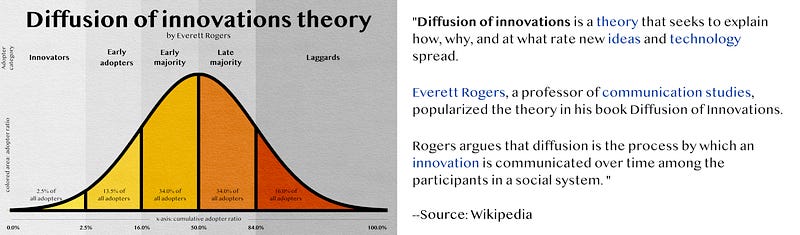
Diffusion of innovations is a theory that seeks to explain how, why, and at what rate new ideas and technology spread, or diffuse, in a social system [1]. Everett describes four elements that may influence your innovation’s adoption:
- The innovation and its characteristics
- Communication channels — How potential adopters learn about your innovation, e.g., meetings, emails, or in-house communication platforms
- Time — time that is required for your potential adopters to go through their individual decision process
- Social system — e.g., your team, department, company, or similar.
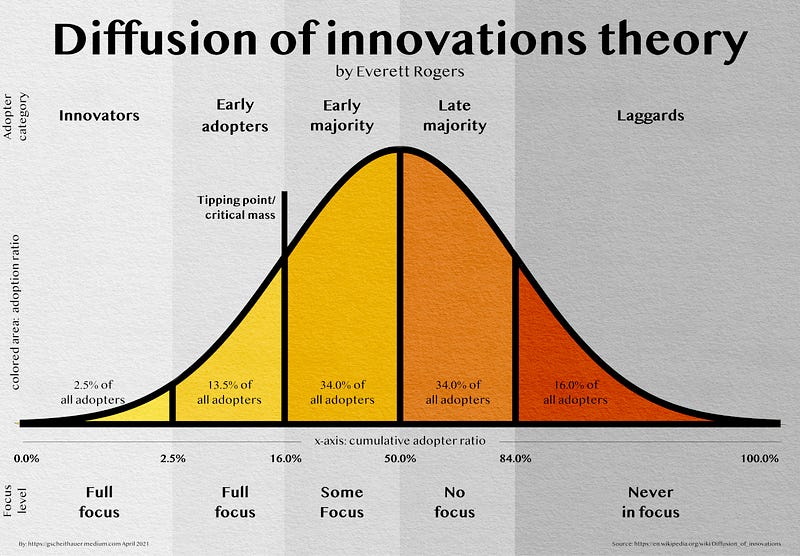
One of this theory’s cornerstones is our understanding that people are different. Diffusion of innovation distinguishes between five adopter categories with different social statuses, risk appetite, and time needed to decide to adopt a new idea.
- Innovators are willing to take risks, have the highest social status, are social, and have the closest contact to scientific sources and interaction with other innovators. Their risk tolerance allows them to adopt technologies that may ultimately fail [2].
- Early adopters have a high social status and are more socially forward than late adopters. They are more discreet in adoption choices than innovators [2].
- Early majority adopt an innovation only after some time that is significantly longer than the innovators and early adopters. The early majority have above average social status and are in contact with early adopters [2].
- Late majority adopt an innovation after the average participant. These individuals approach an innovation with a high degree of skepticism and after the majority of society has adopted the innovation. Late majority are typically skeptical about innovation and contact others in the late majority and early majority.
- Laggards are the last to adopt an innovation. Unlike some of the previous categories, individuals in this category show little to no opinion leadership. These individuals typically have an aversion to change agents and are in contact with family and friends.
It is worthwhile to point out that your concentration should be focused from left to right. Try to win over people that are open-minded to new ideas and are willing to try them out. This is in stark contrast to try to convince people that are openly or secretly against new ideas. Please note that to succeed (reach a high individual adoption rate), your goal is not necessarily to acquire a majority adoption rate. According to Rogers, critical mass is achieved by winning over innovators and early adopters (i.e., 16 percent). The idea is that then enough individuals have adopted an innovation and that the remaining adoption is self-sustaining.
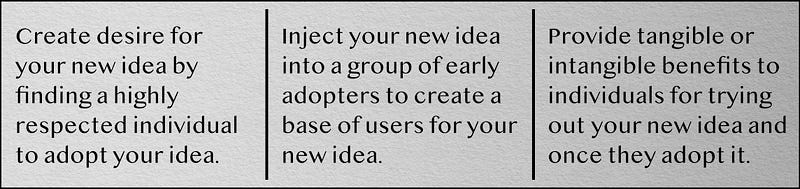
Rogers also provides three generic strategies to reach critical mass. These strategies are not exclusive, and you might try them out in parallel.
- Find a potential adopter from either the innovator or early adopter category who is highly respected in the relevant social system (e.g., in your team or company). Invite her to try and adopt your new idea. This might create a desire for other potential adopters to try it out for themselves.
- Identify a group of potential adopters that you feel are likely to see benefits applying your new idea. Convince them to try it out as a group, and thereby you create a small fire that may spread further. This is called innovation injecting.
- The last strategy focuses on increasing reach once some individuals adopted your new idea successfully. You might want to think of ways to show how successful adopters benefit from this new innovation, and thereby creating positive reactions for other potential adopters. Furthermore, your company might think of ways to make additional benefits for early adopters — for example, visibility in your company or paid time for trying out your new idea.

Also, it is valuable to understand Rogers’ adoption process that potential adopters need to go through individually. (1) Awareness, (2) Interest, (3) Evaluation, (4) Trial, and (5) Adoption. At any moment, potential adopters may quit this process that results in a lower adoption rate and consequently increases the likelihood of a failed innovation adoption.
Potential adopters may use these five adoption factors for their individual decision-making process.
- You want to think of the relative advantage for potential adopters of your new idea over the current situation. Please make sure to think from the perspective of your potential adopters and not from your own perspective.
- What is your idea’s compatibility with your potential adopters’ life and workflow?
- What is the perceived level of complexity or simplicity of your new idea in the eyes of your potential adopters? The likelihood that individuals will adopt your new idea is low if it is perceived as complex.
- Likewise, what is the perceived trialability of your new idea? Is it easy to try it out without any hassle? The less hassle it is, the more likely individuals will try it out.
- How may others observe your new idea, and likewise significant, its benefits? Observability: The better individuals might watch your new idea, the more likely potential adopters will communicate it in their social systems, hence improving your innovation’s diffusion.
How you can try it out it
To structure your approach, I created a template for you. Please compare the image below as well. Feel free to adapt it to your needs.
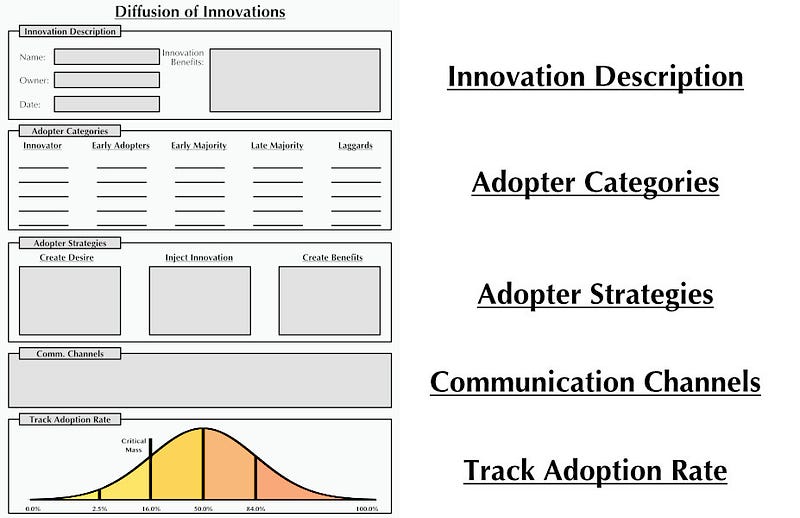
Firstly, describe your innovation. Give your idea a name and provide owner and date information. Next, you might note your idea’s benefits, including taking account of the 5 adoption factors.
Secondly, identify and categorize your potential adopters into the five categories Innovator, Early Adopter, Early Majority, Late Majority, and Laggards. This step is essential since, in the following steps, you want to concentrate only on the first two categories to reach critical mass: Innovator and Early Adopter.
Thirdly, think of actionable adopter strategies. As mentioned earlier, you might want to create desire, inject your innovation into a group, and create benefits for early adopters.
Fourthly, and after settling for adoption strategies, derive relevant communication channels to reaching your innovators and early adopters and that are aligned with your adopter strategies.
Lastly, the template allows you to track the adoption rate. To track accurate numbers is most likely impossible. It is sufficient to do this based on your judgment and feedback you receive from your team or company.
Please note that this template is not perfect and by no means exhaustive. Instead, it might give you a starting point and makes it easy for you to try it out.

In this article, I showed you the theory of Diffusion of Innovations by Everett Rogers and its concepts. I also described how you might apply it to help you implement new ideas in your team or company. Lastly, I introduced a one-pager template for immediate use.
Personally, my most exciting takeaways from reading and writing about this theory are:
- It is not necessary to convince a majority of individuals to sustain innovation adoption. Nor should we focus our attention and effort on late adopters or laggards. We should instead focus on early adopters and try to reach the tipping point.
- Create a strong why for your target group. Clearly think of and state the benefits of your new idea.
- And, with so many things in life, be empathic with your target group. Look through their eyes; try to walk in their shoes.
What do you think? Is this something you would like to try out and share your experience here with us? I would love to hear your story. Thank you!
References
- Rogers, E. M. (1962). Diffusion of innovations. New York: Free Press of Glencoe.
- Wikipedia contributors. (2021, February 15). Diffusion of innovations. In Wikipedia, The Free Encyclopedia. Retrieved 20:42, April 14, 2021, from https://en.wikipedia.org/w/index.php?title=Diffusion_of_innovations&oldid=1007001997