
SOCIETY | SELF | GROWTH
Focus on Ideas, Not People
The safer way to duel in today’s digital colosseum.
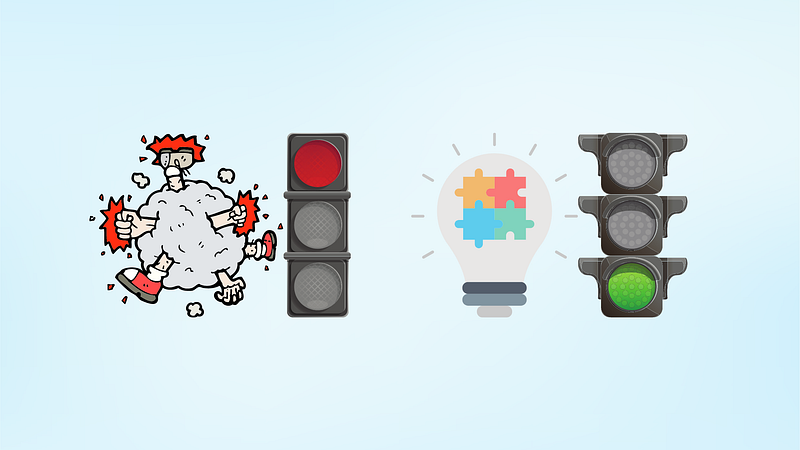
When climbing a mountaintop, begin at the top.
— Zen Proverb
I’ve wrestled with the question of how I should go about sharing my opinions on social media.
Before that, I grappled with the problem of whether or not I even should.
That’s because there’s some truth to the statement, “Opinions are like assholes, everyone has one.”
Sharing opinions on the internet is quick and easy, and even easier is the dopamine fix we get when we assume the infallibility of our own perspective and dish out hatred and condemnation accordingly.
That’s one way to use our energy day after day — clapping at a virtually endless number of digital opponents in an online colosseum where everyone is trying to be the “winner.”
Some would call that a zero-sum game, and I’m inclined to agree.
But there’s always a different way to voice ourselves, if only we take a long enough time out to figure out what that is.
When it comes to the views I express online, I find it important to consider what sort of signal noise I want to add to the mix.
Will it be constructive, or destructive, in terms of how it influences others?
I oftentimes refer back to the opening Zen proverb to remind myself that I always have a choice regarding how I interact with social media each day.
When expressing myself online, I can choose to engage in the endless drama that is social media, or I can cut straight through it to the top of my own, internal mountaintop — the ideas that, in my experience, have been helpful for personal growth as well as those that have been most the fascinating to entertain.
Ideas start us off on a peak. Caving to the drama starts us off in the mud.
It’s okay if we’re in the mud from time to time, but it bears remembering that we can always return to the peak.
The problem, of course, is that it’s easier — fun even — to talk smack about other people and to make the entire focus of one’s platform a sort of tabloid-level online muckraking effort.
However, it was Eleanor Roosevelt who said, “Great minds discuss ideas; average minds discuss events; small minds discuss people.”
I’ve learned to be extremely skeptical of the “good feeling” I get when I write something that makes me feel superior by assuming that someone else is inferior in some regard.
I don’t want to remain a small mind.
I want to unlock my mind’s potential.
These days, I’ve come to feel like the only way to do that is to keep feeding it ideas, rather than drama and the negative feelings that come with it.
Don’t get me wrong, I’m not perfect.
I’m not here to condemn gossip entirely, nor discussion of current events.
It’s absurd to think that the entirety of humanity will one day forgo these things to sit around and pontificate philosophically all day.
It’s likewise absurd to think that we can always control whether or not we “sit out” of the cultural “discussions” (more like boxing matches) taking place online.
Sooner or later, people will come trying to drag you in. When that happens, it’s helpful to remember not to attack and engage individual people, but rather the ideas they advocate.
Furthermore, the world would be a boring place if we never talked to each other about other people, and at least in some domains, such as politics, it’s relevant to talk about the character of certain individuals — such as the POTUS.
But when it comes to how we leverage a social media platform to make a change in the world, the much more difficult path of letting go of our desire to focus entirely on other people so as to grapple more with ideas is what sets us up for greater fulfillment in the longterm.
Gandhi helps us understand this in his own words.
Your beliefs become your thoughts, Your thoughts become your words, Your words become your actions, Your actions become your habits, Your habits become your values, Your values become your destiny.
— Mahatma Gandhi
I don’t know about destiny, but our beliefs?
Some would say that it's those that we should question the most — especially if we are trapped in the vicious cycle of only mustering negative opinions about others.
Is that really a sign of intelligence, or is it a sign that we haven’t worked hard enough to figure out how to forego condemnation and ridicule in favor of something more elevating and constructive?
What we routinely think can best be described as our thought patterns, which are habits in and of themselves. If those habits are turned onto people rather than ideas, then we’re going to get more of the same — endless drama.
That’s why many successful people encourage us to change our beliefs and thought patterns before trying to change the world. If we don’t get it right on that internal mountaintop, we aren’t going to get it right in the external world.
What we say — either on a written blog such as this one or to others in our personal lives — is a direct reflection of what we believe and think on the inside.
That’s why we have to go in there, do some self-reflection, figure out if we are mostly in the swamp or on the mountaintop, and try to listen more to that side of ourselves that is already seated upon a beautiful peak, amongst the clouds.
In the interest of becoming more compassionate as time goes on, I’ve had to question the urge I feel to want to utilize my blog to mock and condemn, rather than express in a more non-violent way.
Condemnation, like all other quick pleasures, is deceptive.
It makes us feel like we are making a huge difference when we tell other people how awful they are.
But the reality is that internal vitriol acts more to hamper our own growth than it does to change anyone else’s mind on a particular subject. To do that, we have to find more effective means of communicating the ideas we want others to consider.
The internet will also continue to supply an endless number of toxic scenarios for us to participate in, and so we have to question how long we are going to allow our energy to be consumed by something totally unproductive.
That being said, it’s not as if I’m free from the desire of wanting to clap at people or share an opinion that’s at the expense of a segment of society or an individual.
Sometimes, I’m tempted.
Sometimes I even fail, slip up, and end up saying/writing things I regret later.
The important thing to remember, however, is that focusing more on ideas and less on people is a process, not something that is ever fully complete.
We learn as we go along.
What I try to remind myself each day is that there’s always a better way to say whatever is on my mind than to vent my rage at someone on the internet.
If I can tone myself down even a minuscule amount before responding to someone, then I consider that a huge victory in terms of my own self-growth.
Even in the cesspool that is the online political discussion, we can choose to stick to ideas — policies, etc. — rather than partake in character assassinations, muckraking, and the reinforcing of tribal divisions.
The lesson is this: there is always a better way to say what is on our minds than what we may be tempted to say in the heat of the moment.
We may have to pause and reflect on what we’re thinking for a while, but that’s just another part of the process, right?
No writer or creative ever became good at what they do without self-reflection.
One might even make the argument that this is indeed what the job entails.


