
Focus is about past, present and future
“Living the Scrum Values” — Episode 3
At first glance, of the five Scrum Values, Focus should be the easiest to understand. It’s all about getting on with the job, helping people do what they do best, getting the head down, and doing real work, right? So, it’s all about the Daily Scrum then? High-bandwidth communication where we preserve our focus on the Sprint Goal and keep each other up to date on what we are doing for the next 24 hours?
Well, yes, but there is more to it than that… I find the Scrum Guide to be a little enigmatic with its explanation of focus:
“Everyone focuses on the work of the Sprint and the goals of the Scrum Team.” — SG
In this post, I’ll explain why I believe attitude to focus is correlated with attitude to time. As a Scrum Team, we need to preserve focus on the present, for sure, but we also need to learn from the past, and prepare for the future. Time, like focus, is a three-eyed monster.

Fade in. Exterior scene, day time. A misty swamp. Surrounded by undergrowth, a teacher and a student stand on a bank. The teacher has a wooden staff and wears a cloak, hood up, obscuring his face. The student wears jeans and a t-shirt that says ‘Scrum Masters do it standing up’. The student has hands out, as if asking a question…
Apprentice: … but master, how can I focus on the present if I have to look forward all the time?
Master: Look forward you must, but remember, a gift the present is. To your team, focus you must give, mmm… yes…
Apprentice: …. uh… Bob?
Master: Yeah?
Apprentice: why are you talking with that weird voice?
Master: Huh? (coughs and clears throat) Ahem! Woo, sorry! I guess the setting got me a bit carried away!
(removes cloak, reveals regular guy underneath)
Master: Ok, here’s the thing. The team need to focus on the current sprint, and the scrum master needs to help preserve that. So… no interruptions for the team, ok? That’s important!
Apprentice: (scrambling in pockets for writing materials) Dammit, I had a notepad… ok, preserve focus… no interruptions...
Master: And the team also need to participate in refinement to get future work ready, you got that? The guide reckons that’s roughly 10% of their time. That sound good?
Apprentice: (stops searching slowly): But…. isn’t that an interr…
Master: (talking more quickly now) Then, in the retrospective, we have to take some time to look back and learn from the past, and change some of the team’s processes for the future as well… but in a good way, yeah?
Apprentice: (now looking confused): Um…
Master: So, as a Scrum Master, you need to get all that done… with… focus!
(to embellish the word focus, Bob makes guns out of his two hands with thumbs and forefingers, and pretend fires at the apprentice. As he fires, he beams away, Star Trek style, leaving the apprentice alone on the bank of the swamp)
Apprentice: Oh… kay…
Fade out.
Cultural attitudes to Time
Fons Trompenaars and Charles Hampden-Turner developed a model of culture after parsing responses to questionnaires, surveys and interviews from more than 46,000 managers in more than 4 countries. Trompenaars and Hampden-Turner published their findings in ‘Riding the Waves of Culture’ and it’s a great read for anyone interested in diversity and how to communicate with people from different cultures.
One of the factors in their model relates to time. Different cultures view time in different ways. For example, they found that some groups see time as sequential. Anyone from the UK, Germany or the U.S. in the house? This could sound familiar... For this group, the past, the present and the future are sequential. Timekeeping is very important, and being late is an example of unacceptable behaviour. For these groups, the art of making a plan and sticking to it are highly prized.
In Scrum teams, it’s possible to see positives and negatives associated with both attitudes to time.
However, other groups view time as more synchronous. Anyone here from Argentina or Mexico? You guys might relate to this. In this group, the past, present and future are interwoven, and people often work on more than one thing at any one time. Deadlines and commitments are seen as flexible and liable to change.
In Scrum teams, it’s possible to see where there are positives and negatives associated with both of these attitudes to time. We want to accurately predict when we are going to deliver our work, but hey, we also want to respond to change, right? We can’t get too upset when change happens, can we?
As you can imagine in an organisational context, there are challenges here, particularly when working with diverse teams. Trompenaars and Hampden-Turner describe an intercultural competency as the art of interacting with members of diverse teams where both attitudes to time may be present, and developing a shared understanding.
Attitudes towards time will influence a scrum team’s ability to cope with a real challenge: the ability to preserve focus on getting the current sprint backlog done, while also ensuring that we are getting the next Sprint backlog ready. We are focused on the present, but we have one eye on the future.
Team Activity — Three Circle Test
With Frederick Koenig’s 3-Circle Test, you can check in with your team’s attitude to time in a short activity. To do this you just need paper, sharpies and around ten minutes.
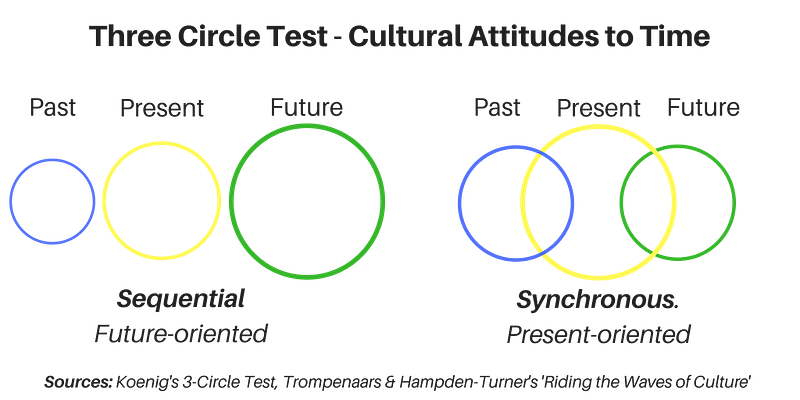
With a blank sheet of paper and a sharpie for each person, ask your team to draw three circles. Each of the circles should represent the past, the present and future.
The circles can be organised any way you want, but just make sure to label them so you can tell which is which.
According to Koenig, two things can be determined from the placement and size of the circles. Sub-consciously, we draw larger circles for the more important timeframe. In addition, by either drawing the circles as independent or overlaying them, we can learn if we are sub-consciously sequential or synchronous in our attitude to time.
Refinement is also about Focus
If you can gain a better understanding of your team’s attitude to time in this way, you will be better able to understand how to approach a tricky problem like organising refinement.
If a team has a structured, sequential approach to time, then they might want to structure refinement in a predictable way. This will help avoid the perception that refinement is an interruption to their focus on the goals of the current sprint…
With teams like this, I would recommend scheduling a set time for refinement, potentially straight after the daily scrum. In this way, the team can better predict when they will be needed. This also helps reduce the frequency with which the team switch contexts, and can make refinement feel like less of an interruption.
If the prevailing attitude towards time in a team is structured like this, it could also be helpful to only invite team members who are directly needed for each particular refinement discussion, rather than including the whole team by default. The ability to opt in and opt out are very important here too.
If a structured, sequential attitude to time prevails, then the team will probably prefer to structure time-boxed refinement sessions in a more predictable way.
Where there is a more synchronous attitude to time prevailing in a team, this kind of structured approach may not be required as much, and refinement can potentially be more ad-hoc, and even involve the whole team as required.
Context is everything, and a great Scrum Master will implicitly understand how to organise refinement in a way that suits the team best. The three-circle test might teach you something about your team that will influence how you organise refinement.
The Retrospective can also be about improving focus
We could also describe the retrospective as a means of improving the team’s focus in future sprints. Rather than asking “what did we do well” and “what could we do better” in every retrospective, a Scrum Master can switch things up. Why not try two different questions?
What’s helping us to focus on the Sprint Goals?
What’s taking our focus away from the Sprint Goals?
By asking these two powerful questions, we might learn a little more about the environment of the team, and any potential changes that are suggested will have a development team oriented goal baked in. In making proposed actions relate to focus, we are setting the context. A little disruption to processes might be better received by the team if the outcome is an improvement in focus at the end of it.
To close, in the Daily Scrum, it is helpful for a Scrum Master to set the tone by explaining that the event is about preserving focus on the Sprint Goals.
We can also express the purpose of refinement in the same way, but future-oriented this time. How we organise refinement with our team should consider their attitudes to time.
Lastly, if we want to make our retrospectives more about focus, why not make our powerful questions directly relate to the value. Ask your team, what can you do to help improve focus?
Attempting to improve focus is a very worthy objective, and in doing so you’ll be helping your team to Live The Scrum Values.
