avatarDr John Frederick Rose

Summary

The web content discusses the evolution and future potential of flying wing and blended wing body (BWB) aircraft designs, emphasizing their efficiency, stealth capabilities, and the challenges faced in their development, with a nod towards electric and solar-powered aircraft as the next step in aviation technology.

Abstract

The article provides a comprehensive overview of the flying wing and blended wing body (BWB) aircraft designs, tracing their history from early prototypes like the Northrop YB-49 to the modern stealth bomber B-21 Raider. It highlights the aerodynamic advantages of these designs, such as reduced drag and increased lift, and addresses the control and stability challenges they present. The piece also touches on the revival of interest in these designs due to stealth technology and the potential for commercial applications, with initiatives like the Boeing X-48B/C projects aiming to create more fuel-efficient passenger aircraft. Furthermore, it suggests that current global challenges, including resource scarcity and geopolitical tensions, necessitate a shift towards more sustainable aviation solutions. The article concludes by pointing to electric and solar-powered aircraft, such as the Collins Aerospace prototype electric motor for the Airlander 10 airship, as a promising direction for achieving zero emissions in aviation by 2030.

Opinions

  • The author believes that flying wing and BWB designs are not only viable but also necessary for the future of aviation, given their efficiency and potential for stealth applications.
  • There is an opinion that the development of commercial jet aircraft using flying wing and BWB designs is a logical next step, with the potential to significantly reduce fuel consumption.
  • The article expresses that current global issues, such as pandemics, rising fuel costs, and geopolitical conflicts, underscore the need for aviation technology that is less dependent on scarce resources and ground infrastructure.
  • The author posits that electric-powered aircraft, especially those capable of generating their own power through solar cells, represent the way forward for a sustainable and self-reliant aviation industry.
  • The author seems to advocate for the adoption of new technologies, like the Collins Aerospace electric motor, to meet the goal of zero emissions in aviation by 2030, indicating a commitment to environmental sustainability in the field of aeronautics.

Flying Wing Aircraft Trends.

Glimpse of Intriguing Aircraft designs and where they’re going.
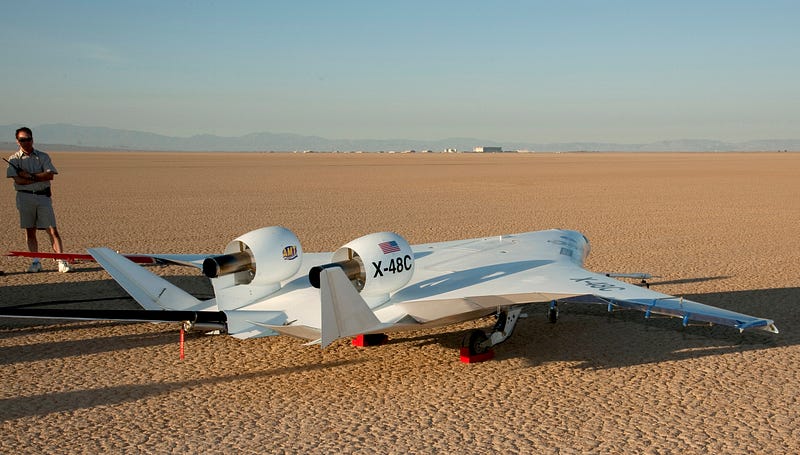
NASA-Boeing X-48C blended wing body technology demonstrator awaits its first flight from Rogers Dry Lake on a hot August morning at Edwards Air Force Base, Calif (2012). Photo by Carla Thomas — File: NASA-Boeing X-48C before first flight.jpg, Public Domain, https://commons.wikimedia.org/w/index.php?curid=20914981.
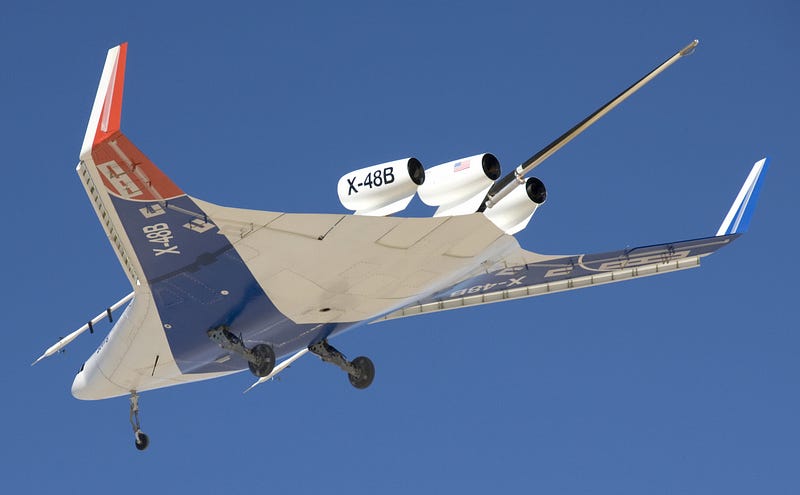
Boeing X-48B seen from left and below during its first flight (20 July 2007). The winglets, which also serve as rudders, are particularly visible. Photo by Carla Thomas/NASA — This image or video was catalogued by Armstrong Flight Research Center of the United States National Aeronautics and Space Administration (NASA) under Photo ID: ED07–0164–04., Public Domain, https://commons.wikimedia.org/w/index.php?curid=2788015

Early Days.

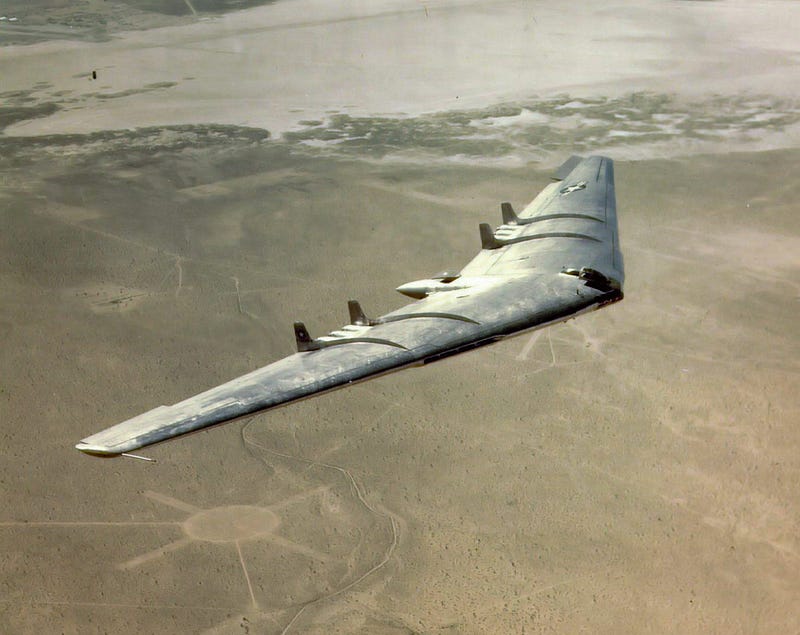
This picture represents the first time I found out about flying wing aircraft. Northrop YB-49 Flying wing, a heavy bomber prototype which first flew in 1947 (Earlier YB-35 bomber prototype converted to jet power). Public Domain, https://commons.wikimedia.org/w/index.php?curid=261723

Flying wing is tailless fixed-wing aircraft with no definite fuselage, Crew, payload, fuel, and all equipment inside wing.

Flying wing lowest drag design for fixed wing aircraft, Suffers from instability and difficulty to control, Concept only for subsonic aircraft.

Blended wing body (BWB) is fixed-wing aircraft with no clear dividing line between wings and main body smoothly blended together.

BWB reduces drag associated with wing-body junction, Usually given wide airfoil-shaped body allowing entire craft to generate lift to reduce size and drag of wings.

Flying wing research started 1920’s and culminated with Northrop YB-49 jet powered flying wing first flight 1947, Interest waned with development of supersonic aircraft.

Technology revived 1980's, Interest in stealth technology, Difficulties arise when trying to fit crew and life support engines and undercarriage flight support equipment payload and fuel all in confines of wing section, Blended wing body solved problem.

Now in 2022
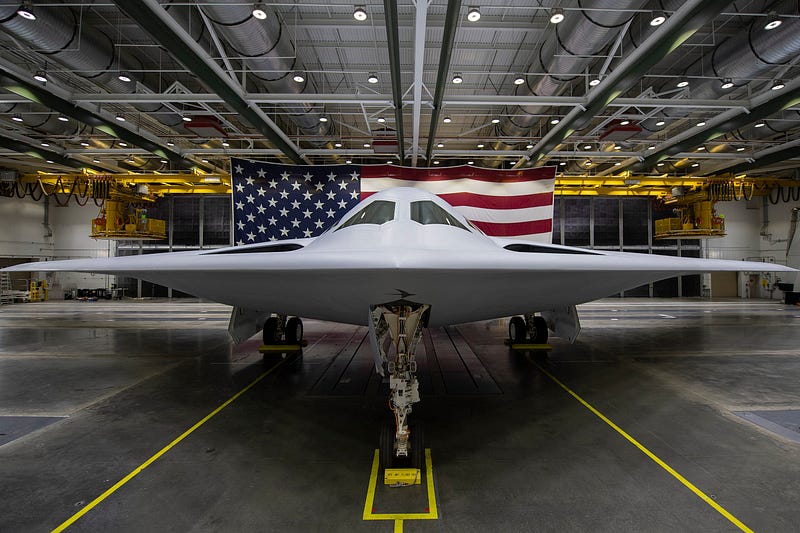
Northrop Grumman B-21 Raider in a hangar at Plant 42, Palmdale, California 26 November 2022. Picture by Staff Sgt. Jeremy Mosier, United States Air Force — https://www.dvidshub.net/image/7538113/b-21-raider-unveiling, Public Domain, https://commons.wikimedia.org/w/index.php?curid=126245864 (As a work of the U.S. federal government, the image or file is in the public domain in the United States).

US B-2 bomber direct descendent of YB-49 with one key difference, B-2 uses stealth technology for radar invisibility, B-2 made debut in 1988 B-21 latest iteration 2022.

Flying wing and blended designs proven to work in combat, Next logical step is development of commercial jet.

Passengers and Cargo.
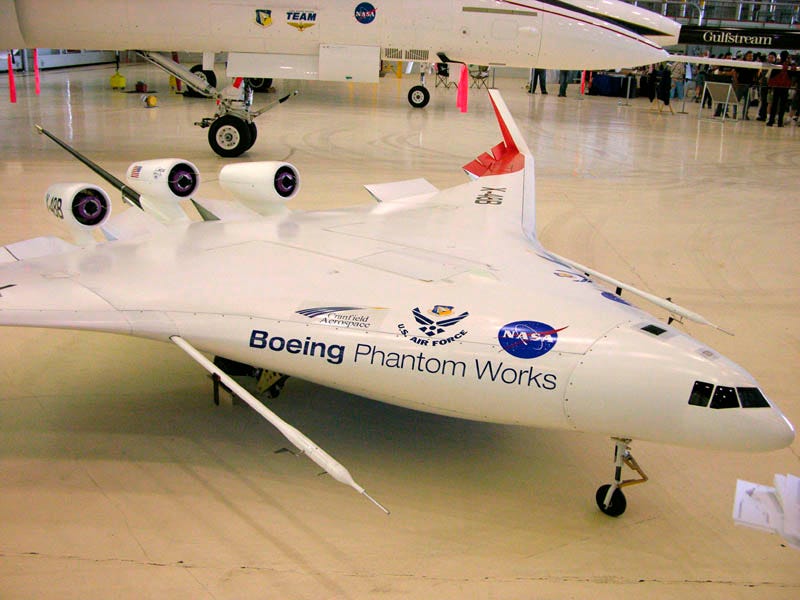
Boeing X-48B flight test model 28 October 2006. Photo by Alan Radeck. Licensed under the Creative Commons Attribution-Share Alike 3.0 Unported license.

Boeing and NASA developing blended-wing aircraft for 800 passengers per flight, About size of Boeing 747 but estimated to use 25 percent less fuel.

Team built X-48B in 2006 concentrating on low-speed control during take-off and landing, X-48B wingspan 21-foot (6.4 m) and weighs 392 lbs (178 kg), Composite materials build, Three turbojet engines.

Following tests X-48B modified to X-48C, Vertical stabilisers and two turbojets in 2012, Top speed of 140 mph max altitude 10,000 feet.

X-48C first flew August 7 2012 completed 8-month flight test program with 30th flight on 9 April 2013.

Boeing and NASA plan to continue developing blended wing technology aiming to build transonic demonstrator.

My Thoughts.

We don’t need more of the same technology ever stretching scarce resources and heavy dependence on ground infrastructure.

Pandemics permanent, Fuel costs spiraling, War in Ukraine, Contentions East vs West, All this means we have to do more with less and become self reliant.

I think way forward is electric powered aircraft able to generate own power through solar cells mounted on wings like the Collins Aerospace prototype that aims for zero emissions 2030.

Collins Aerospace Produces Prototype Electric Motor For Airlander 10 Airship
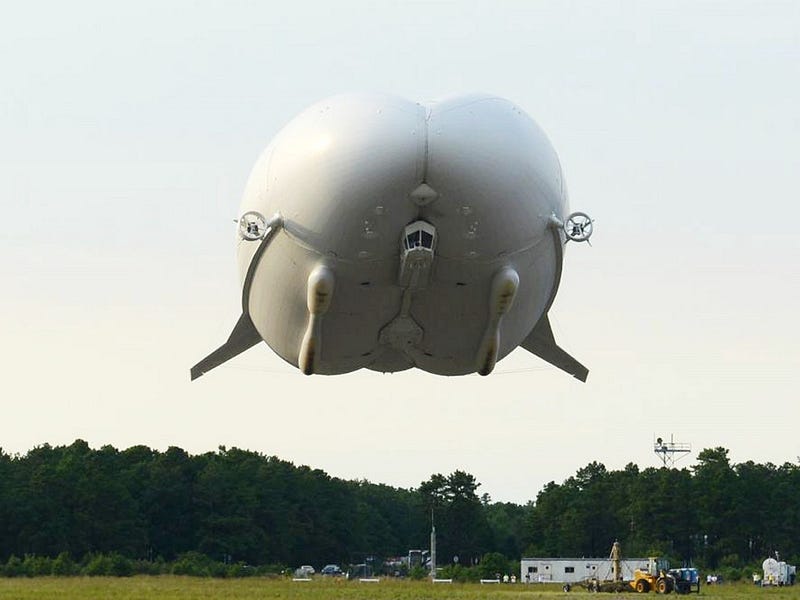
The HAV 304 dynastat, seen bow-on. Picture by Philbobagshot — Hybrid Air Vehicles, CC0, https://commons.wikimedia.org/w/index.php?curid=50742873. ( Creative Commons CC0 1.0 Universal Public Domain Dedication).

Blessed be.

Join Medium with my referral link — Dr John Frederick Rose. Read every one of my stories and thousands of other writers on Medium. Your membership fee helps support me and other writers you read. You’ll also get full access to every story on Medium.

Recommended from ReadMedium