
Flowers in Winter Snow
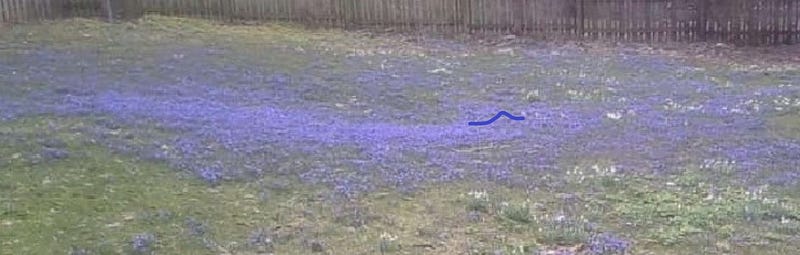
Trista Ainsworth wrote a story worth reading, Watching Nature Unfold: This Is a Magical Opportunity. Her backyard sounds like a good place for renewal. Mine is just a plane square with some flowers along the back of the house, not much room for walking. It made me think of a brief time when that plain square turns into a sea of renewing color in late winter.
Here are some pictures of the late winter flowers that unfold in my backyard every year. They are uplifting and refreshing. There is also a brief description of each flower. I am not a gardener, and these flowers require no work to maintain. I let them grow and blossom, then they die back just in time to start mowing the lawn.
I live in the Northeastern US. We can get a lot of snow, averaging around 100 inches each year. Frigid temperatures drag into March and April. We may even get a coating of snow by tomorrow morning. But every year, beginning in late January or early February, I get to see flowers push back the cold and snow.
Snowdrops
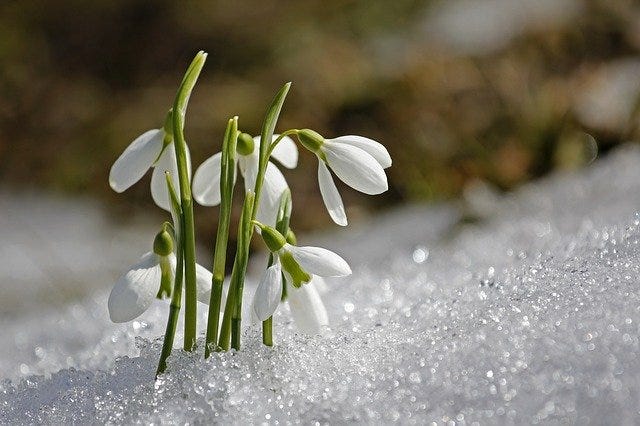
In late January or early February, tiny shoots of green push up through the snow. If the snowpack is low enough, you see small circles of bare ground surround these shoots. The warmth of new growth melts the surrounding snow. Soon, more shoots of leaves sprout upward with a hint of white on a central shoot. Then a little white drop develops, hanging from the top of the central stalk. With winter sun streaming down, the flowers bloom into their bell shape. When temperatures drop again, the flowers don’t mind. They curl up a bit and wait for the snow to melt. They defy the myth that freezing temperatures will kill them.
Winter Aconite
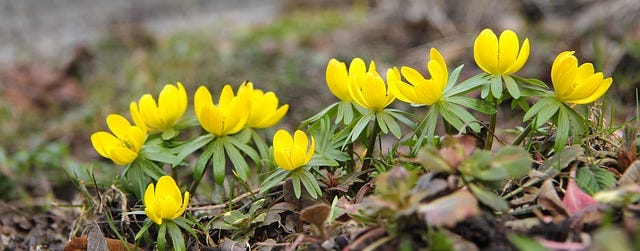
Within a few days of the Snowdrops, the bright yellow winter aconite emerges, slowly at first. Progressing rapidly, they burst into a bright yellow carpet. Each petal will eventually form into a small pod containing about 6 seeds. The plant will self-seed. That means a small group of plants will slowly spread to cover more ground.
When the weather pivots to cold, or when the sun disappears, the flowers curl up into a yellow ball. But with the warm infrared rays of the sun, they unfurl to all of their yellow glory.
Glory of the Snow
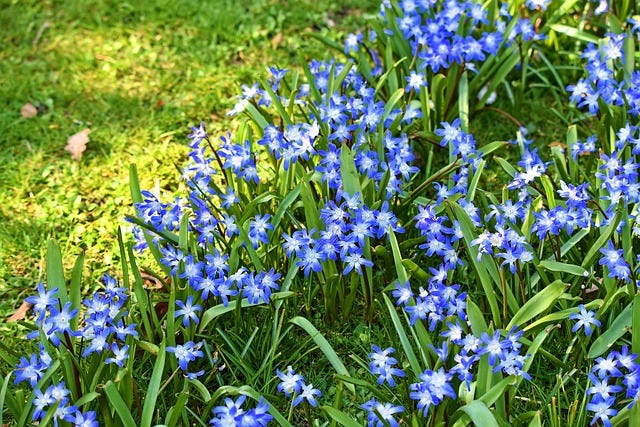
The third flower is the easiest one to cultivate. Glory of the Snow is a flower with bright blue. This flower grows a week after the other two. It first appears as dark purple shoots springing up all over the yard. It quickly grows to a sea of blue that has grown to cover most of my back yard. Walking among them is a visual experience like none other. They look great from a distance. However, standing among them is an other-worldly experience. The flowers surround you with endless growths of bright blue surrounded by darker green from their leaves. Patches of fading white snowdrops and fading yellow aconite interrupt the blue mosaic of the glory of the snow.
The Carefree Flowers
The picture at the top of this story shows a blur of the colors from my back yard. The blue Glory of the Snow are dominant, but you can see hints of white from the fading Snowdrops. In the upper left there is a hint of yellow from the Winter Aconite that are past their prime.
I have had trouble getting the plants to grow from seeds I plant in different areas. The seeds that spread from the established plants take hold with no problem.
These flowers also survive the cold and snow.
Heading into traditional spring, crocuses around town are blooming. My one patch of daffodils has already bloomed. They are about two weeks early this year. But we had a mild winter, at least by our standards.
My three early bloomers have turned to the work of getting ready for next year. Seeds are maturing. Leaves are producing energy for the bulbs and tubers that will survive in the ground, ready for next winter’s emergence. I just let them grow and do their thing. In a few weeks I will get the lawn mower out, and mow them down. The first mowing is difficult. I have to set the mower deck on its highest setting and go very slowly because of the dense cuttings. I let the clippings mulch and the mower will turn the cuttings into mulch that can fertilize the new grass. Then they disappear for another year.
The winter beauties give a sense of annual renewal and joy. I am reminded of the words from a folk song by Gordon Bok, Ann Mayo-Muir, and Ed Trickett:
“It’s a pity we don’t know what the little flowers know.
They can’t take the cold November, they can’t take the wind and snow.
They put their glory all behind them, bow their heads and let it go,
But you know they’ll be there shining in the morning.”
These gorgeous flowers can take the wind and snow, but they also bring the morning of spring in late winter.