
Travel & Cities
Florida Woman Goes (Went) to Burning Man
And eventually discovers that Florida burns just as bright
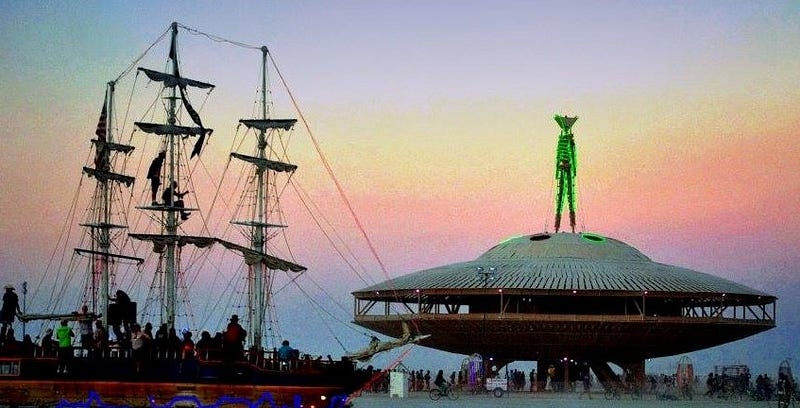
These days, everyone knows, or thinks they know, about Burning Man. An awareness about the temporary city built in the Black Rock Desert has worked its way into popular culture, via media coverage, influencers and celebrities who have made the trek in recent years.
Between 2004–2013, I went five times. I live in Florida, so getting out there with all my gear was no simple task.
Burning Man is not a “festival.” The difference is, upon arrival at the gate, one must have everything they need for the week or be prepared to bank on the playa (the alkaline, talc-like, dusty terrain) providing anything that might have been forgotten or forsaken. There are no vendors on-site; no money changes hands, except for purchasing ice.
Burning Man is based on ten principles, including “radical self-reliance.”
“The playa provides,” is an oft-spoken phrase in Black Rock City (The temporary city in the desert that is Burning Man) and, in my experience, has proven to be very true indeed. Surrender is the key to not just surviving, but enjoying what invariably is an incredibly trying experience for the crustiest of burners or the sparkliest of “burgins.”
Even the most extroverted of extroverts will have a moment out there in the dust when they feel like they just can’t take it anymore and need some space. Or something. In true synchronistic form, whatever that “something” is, it usually appears right when it needs to.
Burning Man is a disco ball moment of life blown up to massive proportions then shrunk down to a microcosm. Burning Man is a millionaire turned circus clown who becomes addicted to meth and ends up in an alleyway, then finds a small wildflower growing out of a crack in the pavement. He may smoosh it, he may plant it. Hell, he may even eat it. Not sure what happens next.
There is no “right” or “wrong” way to do Burning Man. You just do it.
My Initial Experience
A month or so ago, Facebook informed me that the main ticket sale for 2023 was starting at noon, roughly five months before the actual event. Tickets sold out within a couple of hours.
This is a big change from my first few years. Back in the day, I decided to go about a month before the event, bought my $250 ticket through the website, and received it in the mail a week or so later. Now one must establish an online “Burner Profile” first, and tickets are sold in multiple tiers. Purchasing through the main sale, with tax, shipping and vehicle pass included, runs nearly $800, and there are multiple other increasingly expensive opportunities to purchase a ticket as the event draws closer.
There are some exceptions. If you are part of a theme camp or can prove you deserve a low income ticket, those opportunities are available. But they are scant.
When my then soon-to-be husband, Mark, decided to take the adventure with me in 2006, we ran into a slight problem. Following months of prep, a plane flight to Reno, picking up our rental car, purchasing 20 gallons of water and groceries for a week and heading out on the three-hour drive to Black Rock City, he realized he’d left his ticket sitting on his desk at home. We were finally on the last leg before arrival, him behind the wheel. I pulled out my ticket and waved it excitedly, then watched the blood drain from his face as he realized what had happened.
Panic briefly ensued, but we stopped at the Burning Man organization office (Burning Man is an LLC) near the entrance and he was able to buy a new ticket, which was refunded when we returned home and he mailed in the old one. Ah, the good old days.
Even when tickets were considerably less expensive, it took effort and money to get there from Florida. The first couple of years I went, people were impressed when I told them where I was from. I always flew, so one of my two pieces of luggage was my tent. Otherwise, infrastructure was provided by the people I camped with, who drove in mostly from the San Francisco Bay area.
Now, people come from around the globe.
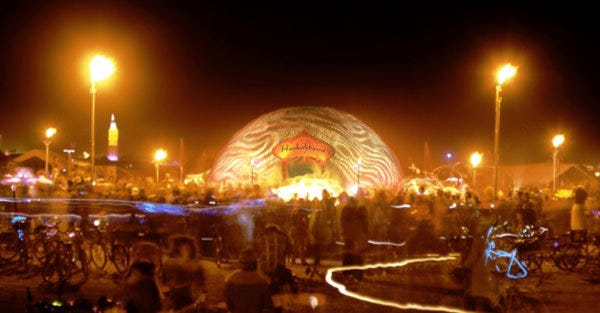
Participating with my “home camp,” Hookahdome, was my first lesson in vulnerability.
The camp consisted of a 40-foot dome, air-conditioned, outfitted with silks, rugs, tapestries and Moroccan lanterns to emulate a Bedouin dreamscape. Inside the dome were hookah tables, which we kept burning with shisha (flavored hookah tobacco). We served mint tea and delightful conversation, while a variety of musicians and other performers graced the space inside, as well as on our “front lawn,” as we jokingly referred to the area just outside of the dome. Our camp was on the “esplanade,” the large open space in the middle of the city, so we were expected to be operational 24/7.
My childhood best friend, Monet, met one of the Hookahdome camp founders when she first went in 2003. He offered her a ride on his Magic Carpet, an “art car” (mobile pieces of art built on the frame of a golf cart, car or bus), which looked like the classic flying magic carpet, complete with ripples. Art cars often have elaborate sound systems, some of the largest built on city bus frames and ultimately becoming moving dance parties. These mutant vehicles cruise the playa at 5mph picking up and dropping off passengers as they go.
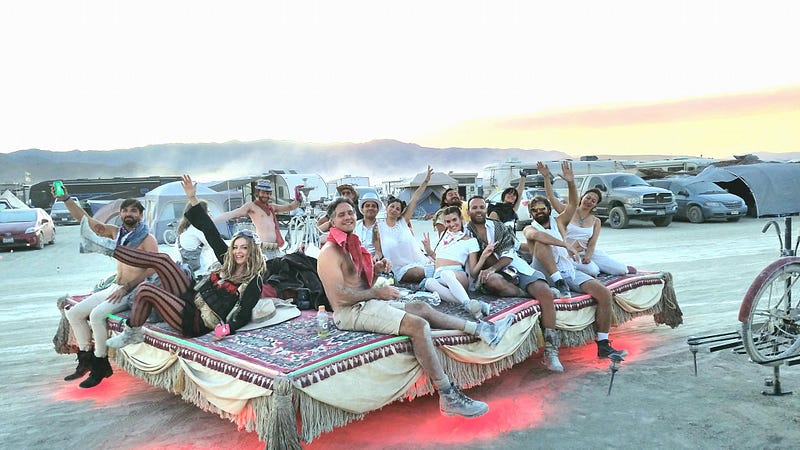
Upon her return to the “default world,” (the world outside of Burning Man) Monet told me, “I went to this amazing thing in the desert. I found our people,” and convinced me I must join her the following year.
She was living in another state at the time, so we prepped over the phone. She gave me a list of items to procure, including a hydration backpack, a headlamp and, if I could find one in time, a big furry coat. She was adamant about those three items. And costumes.
Costumes are an important element of the burn. One doesn’t have to dress up, but given the opportunity to be anyone (or anything) else, why not take it?
People usually pack day and night costumes. Hot days mean less clothing, sometimes none at all. Nights tend to be more elaborate with fur and something called EL wire- thin strips of neon-like material available in every color imaginable.
Costumery for the burn became a specialty of mine. The way this works is I will have one piece — a hat, a dress, etc., then the rest of the look will evolve around it. An example: I started with a blue and yellow aquatic-themed skate dress, then incorporated UV sensitive, lifelike jellyfish earrings; one blue, one yellow. Then I purchased a handmade mini top hat with portholes on the side showing underwater scenes over a bright blue wig and matching makeup and accessories.
My first year I made some costuming mistakes. The night of the man burn I wore a zip-back seventies jumpsuit with butterfly wings tied over it, a belly-dancing hip scarf around my waste and my requisite Big Furry Coat (We live in Florida, so the fact that my mom happened to have a full length one, unused in the back of her closet was an amazing coincidence) with my hydration pack over it all. Yeah, using the port-o-potty was no fun.
In 2004, Monet and I were on the early arrival list, which meant we were allowed into the city before the burn began, so we could help build our camp. I will never forget that first night. There was no wait at the gate as we arrived at about midnight.
When we could see the city lights in the distance, Monet excitedly turned the music in our van to the radio station broadcasting live from Black Rock City as we approached along the winding mountain road. After entering the gate and showing our tickets, volunteers who serve as “greeters” hugged us, instructed us to ring the large bell, suggested we roll in the dust, asked if we wanted spankings and with huge smiles said, “Welcome home!”
There was no cellphone reception on the playa back then, so finding people could be tough. That was actually one of the best aspects of ye olde Burning Man; disconnection from burgeoning tech and no prevalent social media.
When we found our camp, I was again welcomed with open arms. A group of about ten people introduced themselves and helped us set up our tents. Then we gathered together around a hookah and got to know one another. Interestingly, the usual talk about jobs and day-to-day responsibilities was completely absent from our conversation. We instead talked about plans for our camp; building the dome, decorating it, music, performances, Magic Carpet rides and everything we would provide to those who chose to participate in the magic of that one week. The feeling of inclusion was infectious and even just recalling it during my lowest times has been one of the most valuable gifts I’ve ever received.
Then we got to work building the dome and setting up our schedule so we would be operational in a few days when people arrived. Because we had flammables inside, one of the jobs was to work as a door person, monitoring the flow and limiting the number of people inside to forty at a time. Our camp was an oasis in the desert, so it was popular and there was a constant line of people waiting to go inside. And nothing draws people to a line like a line.
In any case, the door person was also responsible for providing hospitality to those still waiting to enter, and I blossomed in this role. While I had mostly shed my shyness as I got further from high school, when I was with Monet I tended to take a back seat. A gorgeous, red headed dancer who magnetizes people toward her, I was in her shadow when we were together.
But now, having grown into my own identity and feeling so fully accepted by the people around me, those insecurities flew out the window, and I embraced this job as a gatekeeper. The feeling of purpose, contributing to this gift of a magical space for people to relax and be entertained, and the gratitude they showed us for allowing entry was powerful. I met people from around the world and heard so many stories: often hilarious, frequently relatable and occasionally heartbreaking. It was not always easy; I dealt with people on a wide variety of substances, so sometimes my job meant talking people down or cheering people up.
Huge life lessons in that line. I witnessed just how vulnerable other people can be and felt myself raw as I shared my own stories of love and loss.
And to think, it was just a line. But at Burning Man, waiting in a line to enter an experience can be its own experience.
The Evolution
In 2008, we decided to create our own camp, meaning, at the very least, we had to create our own kitchen and lounge area. Another childhood best friend, Manda, and her then-fiance, Doug, lived in Oregon and we made plans to go as a group. They asked me to perform their wedding ceremony at Burning Man.
Mark ordered the materials for our communal shelter and shipped them to our friends, who loaded it up in a truck and picked us up at the Reno airport. Then we all drove further into the desert, entered the city gates just before sunrise and found a place to land. Everything went well until suddenly it didn’t.
In retrospect, the only excuse I have for what happened was this was fifteen years ago. If there was even one Burning Man Facebook page, it was not well-trafficked, and resources to communicate with other burners when you lived in far flung Florida were scarce.
We found out the hard way that the canvas and PVC party tents Mark ordered were nowhere near capable of withstanding desert dust storms. As we were attempting to set them up, the strong winds ripped them to shreds. If we didn’t catch the remnants, they would become potentially dangerous “MOOP,” matter-out-of-place. MOOP on the ground is bad enough, but MOOP flying through the air at 60 mph could have been deadly.
At one point Doug muttered the now legendary line, “When does this get fun??” Our neighbors, veteran burners whose camp setup was the equivalent of a one-story house complete with a living room, kitchen and bathroom, took pity on us and did what they could to help. They had plenty of extra gear, including metal clips and stronger materials. Then another friend who later joined us arrived with another friend whose camp had bailed on her, and they provided the rest of what we needed to create our space.
And they brought breakfast burritos. Those premade breakfast burritos thawed on a camp stove ended up being like manna from heaven during what was to be a very challenging week.
After several days of working between dust storms, we finally scrapped together something that resembled a camp. But by that time I had developed pneumonia. Being that sick is bad enough; being that sick in the middle of a raging party in the desert is a nightmare. I stayed in the tent every day until it became an oven, around 9 a.m., drank as much water as possible, peed in empty jugs to avoid constant trips to the port-o-potties, and just tried to stay alive (and still have some fun). When it came time to perform the wedding ceremony for my friends, I had no voice and whispered their vows.
But, this is where the beauty of The Burn resides. In vulnerability. Our lack of experience building our own camp meant we relied on help offered by our neighbors, who turned out to be lovely. Their camp was named “11:11,” and every morning and night when that time rolled around, everyone there would stop what they were doing and yell “11:11!!!!!!” at the top of their lungs. It was contagious.
Our neighbors also had an art car. The 11:11 car, as described by Manda was an “oversized alien rebel carousel ride for twelve with a hammock chair throne cantilevered off one side.” And the sound system kicked. Every time they embarked on a trip through the city, they played a dance music version of California Dreamin’ and we knew it was time to gather our stuff and get to the car if we wanted to catch a ride. For the wedding, they led a caravan of art cars out to a beautiful chapel, made of white metal resembling elaborate lace, deeper in the city, where the ceremony took place.
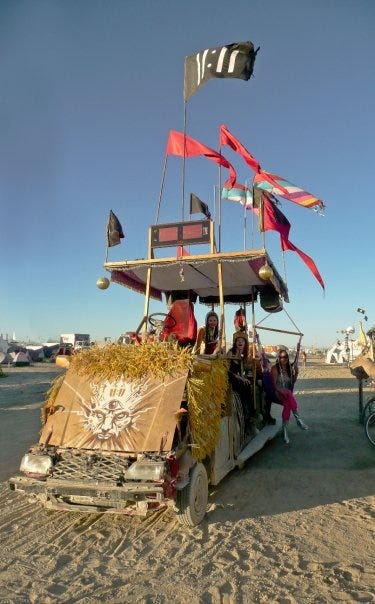
Years later, when I was lamenting to someone who attended that I had to whisper the ceremony, she responded, “It was sweet and sexy. I hadn’t realized you weren’t doing it on purpose.”
Unexpected Returns
After 2008 I didn’t plan to return. I had given and gotten enough and it was time to stop. But after unexpectedly losing my husband, Mark, at the end of 2012, I went back in 2013 to memorialize him.
The week in Black Rock City culminates with the burning of a large, wooden man-shaped structure on Saturday night. Burning Man began in 1986 when founder Larry Harvey burned the first wooden man effigy on Baker Beach in California, surrounded by a group of friends. From there it blossomed into the world-renowned event it is now, with upwards of 75,000 people gathering to watch fireworks explode out of the man before the entire thing is set ablaze in a towering inferno.
But Sunday night, the last night of the event, is when the temple is burned. This has an entirely different vibe. The temple is where people mourn what has been lost and celebrate what has been found. There are funerals and weddings. There are altars built in memoriam, also to be burned. People leave the ashes of their loved ones there.
The mood is generally quiet, introspective and respectful. In 2004 the temple, the Temple of the Stars, was a quarter of a mile long, constructed of scraps from a factory that created 3D wooden dinosaur puzzles. David Best, the builder, became known for his incredible Burning Man temples and now has installations around the world.
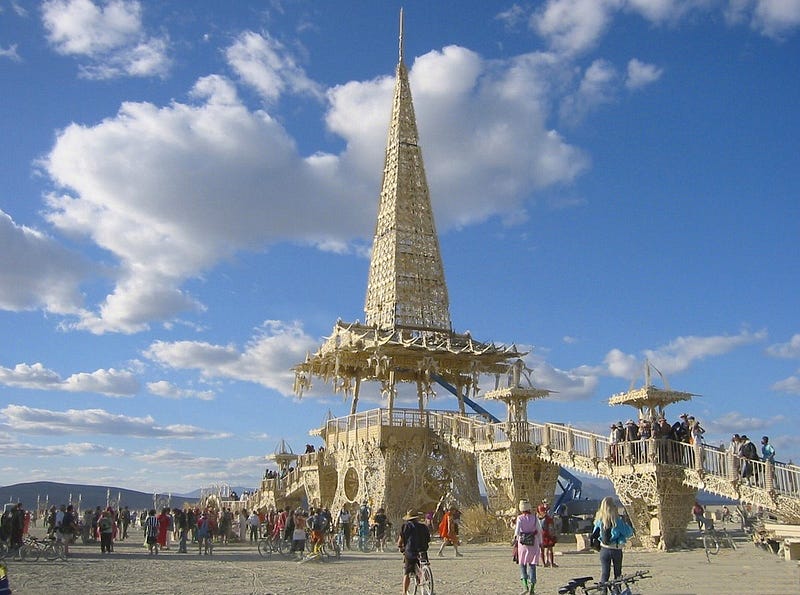
That year, my friends and I found a place to sit near the temple at sunset before it was burned, and watched the crowd fill in around us. Shortly before the fire was set, Best and members of his crew slowly walked amongst the onlookers, quietly saying, “It’s not your fault.” Tears flowed. Thousands of people witnessed this in near silence. We watched elegant fire tornadoes and flaming dust devils spin away from the temple as it slowly consumed itself, sending prayers of loss and love to the heavens.
When I went back In 2013 to memorialize my husband, I again camped with my beloved Hookahdome, now having grown from about 20 people in 2004 to over 100 in 2013. By that point, the population of the city had tripled in size.
I did not arrive early for the build and I did not stay for the break down. I was there for a purpose; to honor my late husband at the temple, see some old friends and let loose after a surpassingly difficult year.
By that year, Hookahdome hosted a constant flow of globally recognized musicians and other performers. One night of music was dedicated to Mark. I again worked my beloved spot at the door.
I danced in the middle of blinding dust storms. I crossed the playa seated in my favorite spot on the front edge of the Magic Carpet, waving to people and beckoning to hop on and join us for the ride. I brought one of Mark’s favorite costume pieces to the temple, placed a letter to him inside of it, and sobbed while I watched it all burn.
I accomplished what I set out to do, but it was not easy. I let go of grief out there in the dust, but I also let myself run a little wild. And it was enough. I knew I was finished with The Burn and I was content in that awareness.
Florida Burns
People who enjoyed “that thing out in the desert” eventually realized that they could do it themselves and more frequently, but on a smaller scale. So regional burns, some affiliated with the Burning Man, some not, were created. Like Burning Man, grant money is provided to artists to create interactive art pieces. Now there are regionals all over the country, and the world. Afrikaburn in South Africa is a big one. There is a small regional in Japan. Love Burn, on Virginia Beach Key, a state park just off the coast from downtown Miami, has grown into the largest burn outside of “the big burn.”
My first Love Burn was in February 2020, just weeks before the start of the pandemic. I was only there for a couple of days but long enough to know I wanted to return. The rigors of the desert are a uniting force at Burning Man, so something is lost without that struggle, but the ease of a burn in February on a semi-tropical private island holds a special kind of magic.
It was accessible, being only a four-hour drive from where I live, and for others, only about 20 minutes from the Miami International Airport.
All of this created obvious appeal.
Tickets have leaped in price since 2020. Not surprising; now that COVID has diminished, people are hot to burn again.
Money is tight and I hadn’t planned to go this year, but several friends chipped in for my ticket and surprised me. Monet was one of those friends. Together, we created a camp similar to Hookahdome, with a variety of delicious teas served under a beautiful tent.
Getting through the gates was tough; there was a gigantic line and a convoluted method for both parking and finding one’s camp. But I made it.
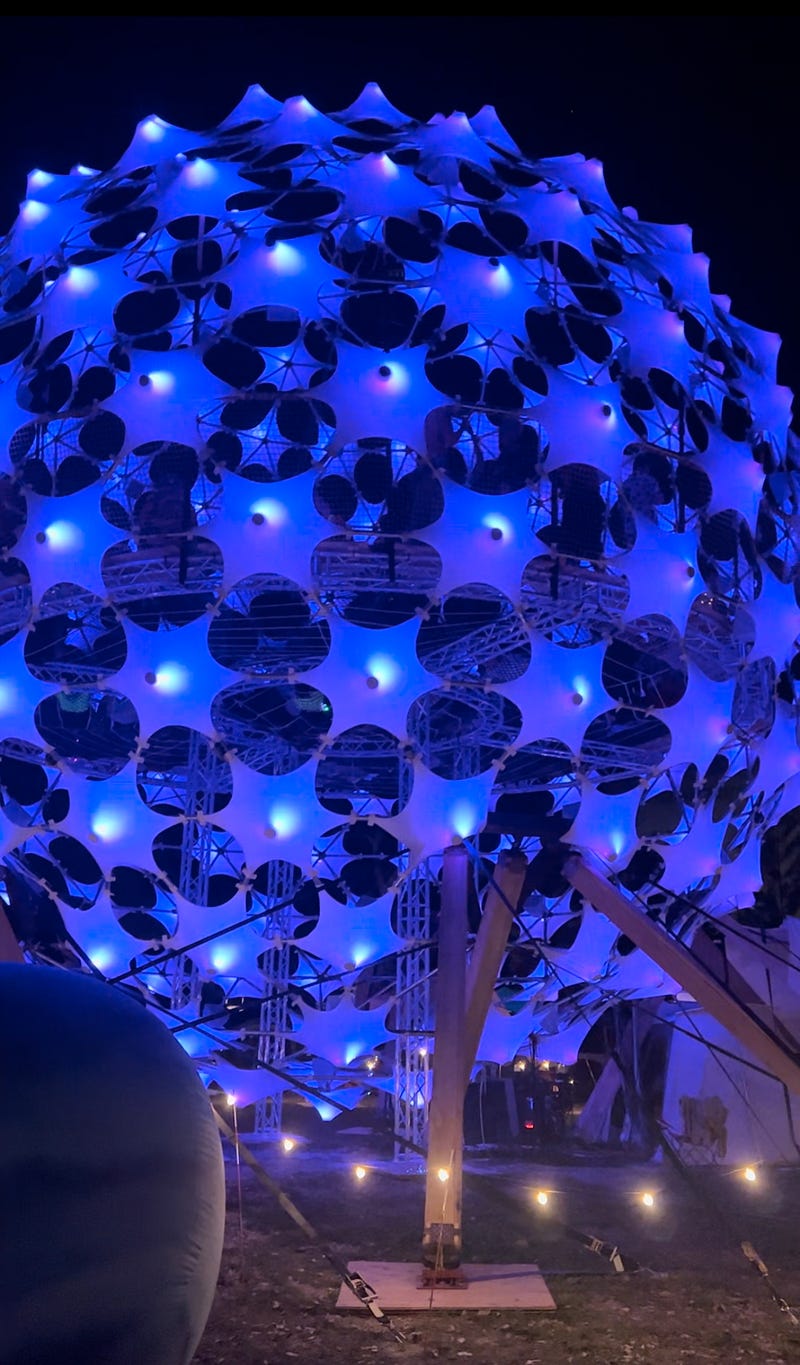
The unexpected growth of the event since 2020 provided the vulnerability. There were so many people, places and things. The art was breathtaking, just like at Burning Man. I sat inside of a giant color-changing orb listening to Dark Side of the Moon followed by Beethoven’s Fifth Symphony through an amazing sound system. Chatter with new friends alternated with extended moments of silence.
I led a parade of several thousand people. A good friend of mine was the recipient of one of the aforementioned grants and created a parade complete with a marching band and hundreds of beautiful handmade Venetian-esque masks handed out to participants.
When I was asked to lead the parade, I set to work on my costume. I knew we would be under UV lights, so white was a key element. I wore a multicolored sequined mini dress, white, rhinestone studded fishnet hose on my legs and arms, gold sneakers with LED color-changing soles and a long, white wig topped with an art deco marching band hat. All of this was to match a white mask I decorated at one of our work parties, leading up to the burn. This year, I also spent weeks decorating the underlay for my first wedding dress. I colored geometric designs on it and wore it while I was serving tea to our guests. I love that a burn gave me a reason not only to wear my old dress, but to make it into a conversation piece and imbue it with new, happy memories.
I was ecstatic when I found out that one of my favorite camps from the big burn was at The Love Burn. While upbeat dance music played, people undressed and, as a group, were shepherded into an area with clear vinyl walls and drainage.
The vibe was ecstatic, not sexual. Group after group is sprayed with a foam of peppermint Dr. Bronner’s soap (The owner of the company is the camp founder) while the people doing the spraying graced the crowd with compliments such as, “You are BEAUTIFUL!!! You are THE BEST!!!” The dancing continued until everyone came out the other side, refreshed physically and renewed on a soul level. Yes, it is a moment of supreme vulnerability to be naked and dancing with 20 people you don’t know. But in that moment, all the fear and shame was rinsed away.
As I was wandering alone one night, on a path near the beach, I stumbled across a camp with a bar area separated with velvet stanchions. The camp was called “Very Important Burners,” and for entry, one had to dance a jig or sing a song. I watched, I waited, I desperately tried to figure out what I was going to sing (I don’t really know how to do a jig). Next thing you know, Marilyn Monroe’s version of Happy Birthday, when she sang it to JFK, was coming out of my mouth. The crowd loved it, and in I went. After being offered the drink of my choice, I was on the beach watching the most vibrant fireworks display I had ever seen.
Ultimately, rewards come with challenges. In order to see those epic views, jagged peaks must be crossed. Sometimes we catch MOOP careening through the air before it decapitates someone, then turn that piece of trash into an inspiration for a book that becomes a bestseller.
As I sit here struggling to get all these thoughts of what was so big and yet so little out on digital paper, I hear a loud “BOOM,” and look out my window as a barrage of Memorial Day fireworks light up the sky. At first it scared me, then I saw the light. A gentle reminder that I am, in fact, and will always be, a Very Important Burner.