
Florida softshell turtle hit by cars
By Joanna Fitzgerald | Director of the von Arx Wildlife Hospital
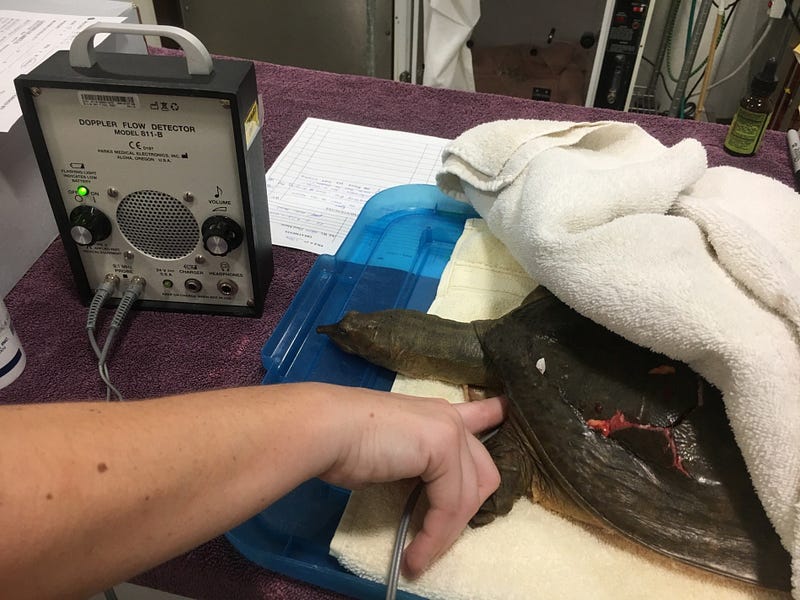
A Florida softshell turtle was among the 98 animals admitted to the von Arx Wildlife Hospital at the Conservancy of Southwest Florida this past week. Other admissions include a brown pelican, a yellow-billed cuckoo, three big brown bats and two Seminole bats.
The Florida softshell turtle was rescued from the road. This softshell was one of nine turtles, representing five different species, admitted this week, all were hit by cars. The woman who rescued the softshell was so disheartened when she arrived at the von Arx Wildlife Hospital. She had pulled over to help but before she could retrieve the turtle from the road, it was struck by a vehicle.
Hospital staff immediately noticed the severity of the injury to the left side of the turtle’s carapace (top shell). Also noted was the limpness of the turtle’s head and neck. There was no pull back response when the turtle’s front and back legs were extended. Hospital staff suspected the turtle was dead on arrival.
A Doppler ultrasound exam was performed on the turtle to check blood flow but nothing was detected. The result of the ultrasound, along with other tests, confirmed our assessment that the turtle was deceased.
Turtles have unique anatomy and physiology which makes it challenging to determine when heart function and respiration have ceased. If a turtle is cold, its metabolism can slow down so the turtle may appear lifeless. It is impossible to see or feel for a heartbeat due to their shell.
An injury, such as a large, open chest wound that would typically kill a mammal or bird isn’t necessarily fatal for a turtle. In fact we have seen turtles with their lungs and intestines exposed that are still ambulatory.
If you find a turtle in imminent danger, please offer immediate assistance if possible. Always remember that human safety is a must — never put yourself or another person in harm’s way when assisting an animal.
If you assist a turtle that hasn’t been injured, place it out of harm’s way in the direction it was headed. Never put a turtle directly in the water. Placing a turtle near the edge of the water keeps land tortoises safe from drowning if a well-meaning rescuer has mistaken it for a water turtle.
A turtle that has been injured needs to be brought to the wildlife hospital for immediate medical attention. Turtles feel pain and most car strikes cause extensive injury. Hospital staff use their vast knowledge and resources to properly assess each patient. If you aren’t sure if a turtle is deceased bring it to the hospital. It is always better to be safe than sorry when determining whether or not a reptile needs medical attention.
Recent Releases — 30 Animals Returned Home
- 4 Eastern Cottontails
- 2 Florida softshell turtles
- 4 mourning doves
- 2 Northern cardinals
- 4 Virginia opossum
- 2 blue jays
- 1 purple martin
- 2 marsh rabbits
- 1 common grackle
- 2 red-shouldered hawks
- 2 American crows
- 3 mottled ducks
- 1 Eastern screech owl
Opportunities to Help
Please visit the Conservancy website at www.conservancy.org to view all of the amazing volunteer opportunities at the Conservancy of Southwest Florida. Your volunteer time is vital in helping us continue our work to protect Southwest Florida’s water, land, wildlife and future.
Joanna Fitzgerald is director of the von Arx Wildlife Hospital at the Conservancy of Southwest Florida. Call 239–262–2273 or see conservancy.org.


