
Floating Cities on Oceans in Our Future?
Is there a business case to re-envisioning our cities?
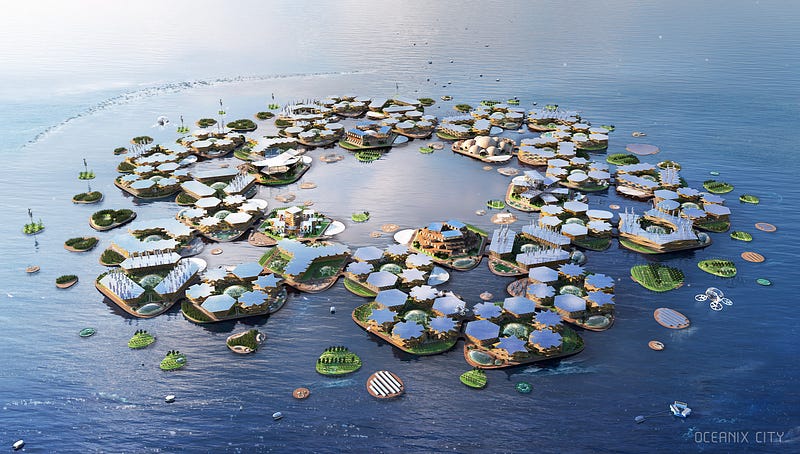
Even at the most modest rate of global warming, ocean levels are expected to rise. This risks 40% of the world’s population in our coastal megacities. At the same time, the world’s population is only increasing. With a capricious, warmer climate, we may not be able to provide habitat for all these growing numbers. In past, a simple solution to demand habitat would be to cut down forests to develop urban centers and farms. There is a great price tag to that approach now. Forests are our carbon sink. Cutting them reduces the ability for carbon removal. Burning up the wood adds even more carbon to the atmosphere. This incredible problem has led some innovators to identify future homes for humanity. Mars is one option. Yet, there is another option that’s closer home — oceans. Water occupies 70% of the earth’s surface. The saline water is not fit for human consumption or irrigation. But, can it function as a new destination for habitat — a floating city?
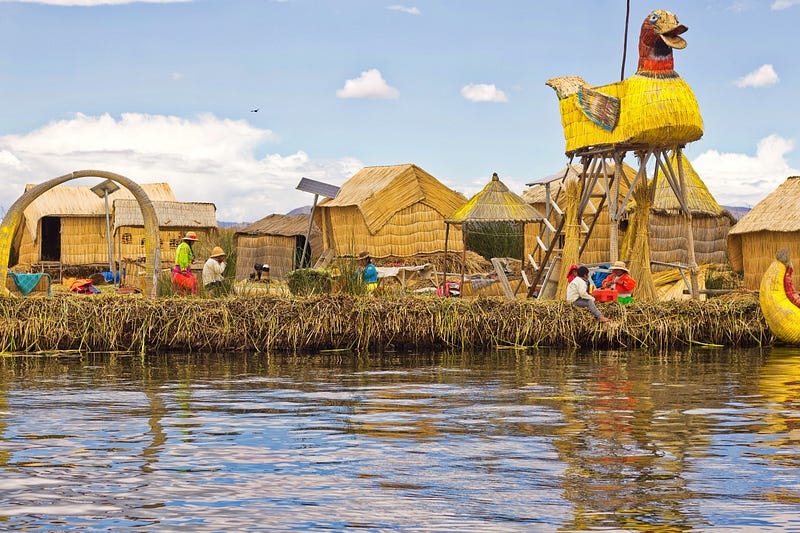
The idea itself is not new. Aztecs’ had the floating capital of Tenochtitlan on Lake Texcoco. Similar islands have existed on Lake Titicaca in Peru, where villagers live on islands made of reeds. Architect Buckminster Fuller had his own plans for a floating city. But, none of these approaches was scalable. Oceanic, a startup founded by the Polynesian businessman Marc Collins Chen aims to solve this problem. The company is supported by the architect Bjarke Ingels. Their vision is of a floating, modular city with farms, power generation, and waste management.
“There are already many iterations of floating homes and apartments, but there’s no integrated vision for how this is going to scale,” — Marc Collins Chen (quoted in FC)
Futuristic Floating City
Businessman Marc Collins Chen became the tourism minister of French Polynesia in 2007. He quickly realized that a large chunk of the Polynesian islands would be underwater at current levels of global warming. After a year in the government, he decided to do something about habitat loss. He came up with the firm Oceanic. The idea was to develop viable, scalable, and sustainable floating cities. Oceanic was born in 2018.
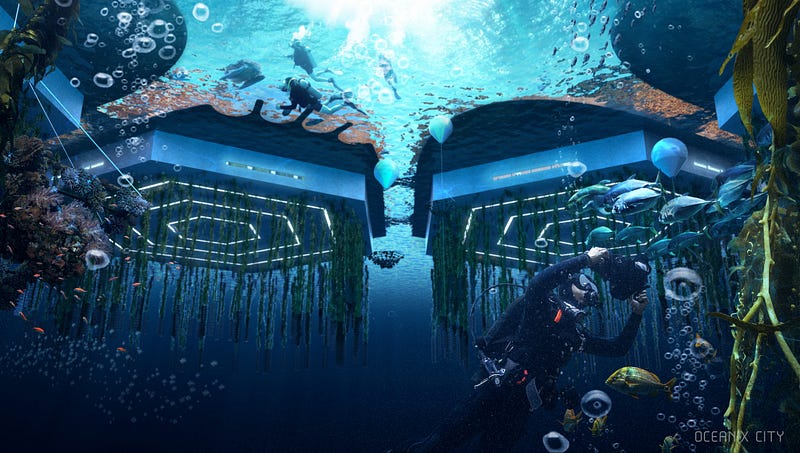
Cities would be built close to current major cities. In a way acting like extensions to the current ones. Major cities have already tried to do this with artificial islands. This includes the ones around Dubai, etc. The problem with these man-made islands is that they are wasteful and costly. Moving earth around also impacts ocean life negatively. At the outset, Oceanic wants to build their floating cities in warmer tropical or equatorial regions. That way they don’t have to worry about heating in winters or freezing waters. The basic unit is a 4.5-acre floating barge that holds up to 300 people. These barges would be anchored via cables to a “Biorock” in the sea bed. Biorock is a concept pioneered by the architect Bjork Ingles. The rock is a wire mesh with a low electric field to attract minerals, which then attract corals to build coral reefs. The barges would be transparent to not occlude sunlight from reaching the seabed.
Building a floating city
Oceanic's plan is to first build a neighborhood on a barge. Six of these can be connected to build a village. The villages collect in a hexagonal design to build a city of 10,000 residents. Uninhabited islands would provide power through solar, wave, or wind energy. Other islands would have farms using hydroponics, aeroponics, and other sustainable agriculture systems. The city would run with minimal waste production. One thought is to keep the island meat-free to reduce energy consumption. Recycling would minimize waste. Desalination, rainwater, and air-water harvesting would provide potable water. This all is possible due to the modular approach of the city. As the city grows, islands can be added on the side with these features.
Of course, the city has to be walkable as the design doesn’t allow for cars. Golf carts or electric boats can allow for transportation.
Protection from natural disasters
While self-sufficiency is noble, they are not essential. Basic amenities like food, water, waste management, and energy can all be supplied from the mainland. The more important concern is the risk of natural disasters like hurricanes or tsunamis. With rising water levels, hurricanes are more devastating than before. They can be even more destructive in oceans with nothing to slow down their ferocity. In this case, a fast-moving storm can destroy any floating utopia. Oceanic intends to make its city resilient. Their barges can move in all directions, dissipating the energy of a large wave. The residential islands would be inside the external circle of waste, power, and farm islands. This way residential areas won’t be the first to be hit. The built structure would be less than 7 stories to prevent wind damage. The company claims their islands are designed to withstand category-5 hurricanes.
What is the business plan for Oceanic?
While the cities sound like utopia, a key feature is missing — financial viability! It is not clear how Oceanix would raise money for their grand scheme. Also, what would folks on such islands do for work? Would these islands be more like a tourist spot? Or would there be regular ferry service plying people to cities making the islands a form of suburbia? Oceanic wishes to pursue tech companies to move their offices or data centers to these floating islands. Once an anchor business relocates to the floating island, commercial and living spaces will organize around it. The modular design will be handy in this case. Oceanic first presented their idea to the United Nations in 2019. Public funds may create the first prototype of the city.
“There’s a radical change in the approach, which is why we’re doing this with the United Nations,” Collins says. “The approach is, what is it the countries are actually asking for and what are the needs — as opposed to, ‘We would like to build floating infrastructure because we have this philosophy,’ and see if the countries will let us in.” — Marc Collins in Wired.
Another issue is dealing with the ocean as a real estate. Does the city have jurisdiction over the sea? Who owns the sea retail space? The answers to these questions are not entirely unknown. For the company to meet its lofty goals, it will have to raise sufficient capital to develop a prototype space. This can be followed by pursuing homeowners, businesses, or major employers to move. The initial seeding can then snowball into rapid growth — each step paying for subsequent growth and expansion.
Other approaches to Floating Cities
Oceanic is not the only one. In fact, some other approaches are way ahead. Canal houses in Amsterdam based on circular economy exist. While pricey due to the engineering involved, theoretically they are very self-dependent. They have solar panels for power, rooftop farms, and rainwater harvesting. Similar prototypes have been developed in Copenhagen. Seasteading Institute, once backed by Peter Thiel, is at the forefront of the floating city concept. But, they have hit some choppy waters due to their push on alternate forms of self-government. Marc Collins tied up with the Seasteading Insititute to create Blue Frontiers in 2017. Their aim was to build a floating habitat around the French Polynesian islands as a testing ground for future cities. However, the company had a fallout with the French Polynesian government and Marc left the company to find Oceanic.
Criticism of Floating Cities
While the idea for a floating city is theoretically impressive, there are many issues with it. The foremost one is governance and current tech. How would the floating city or neighborhood be taxed when it doesn’t need many of the usual municipal services? The tech to make the houses possible is either not there or not as efficient. There is also the concern of how long the barges can withstand exposure to seawater. Seasickness may concern residents. Marc Collins calls these cities more of a lab at first to develop the tech to realize the utopian vision.
A final concern is a floating city may end up being a destination for the rich while the climate refugees languish in overcrowded cities. At this point, the entire concept of Oceanic is just that — a concept. Perhaps even behind schedule when compared to building habitats on Mars. Will this ever become a viable business? Will we move to cities on the sea? We will have to wait for some more years to answer that!


