
Flee to the Desert
Why did the Egyptian Desert Fathers abandon the cities of Rome in the fourth century?
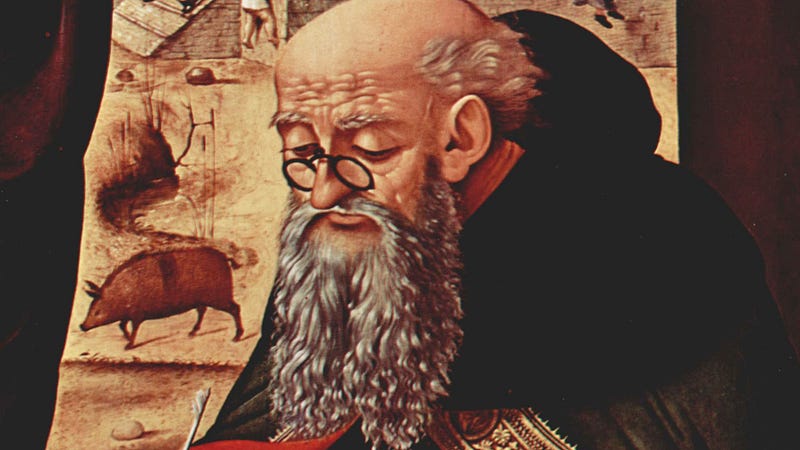
In the mid-fourth century the Roman world witnessed one of the strangest phenomena of its 1,100 year history. Men and women — Christians, who were to all outward appearances sane, sensible, and sober — began to abandon their towns and villages, families and friends, vocations and careers to make their way to the harsh deserts of Egypt. Some settled in newly-established colonies along the Nile river; others chose to live alone, away from the river, in isolated stone cells concealed in the arid wasteland along the eastern rim of the Sahara. Here, living beneath the scorching sun, these men and women devoted themselves to a single-minded search for God.
The Creation of Saint Anthony
Word of the new movement spread. Amazement grew. A bishop of Alexandria named Athanasius wrote a book in 356, The Life of Saint Anthony, about the “founder” of the movement. This burst of publicity led many to regard Anthony as the “Father of Monasticism;” in fact, he was the most famous example of these early monks, not the first.
According to Athanasius, Anthony had been raised in an upper-middle class Egyptian family. His father was a minor land owner. Unfortunately, his parents died when Anthony was in his late teens, forcing the young heir to assume control of the lands and responsibility for his younger sister.
One Sunday morning, Anthony went to church, and he heard the story of Jesus and the rich young ruler. A wealthy man had asked Christ how to win salvation, and Jesus had replied, “If you want to be perfect, go, sell your possessions and give to the poor, and you will have treasure in heaven. Then come, follow me (Matt 19:21).”
These words changed Anthony’s life; he felt as though they had been spoken directly to him. He sold his lands and gave the proceeds to the poor. He placed his sister in a community of women (Athanasius does not record her reaction to this change of life), and he devoted himself completely to following Christ. He learned the rudiments of the ascetic life from old men who were living outside his village (which undercuts the claim that Anthony was the first monk), and then he went out into the desert to seek God in the great silence.
We might never have heard about Anthony, but Athanasius’ biography turned him into a celebrity. The book — filled with stories of Anthony’s struggles against the demons in the desert, and his ultimate emergence as the greatest Christian holy man since the Apostle Paul — became a Roman bestseller. The thin volume, originally written in Greek, was translated into other languages. Scribes churned out thousands of copies, and stories about Anthony and his associates spread to the far edges of the Empire.
The book altered lives wherever it was read. Fifty years after its publication, Saint Augustine met a pair of young Roman officials in Trier (modern Germany) who had stumbled across a copy of the Life. Interested, they spent an afternoon in a pleasant garden reading it. Upon completion, the two men were shaken and they began to question their chosen vocation:
Tell me, I ask you — one of the men said to his companion — what do we hope to accomplish with all of our work? What do we seek? For what cause do we fight? Is it really better to place our hope in the palace, to count on becoming friends with the Emperor? Isn’t that a position that is fragile and filled with danger? Doesn’t such a perilous path present even greater dangers? When will we reach that point? Nevertheless, if we want to, we can become a friend of God right now! — Augustine, Confessions, 8.5.16
The two young men were so inspired by what they had read that they renounced their secular careers and, moving to the outskirts of the city, constructed a stone dwelling where they began to live as monks, modeling their lives on Anthony’s example.
The Desert a City
During the fourth century, the number of desert Christians grew, until, in the words of the fifth century author, Palladius, “The desert became a city.” The monastic movement was underway, and although every region within the Empire claimed monks, Egypt, home of Anthony and the Desert Fathers, was the heartland, the birthplace, and the spiritual core of the movement. Large colonies of monks flourished in Scetis, Nitria, Cellia, and along the Nile River. Thousands of men and women tested their faith in the desert, revealing both a hunger for God and a sense that the Christianity of the city, of the church, of the clergy, had somehow failed. People hungered for depth, a more profound spiritual experience. They found it in a very unlikely spot.
The Teachings of the Fathers
In the decades that followed, famous ascetic masters lived and flourished in the desert. Disciples recorded and transmitted collections of their teachings, a body of wisdom literature known as the Apophthegmata patrum (The Sayings of the Desert Fathers). Most of these sayings are short, intended to promote further thought in the listener:
Abba Agathon, wanting to learn about silence, held a stone in his mouth for three years. — AP-PA 88.1
Like a Zen koan or a short meditation from Marcus Aurelius, the sayings open a window into eternal truth and encourage the reader to explore a deeper, more substantial reality. They advise us how to structure our social relations, and chastise us when pride obscures our own failings:
A monk saw a group of nuns coming down the road toward him. He immediately turned his back on them, so that his eyes wouldn’t be tempted by lust. As the nuns passed, their abbess said to him, “If you were a true monk, you wouldn’t have even noticed that we were women.” — AP-GN 154
People were drawn to the desert fathers for much the same reasons we continue to pursue self-improvement: our lives, consumed with busyness and distraction, feel empty. We share a sense that there is something more, a higher, better version of ourselves that we could attain if only we had a curriculum and a teacher. The desert fathers offered both. In an uncertain age, a time much like our own, they pointed to the signposts along the inner road, and proposed a path forward.
Wisdom is eternal and universal; it transcends race, cultures, and religions. Like other great ancient philosophers, the desert fathers have much to teach a twenty-first century world.
All translations of Greek and Latin texts in this article are by the author.