Flamenco and Finding the Rhythm of my Heart
A Born Again kid grows up.
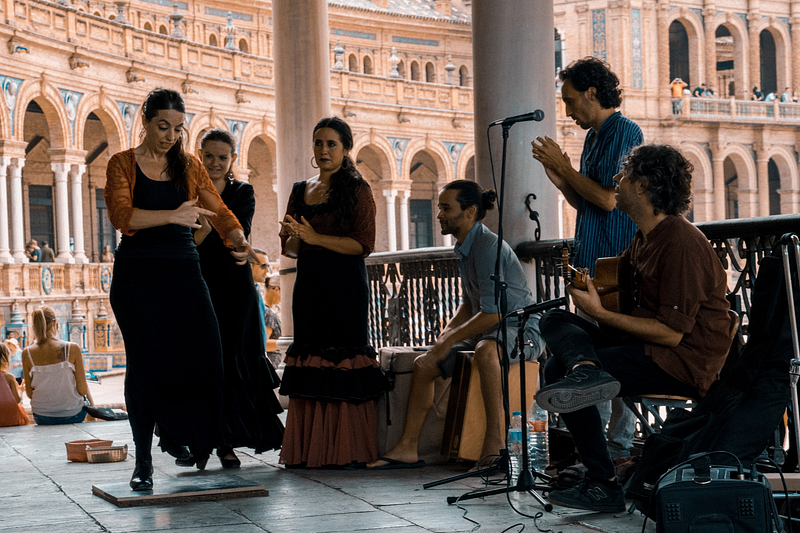
Dance has had a complicated role of wonder in my life.
I grew up in a home where dance was akin to sin. My parents were fundamentalist Christians, and in their minds anything connected with the human body — yes, dance — was sexual, and to be avoided.
Rotary Phones
My mother spent hours attached to that umbilical cord of the 1960s landline telephone, and that enabled me to put a record on the stereo in the room around the corner, close the door, and move. I only had to remember not to jump or leap about too much which would make the needle skip, and that might bring about a put-the-phone-down lecture. But as long as my housewife mother was on the phone, I was safe to dance.
Once in school, I borrowed library books about ballet, and practiced the poses, using my windowsill as a barre. I took figure-skating and asked for dance lessons, hoping the figure-skating would be a good reason to study dance…but my parents were not fooled: dance was dance. I skated without the practice of an arabesque.
Legs to Run Away
I ran away from home when I was seventeen (do I need to explain why?) and spent the next number of years paying too much for rent and being broke. I had to choose between night school writing class and dance classes. I had to choose writing. But I danced in night clubs, and finally, in my mid-twenties, I took ballet classes.
Ballet
Ballet was the most familiar dance form. I was fortunate enough to find an old couple who taught adults as if they were children. They taught us well, explaining the properties of the human body and the unnatural work that is ballet, taking care that we not injure ourselves. I loved those classes; they felt to be some piece missing from my early years. They filled some old chinks in my walls, kept the wind from blowing me down, made me strong.
But then I had my first child and moved out of the city, and there was no time or place for dance.
Ballroom
Children do grow up eventually, and when my youngest was eleven, a friend suggested I join her in a living room dance class a mutual friend was teaching. What dance form? Something she’d pulled together with her knowledge of ballroom dance and Latin forms…a sort of partner-free dance. Every Wednesday evening, for one year, I went.
And the first thing I learned was that my mind seemed incapable of holding the succession of more than two consecutive steps. I was always half a step behind because I had to watch the teacher, and guess at what was next. I learned the rhythm of rumba, and the nature of a jazz box and that waltzes are in three.
Jazz
My childhood without dance, and with little music (and certainly not music with real rhythm! Churchy dirges for the most part), limited my feel for movement. But after one year of that living room dance group, I challenged myself to go to a dance school and sign up for a jazz/modern class. WHAT was I thinking?
For another year, every Friday evening, I would show up, jazz shoes in hand, and find some spot among the four young women who were taking the class for recreational fun. The four of them had danced since age 3 or 4 and were now in college, and wanting to keep a few toes dipped into their childhood passion. Then there was me. They would move their spines in ways I thought not possible, and fall to the ground and roll in a way that was indeed dance, and for me was more about clumsily crashing and heaving to stand. Not in any way connected with grace.
It was a challenge; it was not dance. Not for me. At the end of the year I was just pleased I’d not given up. And just before the end of that year, a friend invited me to an open house flamenco class.
A Different Dance Class
The flamenco teacher, from South Africa and of Greek heritage, burned fiery passion — in the slightest movement, and even in word. She began by sharing the history of the Los Gitanos people, or the Roma, and their oppression by the Spanish Catholics. How they hid in the caves of Andalusia.
The idea of people hiding in caves, yet making incredible noise with hands and feet and singing, utterly caught me.
The thought of that religious persecution and the ferocity of the feet, the defiance of a certain angle of jaw, the hand gestures…all resonated deeply.
I signed up. The first couple of months I did only an hour a week. The next few months, a couple of hours. But in short order, it was four hours every week, continuing with that for four years, until I moved away.
It took two years to even begin to understand the feel of the rhythm of the music, with the accents on 3–6–8–10–12 as we made our way through the rhythms, so alien to my ears and soul.
And then to dredge up from my very bowels, in spite of inner resistance— those sadly upper-two-thirds-of-North America Puritanized bowels of mine — the force that is flamenco. And it is a force, of spirit and verve. Of sustenance.
I would go through months of learning footwork and hand movement, down to each finger, each timed, my brain constantly adjusting, pushing. Always, always a half step, then a quarter step, behind. Lagging. I could see how it was hard for the teacher to work with me. She pushed. I loved how she pushed. But damn. It was hard.
Three Significant Pieces
Focus
Dance is a meditation, a focusing meditation. Thoughts about Anything Else cannot enter my mind when I am dancing. It is all about the music, the timing, and my body moving.
For those hours I am freed of whatever else is in my life.
Ironically, it’s a kind of prayer and connects the trinity of physical, emotional, and mental. All equally.
Learn to get back on the horse
Related to focus, yes. It is the other half. When you do lose focus, when your working with the rhythm slips, when you falter, you do not stop. This took a long time to learn.
“Stay on the horse,” said my teacher, meaning the rhythm. “If you do fall off, get back on.”
This now resonates through so many other areas of my life, whether my parenting falters, or I let go of a friendship, or a story I am writing starts to spin away. When confidence frays… I get back on the horse.
The “compas” — that is, the accented rhythm — is akin to your heartbeat
This realization for me was when the two other pieces — of focus and getting back on — not stopping — made sense. And maybe this is the beginning of grasping the real flamenco piece: the sense of it in one’s very gut and soul. It isn’t about what is outside of one; it comes from within. It is internal and external rhythm connecting.
Thank God for the Wholeness That is Dance
Without saying a word (which can be such a relief for a writer) dance heals.
The body has the capacity to absorb pain and then to process it, to create something new, or renewed; to strengthen. Without words, the body can get on with the work of healing.
Flamenco, with its history, and its rhythms that connect and carry, has its own ability to hold and heal. And re-birth. Born again.
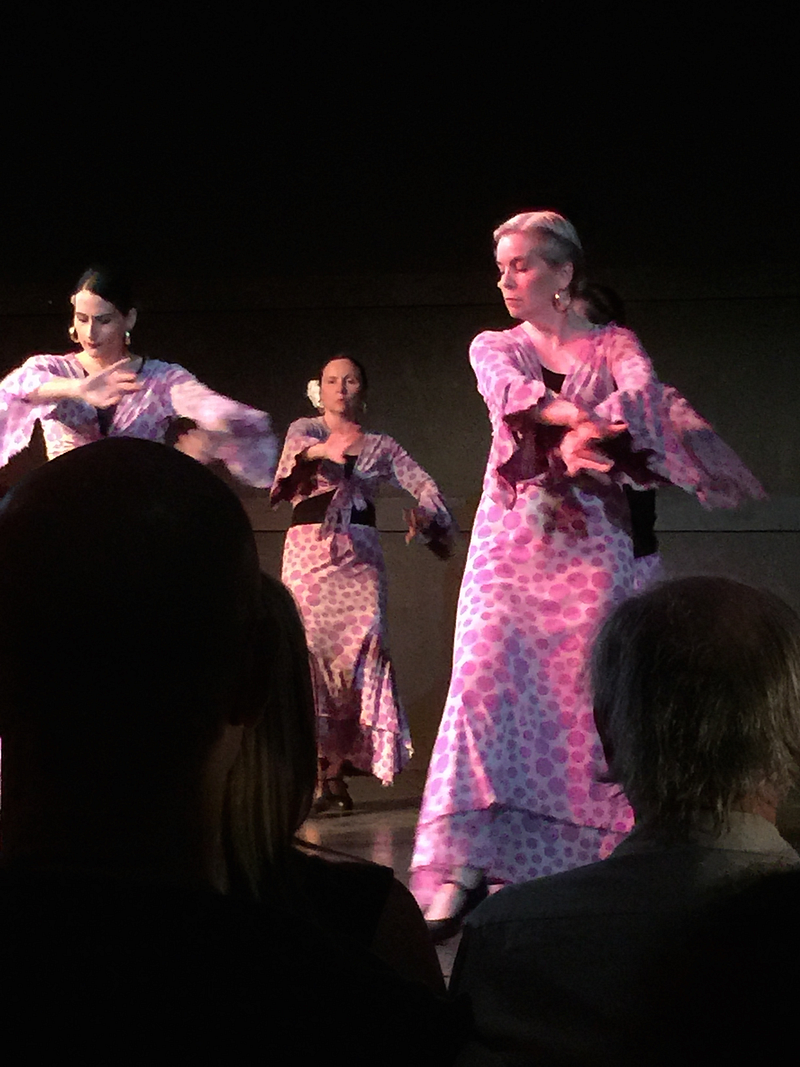
Alison Acheson lives, dances, and writes in a little house with a wood stove in the East Side of Vancouver, BC. Her most recent book is a memoir of her time caregiving her spouse, Dance Me to the End: Ten Months and Ten Days With ALS, and she has published works for all ages of readers, from picture books to adult fiction.