
Fixing Facebook and Twitter’s Fake News Problem and Increasing Freedom of Speech
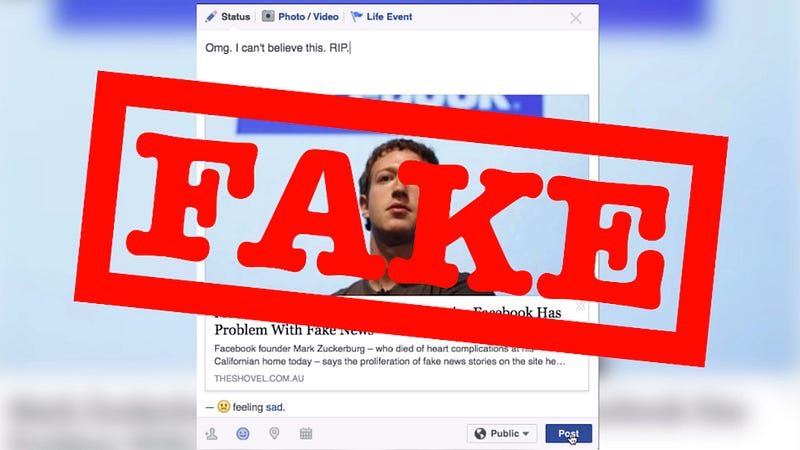
In todays social media environment, it is almost impossible to tell the difference between truth and falsehood. Almost every one of us, has at least once believed a story that was’t credible. To make matters worse, algorithms favor stories that get engagement, and stories that are very emotionally charged are the stickiest. In this click bait world, lying is incentivized and rewarded and as a result, the popular saying, ‘a lie will make its way around the world before the truth gets out of bed’ is more true than ever.
This poses a serious threat to our democracy and society, as any democracy is dependent on an informed public. For the public good and for their own long term brand and reputation Facebook and Twitter must do something, but what are they to do? Both companies are stuck between a rock and a hard place as policing speech is both difficult and not the answer in an open free speech society. Getting this right should not cost us our freedom of speech, and instead the opposite needs to happen.
The only way to defeat a lie isn’t to try and sensor it, but instead to beat it with the truth. That is… to show the truth about the lie itself.
Here are a few common sense approaches each platform can take in order to solve the issue of ‘Fake News’
1. Fake Accounts / Bot Networks on Twitter
- Type of Account: Twitter needs to give more information on the type of account that is engaging in their platform. Is it a real person? Is it part of a bot network? All bots should be labeled in some way so users know whether they are dealing with a person or a bot and if that bot belongs to a network.
- Social Proof: The reason Bots are so effective is because they mimic social proof. As a result, Twitter needs to consider how to count likes and shares and responses from Bots. One way is not not count them towards the totals and only count organic human behavoir. In other words, if a like, comment, share comes through the Twitter API, it does not count towards the total likes, comments, responses.
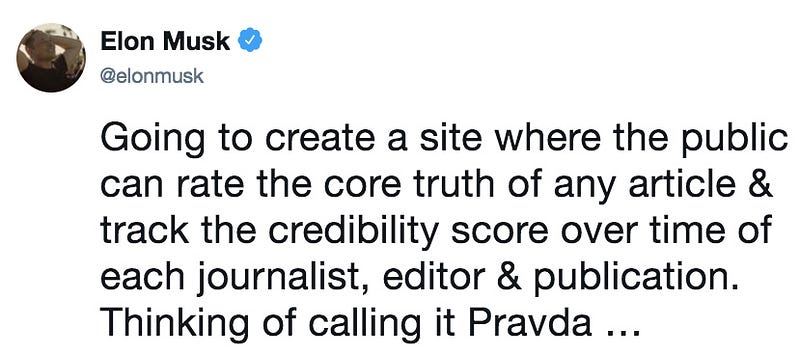
2. Believability Score
One of the best and worst things about social media is that anyone can say anything. On the positive side, it really enhances our freedom speech. On the downside, anyone with an uninformed opinion can muddy up the waters.
Here’s what we can do about it:
Believability Score: This score should indicate how believable a person is in a specific domain. For example, a PhD in Physics should be more believable when discussing Physics on Twitter than a person with a PhD in Psychology and vice versus.
Source of the Score:
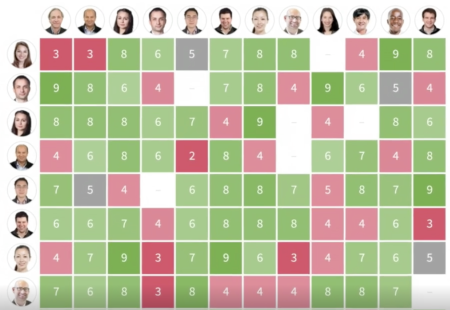
- Occupation/Education: This can be a new type of verification that verifies a person’s identity and occupation/education. If you have a PhD in Physics that you will get a high Believability score in the field of Physics and all related hashtags.
- Endorsements from other Highly Credible Accounts: If a number of other highly believable Physicists endorse your account by positively engaging with it, this will increase your score. This can mimic how Google’s algorithm ranks sites.
3. Punishing Bad Actors
Currently, Social Media platforms give an advantage to bad faith actors and reward them for their behavior. For example, posting very emotional political content, aka Fake News, is far more likely to result in more likes, shares, and clicks which means more visitors more ad dollars.
Here are a few ways FB and Twitter can fix this:
Warning Labels for Bad Faith Actors
Facebook and Twitter users should know if an account has a history of intentionally behaving in a deceptive manner.
How to define Bad Faith Actors
Intentionally Deceptive: If the account has lied on a continual basis, then their Believability Score should suffer and they should have a warning label on their account. Eg: Warning: Account Intentionally Deceptive
How do we know if an account is intentionally deceptive when it’s not a clear lie? They will have a pattern of logical fallacies and baises:
Logical Fallacies:
- Ad Hominem attacks
- Straw man Argement
- Appeal to Ignorance |Appeal to Authority | Appeal to Pity
- False Dichotomy
- Slippery Slope Fallacy
- Circular Argument
- Hasty Generalizations
- Red Herring Fallacy
- Causal Fallacy
- Equivocation
- Bandwagon Fallacy, etc…
Cognitive Biases Codex:
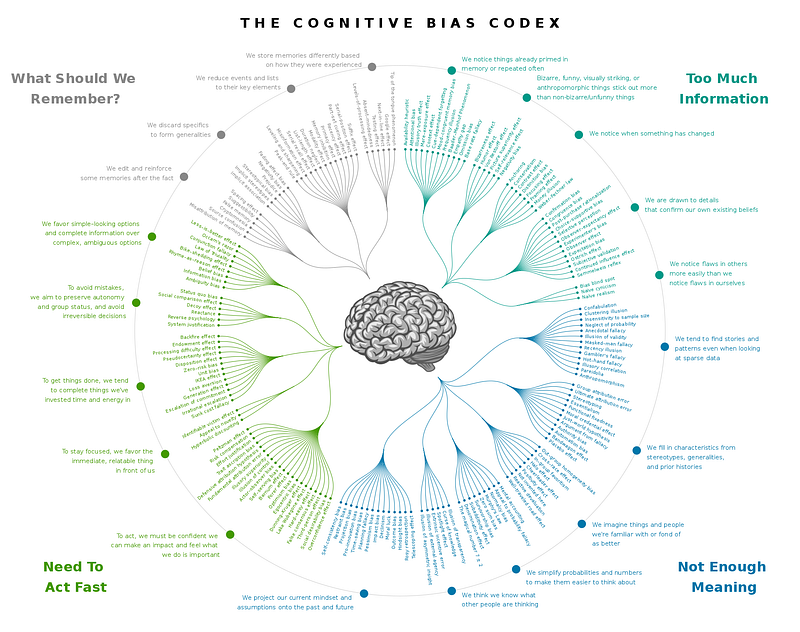
The focus here is on logical fallacies and biases because only through them is deceptive behavoir really possible.
Platforms should not confuse logical fallacies with political correctness. The goal isn’t to try to not offend people or not to make them feel bad. In fact, the truth is often uncomfortable and offensive!
Platforms have a responsibility to warn people about deceptive behavior and miss-information, which has nothing to do with being politically correct.
Propaganda
When logical fallacies are one sided and intended to benefit a specific cause, political view or politician, then the account is engaging in propaganda. Any account that has engaged in propaganda, should having a Warning: Propaganda label next to it.
How to Punish Bad Actors
Bad actors should not be silenced or kicked off the platform, instead they should pay the penalty for lying. So what will the penalties be?
- Labels: Warning Labels on accounts that are deceptive or outright propaganda.
- No Social Proof: Propaganda accounts should no longer show number of followers, likes, shares, clicks, etc…
- Distribution: Posts from Bad Actors should not be boosted by the algorithms, instead they should not be featured at all. The account itself should also not be recommend. If a follower wants to get the latest info from a propaganda account, they will need to go to the account directly. If a propaganda account wants to advertise, the warning labels will follow all ads.
News Content Labels
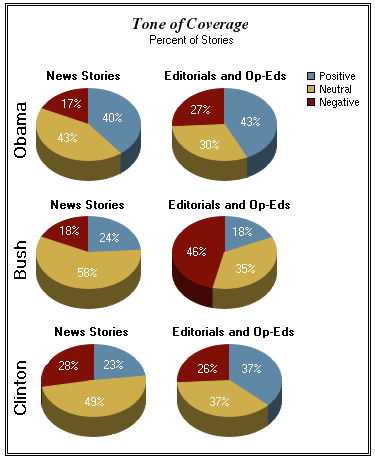
News accounts need to be held to a higher standard so they can be believable. If an account focuses on the News it can fall into two categories:
- Hard News: News that is actual, research based and informational. If it’s speculative or coming from a talk show host or has an editorial element to it, then it should be categorized as an opinion piece. Only Hard News pieces should be labeled: News
- Editorial/Opinion: Regardless of source, if there is a ‘frame’ and specific perspective around a news piece, then is should be in the opinion section and labeled: Opinion.
Additionally, the Social Media platforms have an ethical obligation to showcase multiple opinions on any given topic. Viewers should see a multi faced way of seeing a particular problem, side by side.
4. Radical Transparency
All Warning and Believability labels should have a link so people can see why the account is labeled that way.
In the cases for Believability Score, the link can include snippet on the person’s occupation/education and how other high quality accounts in that field give this account credibility.
In cases of Warning Labels, the link needs to show the content that triggered the warning label and why. The content in questions can be side by side with logical fallacy that triggered it and then compare that content to a highly believable piece of content on the same topic. For Propaganda Accounts, the link can show all of the above and also how the content contains biased information that is one sided and serves a specific interest.
Implementation
There are a number of ways to role out some of the types of features. One way might be to allow users to who are highly knowledgable in logical fallacies to flag content that is in bad faith. These users can indirectly train a Machine Learning algorithm using Natural Language Understanding to be able to predict how likely other pieces of content are misleading.
Since these changes are on an Account Level, once a threshold of bad faith is established the punishment is taken on the account itself which means that the system does not have to be prefect. A propagandist can get away with 100s of lies, however chances are they will get caught at least 10 times ( Platform have to decide how many lies is enough). Once caught 10 times, it will be easy to review their account and put the right labels on them and limit their ability to spread lies going forward.
Why Facebook and Twitter have to Take Action
Just this week, a number of high profile politicians called for regulating the social media platforms. Their solution is to make the platforms directly responsible for the content that users posts. Other politicians want to break these companies up. This is exactly the type of legislation that FB and Twitter want to avoid.
Right now it seems that FB is stuck between a rock and a hard place. Instead of tackling to solve this problem, they are freezing. Freezing is the first, and most common, response when a person or organization is faced with a major threats (I’m referring to the freeze, flight, fight response) but they must take action.
Overall, this is very bad for their Brand. Doing nothing will further cement a negative image of Facebook, and should Facebook ever be broken up due to regulation, it will face a major uphill challenge.
This is the time for FB and Twitter act, before it’s too late.