
HISTORY + RACISM
Five White Heroes For White People to Replace The Racist Ones
We should dethrone some "heroes," but we can't leave a void
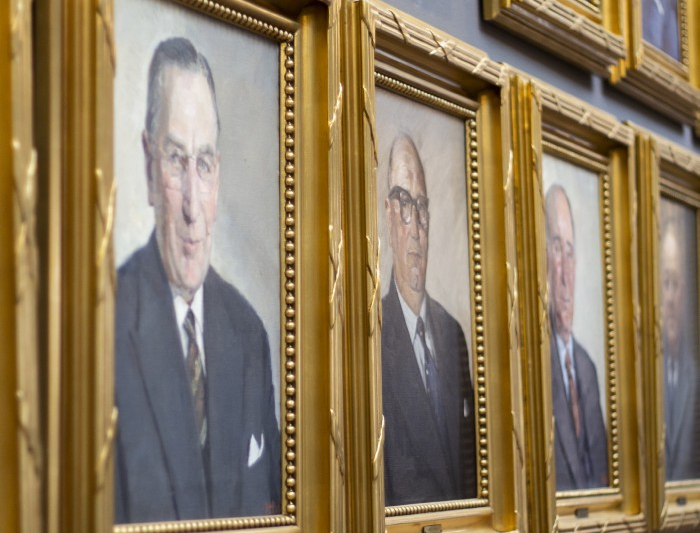
When you call someone a hero, it's because you believe their values and contributions are admirable. Yet, when a nation is founded by men of ill repute, worshiping them becomes a dangerous proposition. Children in public schools around the country hear that the slave-owning "founding fathers" were heroes despite their offenses. Methodically praising slave-owning men, putting them on the money we use, and praising them in schools as heroes feeds into the notion that slavery was a necessary evil, that it was okay to dehumanize Black and Indigenous people. Remember, America is not deprived of heroes, but for too long, White people have decided to worship unworthy men. Let's unpack this.
White people hearing about the misdeeds of the "founding fathers" for the first time may come as a bit of a shock, like when Darth Vader told Luke, "I am your father," in The Empire Strikes Back. Of course, some White Americans hold the "founding fathers" near and dear to their hearts, despite them enslaving Black people and participating in the oppression and, at times, eradication of Indigenous people. Before White Europeans arrived in 1492, 5 million Indigenous people lived in the Americas, but in the 1900 census report, the population dropped to 237,000, the lowest at any time in American History. "Among them, more than a dozen tribes, such as the Pequot, Mohegan, and Massachusetts," were driven to near extinction.
To be clear, America was founded by many White men who felt they had a right to enslave or kill anyone standing in their way. They used the cultural differences amongst people to divide and conquer. After all, "in 1452, Pope Nicholas V charged Alfonso of Portugal with the Christian duty to enslave any non-Christian." And some White people felt they had the mandate to keep. Anyone who was not Christian, which included many Indigenous Black and Brown tribes, were considered savage and treated inhumanely. Despite Christopher Columbus leading his men to massacre innocent people, America still celebrates "Columbus Day." It’s peculiar.
White people did not "discover America"; they conquered the Indigenous people and laid claim to their country. Yet, school children will learn nursery rhymes about Christopher Columbus sailing the ocean blue, yet, they will not likely hear about what this "hero" did once he arrived. Spanish conquistadors "forced their way into native settlements, slaughtering everyone they found there, including small children, old men, pregnant women, and even women who had just given birth." Calling Columbus a hero is disrespectful to every person he and his men killed, and if it makes me "woke" to notice that, so be it.
If told with any level of honesty, American history will yank the white veil from our eyes — the founding fathers were not heroes; they were morally barren by today's standards. The founding fathers were more than problematic; their view of humanity was sick and twisted. "Jefferson, like all slaveholders and many other white members of American society, regarded Negroes as inferior, childlike, untrustworthy, and, of course, as property."
Oh, and for those who insist that we should not judge the founding fathers or any other racists from the past, consider that White men and women in that era understood that racism and slavery were wrong. Some White people were willing to put their careers, their family's stability, and their very lives on the line to improve America and pull the nation out of its barbaric state of justice for some, but not for all. So, where are the holidays celebrating the greatness of abolitionists? And what does it say about America that we worship slave owners in public schools but not the men and women who worked diligently to help America transcend its early state of barbarism?
America does not have a supply chain issue or shortage of heroes.
For America to move forward culturally, she must forsake her slave-owning forefathers and instead embrace heroes who aspired to snatch this country from the depths of hypocrisy. But rather than simply tear down the old heroes, I want to build some up too. So, without further ado, here are five White heroes who could easily replace the slave-owning founding fathers as heroes.
1. William Lloyd Garrison
As a journalist, I admire someone like William Lloyd Garrison, a Christian abolitionist who published The Liberator, promoting the abolitionist campaign. In 1831, in the first issue released, he made his views on slavery crystal clear: "I do not wish to think, or speak, or write with moderation… However, I am in earnest — I will not equivocate — I will not excuse — I will not retreat a single inch, and I WILL BE HEARD." White people in the modern era could learn much from Garrison, who refused to back down from the fight against slavery and rejected incrementalism. Garrison’s newspaper became a revolutionary calling card for fellow abolitionists.
Before the Civil War, Garrison proposed separating from slaveholding states. "From this blend of pacifism and anarchism came the Garrisonian principle of "No Union With Slaveholders," formulated in 1844 as a demand for peaceful Northern secession from a slaveholding South." This scenario is not much different from White liberals in the modern era suggesting a separation from "red states. To be clear, this would be a bad idea since the majority of Black Americans still live in the Southern States and would be adversely impacted; the similarities are startling.
Modern-day Black Americans would take issue with one aspect of Garrison's history. As a "convert from the American Colonization Society," which suggested once free Black people should return to Africa, Garrison believed in the principle of "immediate emancipation." President Abraham Lincoln also thought Black people should leave the country once free, but his views, as well as the remaining abolitionists, changed after the Civil War. Garrison was passionate about one thing — ending slavery because he viewed the institution as a stain on the nation. Garrison supported Abraham Lincoln and "welcomed the Emancipation Proclamation as the fulfillment of all his hopes." While Garrison may not have started his career as an egalitarian, he was a true abolitionist.
Garrison didn't care that White men would lose money by abolishing slavery, nor did he believe Black men, women, or children were inferior. On the contrary, he viewed slavery as a wicked institution. So, if it's wrong to judge men like Jefferson on the morals of today, then how is it that men like Garrison who lived during the same period were fully aware of the ills of slavery?
2. John Brown
Need a little more excitement in your brand of hero? Look no further than John Brown, a militant abolitionist. A 2020 fictional series called The Good Lord Bird uses some of his adventures as the basis for their story. During the real John Brown’s life, he focused on taking direct action to secure justice and liberation of Black people in America. Brown was a "by any means necessary" type of abolitionist. Traveling with a wagon load of guns and ammunition, John Brown and his family settled in Osawatomie, quickly becoming a prominent leader amongst abolitionists. A group called the Secret Six offered financial support to John Brown's abolitionist movement: Samuel Gridley Howe, Franklin Benjamin Sanborn, George L. Stearns, Thomas Wentworth Higginson, Theodore Parker, and Gerrit Smith.
In 1849, the Brown family settled in North Elba, a Black community. While America grappled with formal racial housing segregation until the 1960s, John Brown had no qualms about living amongst Black people. By the spring of 1858, Brown boldly decided to establish Maryland and Virginia mountains as "a stronghold for escaping slaves."
John Brown then traveled to Kansas with five of his sons to join abolitionists struggling in a small-scale civil war "known as Bleeding Kansas" between proslavery and antislavery advocates. John Brown led a raid on the federal arsenal at Harpers Ferry, Virginia, in 1859, intending to establish a safe haven for Black people escaping slavery. Sixteen White men and five Black men took hold of the armory in October. However, after two days of fighting and help from the infamous slave owner and future Confederate Col. Robert E. Lee, the uprising was squashed. Local White slaveowners convicted John Brown of murder, slave insurrection, and treason and sentenced him to death by hanging. John Wilkes Booth, who later assassinated Abraham Lincoln, was in attendance as a militiaman.
The hanging of John Brown and the insurrection he led were noted as primary factors contributing to the start of the Civil War, which eventually led to the end of the chattel slavery system. As Union soldiers marched into battle, they sang a song called "John Brown's Body," which became the "Battle Hymn of the Republic." In addition, the French novelist "wrote that Brown's hanging would open a latent fissure that will finally split the Union asunder."
John Brown was a true American hero who believed all men were created equal and put his life on the line to prove that point. Brown refused to accept injustice as a mainstay of American culture, and as a result, we are freer in the modern era. Men like Jefferson enslaved 600 people, yet Brown spent his life trying to end the system of slavery. So, why don't more children learn about John Brown in school and learn the Battle Hymn of the Republic that inspired soldiers to fight for the version of America they wanted? Too much time is wasted on worshiping faux heroes.
3. Theodore Parker
Theodore Parker wrote impassioned speeches about the ills of slavery that still strike a chord in the modern era. In 1848, Parker wrote A Letter to the People of the United States Touching the Matter of Slavery: "at the time of forming the Federal Constitution, some of the southern statesmen were hostile to slavery, and would gladly have got rid of it. Economic considerations prevailed in part, but political and moral objections to it extended yet more widely." Parker acknowledged that some of the founding fathers did not agree with the institution of slavery. Nevertheless, White men sacrificed Black people's freedom to compromise and maintain the union.
Parker definitely deserves a spot in the pantheon of White heroes because he acknowledged the ills of slavery and thoughtfully pushed back against their racism in real-time. He boldly questioned the logic of the 3/5ths clause. If "slaves are men," Parker contended, "then they should be taxed as men, and have their vote as men," not help to empower slave owners. When people say, "we can't hold historical figures accountable by today's standards," they must have never heard of men like Theodore Parker. In the 1800s, he knew, like many other White Americans, that slavery was not only immoral but also politically illogical. For example, Luther Martin, the then attorney-general of Maryland, thought slavery was "inconsistent with the principles of the American Revolution and dishonorable to the American character." In addition to advocating for the eradication of slavery, Parker also promoted prison reform and women's rights. All in all, Parker was a hero who spoke truth to power.
"Neither law nor custom gives protection to the slave," Parker wrote. "Their connection may at any moment be dissolved by the master's command, the parties be torn asunder, separated forever, husband and wife, child and mother; the infant may be taken from its mother's breast and sold away out of her sight and power. The wife torn from her husband's arms, forced to the lust of another, for the slave is no Person but a Thing." During the modern era, conservatives would accuse Parker of being "woke" for acknowledging the humanity of Black people, and the merit of their fight for equal rights, liberty, and justice for all. However, Parker was undoubtedly a hero who, unlike the majority of founding fathers, valued Black people as fellow Americans.
4. Thomas Wentworth Higginson
Another radical abolitionist, Thomas Wentworth Higginson, a Unitarian minister, also fought for women's voting rights and became a poet, author, and Union officer. Like John Brown, Higginson brought weapons and ammunition to fellow abolitionists in Kansas. As a White man, he was never confused about whether slavery was right or wrong. Higgenson regularly "attended abolitionist meetings at Faneuil Hall and wrote abolitionist poems for The Liberator newspaper."
Like William Lloyd Garrison, Higginson believed in a radical idea that "the Union should not be preserved if it meant maintaining slavery." If America couldn't get its act together and become a country willing to live up to its founding principles, Higginson didn't feel the union was worth preserving. Indeed, his idea was radical, but so was the effort to enslave millions of Black people. In 1850, upon the passing of the Fugitive Slave Act, Higginson became a member of the Boston Vigilance Committee, which "aided escaping slaves." When Higginson arrived at the meeting, he described the legislation as "cruel and unrighteous."
In the modern era, states are currently debating whether girls, women, and pregnant people will have the right to leave the state to seek healthcare, which is not much different from the Fugitive Slave Act, which codified a pro-state rights ideology, where Black people were bound to a system of slavery, even if they escaped into a free state. But, back to Higginson, because his opposition to the Fugitive Slave Act demonstrated his character, liberty was more valuable to him than complacency. As Dr. Martin Luther King Jr. wrote in his speech, When Peace Becomes Obnoxious, "If peace means a willingness to be exploited economically, dominated politically, humiliated and segregated, I don't want peace. If peace means being complacently adjusted to a deadening status quo, I don't want peace."
Higginson became a hero who fought against the institution of slavery and recognized that any version of America that included slavery was not worth keeping. In 1870, Higginson shared some of his experiences in South Carolina in a book called “Army Life in a Black Regiment." Within the text, we learned why arming Black people was fundamental in their pursuit of freedom: "until the blacks were armed, there was no guaranty of their freedom. It was their demeanor under arms that shamed the nation into recognizing them as men." Arming Black men and believing they deserved the right to bear arms was radical at the time, so revolutionary that Higginson lost his congregation because of his views on women's rights, labor, and slavery.
5. The Grimké Sisters
Okay, so I know I said I would share five heroes, but the Grimké Sisters were an interesting pair of abolitionists. Sarah Moore Grimké and her sister Angelina Emily Grimké were Southern White women who despised the institution of slavery. "They developed an antipathy toward both slavery and the limitations on women's rights." In the modern era, some White women can relate to this struggle of seeing the injustices of systemic racism and their own plight as women. However, as Emeka Aniagolu wrote, white women "betrayed" the struggle for racial equality through their voting habits and inconsistent advocacy. So, to get back on track with the egalitarian movement, White women should take a page from the Grimké Sisters' book.
Sara was dissatisfied with the shabby education offered to women and started to attend meetings in Philidephia with the Society of Friends in 1821. Angelina followed her sister's lead and, in 1829, joined her sister, becoming a Quaker. They came out as abolitionists writing a letter for William Lloyd Garrison to include in The Liberator newspaper. In an 1836 letter, "In Appeal to the Christian Women of the South," Angelina tried to appeal to White women's morality to join the abolitionist movement. And her sister Sarah followed up with "An Epistle to the Clergy of the Southern States." Unfortunately, writing about the abolitionist made the Grimké Sisters' social pariah and "strained their Quaker friendships."
Angelina Grimké wrote, "We must come back to the good old doctrine of our forefathers who declared to the world, 'this self-evident truth that all men are created equal, and they have certain inalienable rights among which are life, liberty, and the pursuit of happiness.' It is even a greater absurdity to suppose a man can be legally born a slave under our free Republican Government." Like many Americans, Angelina Grimké saw slavery as an abomination and a contradiction of the principles America was founded upon. She asserted seven propositions, the first of which asserted that, "slavery was contrary to the declaration of independence,” and the sixth of which asserted, "slavery in America reduces a man to a thing, a "chattel person," robs him of all his rights as a human being." In the spring of 1838, the Grimké Sisters' lectures brought thousands to the Odeon Hall in Boston, Massachusetts.
While public school students may never hear about the Grimké Sisters, they were undeniably American heroes, willing to stand firm in their conviction, asserting that Black lives matter and should have never been kept in bondage. While White women often praise figures like Susan B. Anthony, who led segregated women's suffrage marches, the Grimké Sisters never excluded Black people in their pursuit of equal rights. This dynamic duo of White women was not confused about their mission — to secure equality for everyone, not just those who look or worship like them.
States are currently debating whether girls, women, and pregnant people will have the right to leave the state to seek healthcare, which is not much different from the Fugitive Slave Act
Looking ahead
White people are not running low on worthy White heroes, nor are the five+ White people I described in this article a comprehensive list of the good White Americans have done. I took the time to write this article because I often critique the founding fathers and those who cherish them. But, I wondered, what I was doing, as a writer, to educate people about heroes they could put in their place. We must not leave an open void as we tear down statues of old Confederates and denounce the bigotry of White faux heroes. It is fair to judge the founding fathers and other historical figures by the moral standards of the modern era because even hundreds of years ago, Black and White people understood the value of a multiracial, multiethnic, multicultural democracy.
I hope you enjoyed learning about William Llyod Garrison, John Brown, Theodore Parker, Thomas Wentworth Higginson, and the Grimké Sisters. White abolitionists are proof positive that White people do not have to worship slave-owning White men. Who you consider a hero says a lot about you individually, but the heroes we give to future generations say a lot about where we're heading. In a time when any unpleasant historical facts are labeled "critical race theory," I welcome the title. As a society, we must embrace our critical thinking and reasoning skills and understand that racism was never "okay," that slavery was never "justified," and that, as a nation, we should never agree to disagree when it comes to human rights.
🌹Learn more about the author here. 🖊Sign up to read all my stories and thousands more.