
Five Votes I’ve Cast in Past Elections That I Now Regret
…and another ten that I don’t!
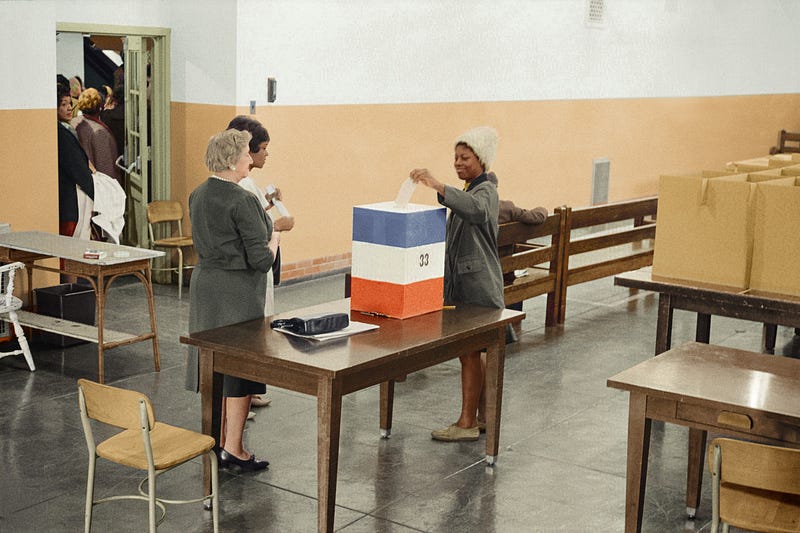
Only one month after I turned eighteen, I was finally eligible to vote in my first primary. It was Wisconsin’s presidential open primary in April of 2000. I proudly voted for Bill Bradley, even though Al Gore had already secured the Democratic nomination one month earlier.
Then, seven months later, I voted for John Hagelin (the Reform Party / Natural Law Party fusion candidate) on the November 2000 General Election Ballot.
Despite how I “threw away” my piddly little presidential vote, Gore still narrowly carried my home state of Wisconsin. So was it pointless for me to have turned out to vote, in the first place?
I don’t know. In fact, in every election, I ask myself whether my vote is actually making a difference.
But I still do it. Because, even if my single vote is only one droplet amidst a deluge of rain — at least I’m making the effort to have my say.
Some people just sit at home, whine about how all politicians are crooks, whine about how their vote doesn’t matter, whine about how Americans “in general” are lazy and stupid — and then refrain from voting, thereby proving their own self-fulfilling prophecy.
It’s people like that who drive me to oppose the hypothetical notion of mandatory voting from citizens.
However, I’ll admit I’ve cast some votes in my 20+ years as a continuous, active, consistent voter which I’ve regretted. This is to be expected, since lawmakers are human…and humans are going to fail at things.
The following are five individual votes throughout my life that I would take back, if I could. And then, for good measure, another ten votes that I’ll never regret — even if they were ultimately symbolic or futile.
Susan Tully (U.S. House, 2000)
In my first national presidential election, I gave my presidential vote to John Hagelin. I voted for Democratic incumbent Herb Kohl in that year’s U.S. Senate race. But I didn’t know who to vote for in my district’s U.S. House of Representatives contest.
Our incumbent, Ron Kind, had spoken at my high school, two years earlier. I was unimpressed. So, in my salad years as a voter, I cast my vote for his Republican challenger, Susan Tully. I’d seen her speak, and she’d seemed more enthusiastic than Kind. In hindsight, I would have done a lot more research on both of them.
Who I would have voted for instead: I don’t know…although I would go on to vote for Kind in five subsequent election cycles (2002, 2004, 2016, 2018, and 2020)
Jim Doyle (Governor, 2002)
It was my first gubernatorial race, as a voter. Wisconsin’s longtime governor, Tommy Thompson, had just departed for D.C. to become George W. Bush’s U.S. Secretary of Health and Human Services. He left a fiscal mess behind for his Lieutenant Governor, Scott McCallum. But while McCallum’s apologists tried to excuse his poor decision-making (“He didn’t know how bad things really were going to be”), McCallum mismanaged the budget in a visible attempt to selectively pander to select cohorts of older voters.
I went with the Democratic nominee, Jim Doyle (who was, at the time, our state’s Attorney General). It was a “lesser of four evils” scenario. Ed Thompson (Tommy’s brother, and the Libertarian nominee) was straight-shooting, but didn’t seem to have a strong fiscal agenda. Jim Young (the Green nominee) was too much of a sanctimonious “white savior.” But over the course of the next eight years, Doyle would make a series of questionable (and unpopular) budget cuts. He was also publicly condescending to voters, while reportedly running a top-down administration of cronyism that paved the way for his successor, Scott Walker, to subject Wisconsin to eight years of Ron DeSantis-style fascism.
Who I would have voted for instead: Alan Eisenberg, a Milwaukee attorney running for Governor as an Independent; he had no chance, but, unlike Doyle, he was willing to tell it like it was
Ron Brown (State Senate, 2002)
Farther down the ballot, U.S. Air Force veteran and Eau Claire fire chief Ron Brown was challenging the district’s incumbent state senator, Rod Moen. I didn’t know much about either of them; this was only my second national election, and, during subsequent cycles, I’d learn how to do much better candidate research.
After reading a newspaper article about how Brown had taken the time to share some beers at a Homecoming parade with UWEC college students, I stupidly voted for him. I appreciated how he was trying to relate to Millennials at a public event. Had I realized that Brown would soon be in a position to support the upcoming state constitutional amendment banning any form of same-sex unions in Wisconsin (which I didn’t find out about until after those midterms were over), he would not have received my vote.
Who I would have voted for instead: Rod Moen (although Democrats won back the seat anyway, four years later, with Kathleen Vinehout)
Matt Dababneh (State Assembly, 2014)
Twelve years later, I was now living in California. Our San Fernando Valley state assembly seat was previously held by Bob Blumenthal…until he vacated it after being elected to the Los Angeles City Council. Matt Dababneh, a former staffer to Brad Sherman (our U.S. Representative), received the Democratic nomination for this open seat.
I passively went with Dababneh, as I was very disenchanted with many of the problems national Republicans were creating for Barack Obama. Three years later, Dababneh would be implicated in a sexual harassment scandal, forced to resign. Given how multiple women accused him of predatory behavior, I suspect he thought he could get away with it despite his high-profile role in California’s state legislature.
Who I would have voted for instead: Susan Shelley, a pro-choice Republican who, despite being in the California legislative minority, could have tried to improve the state’s deteriorating business climate of the mid-2010s
Jerry Brown (Governor, 2014)
During the 2010 midterms, former Governor Jerry Brown decided to move from his late-aughts position as Attorney General to mount a comeback for his old spot in the Governor’s Mansion — made vacant by Governor Arnold Schwarzenegger being term-limited. Brown won his high-profile 2010 gubernatorial bid against Republican businesswoman Meg Whitman. I voted for the Green Party’s gubernatorial nominee, Laura Wells, as neither Brown nor Whitman made a persuasive case in my eyes.
Four years later, Brown ran for reelection. By this point, California had implemented a “jungle primary” system where the top two vote-getters from the primary (regardless of party affiliation) would move on to the General Election. Taking on Brown was banker/economist Neal Kashkari. With a single binary choice between the two of them, I weighed Brown’s and Kashkari’s respective platforms. Brown at least had a water sustainability blueprint; Kashkari didn’t. I voted to give Brown a second term — and soon regretted it after he wasted his political capital on nonstarters such as plastic bag prohibition, opposition to sales tax exemptions, and mismanaging energy utilities.
Who I would have vote for instead: Neil Kashkari, who could have possibly gained more traction if he’d bothered to put forth a water plan
Politicians I Don’t Regret Voting For
On the other hand, while these next ten candidates weren’t ideal in their respective races, I feel I made the best decision I could — given the circumstances — by throwing my vote their way…
Bill Richardson (February 2008)
I voted for the New Mexico Governor in California’s presidential open primary, because I found him to be far more qualified than Barack Obama, Hillary Clinton, or John Edwards — even though Richardson had suspended his campaign, one month earlier. Many of my fellow Queer friends bashed Richardson for failing to support same-sex marriage (which — gasp! — neither did Obama, Clinton, or Edwards, at the time).
Tim Denton (November 2008)
I voted for the Libertarian Party’s nominee for the U.S. House of Representatives, because I was unsatisfied with incumbent Brad Sherman’s performance (although I would end up giving Sherman my vote in 2006, 2010, and 2014). Denton’s policies seemed much more levelheaded and moderate than many right-wing personalities who sometimes run under the Libertarian moniker.
David Hernandez (March 2009)
The fix was in for Antonio Villaraigosa’s mayoral reelection; he refused to debate his nine challengers, and the Los Angeles media treated him with kid gloves. I guess that’s what happens when you do a cameo on The George Lopez Show. Villaraigosa wasted much of his time in office campaigning for other candidates in other places, accepting lavish outside gifts, and cutting LAUSD resources. None of his foes in the 2009 mayoral race were sterling — but libertarian-minded Independent challenger David Hernandez at least seemed fiscally responsible.
Kamala Harris (November 2010, November 2014, June 2016)
Before she became Vice-President of the United States, Kamala Harris won a razor-thin Attorney General contest in the 2010 midterms against union-busting prosecutor Steve Cooley. Voting for her was an easy choice, as was supporting her reelection four years later. Before moving back to Wisconsin, I gave Harris my vote in the summer primary of 2016 as Harris ran for Barbara Boxer’s U.S. Senate vacancy against racial-slur-connoisseur Loretta Sanchez.
Jon Huntsman (June 2012)
I participated in the June 2012 Republican presidential primary given how Obama was running unopposed. Utah Governor Jon Huntsman was the only remotely-rational person running in a field of right-wing ideologues. He’d withdrawn from the primary five months earlier, so my vote for him was mostly symbolic. I voted for Obama in the November 2012 General Election.
Howard Berman (November 2012)
The confluence of post-Census redistricting and California’s new “jungle primary” system ended up pitting Brad Sherman and Howard Berman — two longtime Democratic incumbents from neighboring U.S. House districts — against one another. I stuck by Berman until the very end, because Sherman was a do-nothing figurehead who acted rude toward constituents in public. Sherman won by more than 20 points, and he’s still there collecting a paycheck and a pension.
Wendy Greuel (March 2013)
After Villaraigosa was term-limited out of office, the open Los Angeles mayoral race ended up becoming a showdown between City Council President Eric Garcetti and City Controller Wendy Greuel. I preferred Greuel’s fiscal experience, even though Garcetti seemed like a pleasant enough guy. Garcetti defeated Greuel by 8 points.
Jill Stein (November 2016)
Rob Grover (November 2018)
Once I was back in Wisconsin, I got behind (Democrat) Desiree Gearing-Lancaster in an effort to defeat (Republican) incumbent Treig Pronchinske. Gearing-Lancaster and fellow challenger Max Hart each had an uphill battle for the Democratic nomination against businessman Rob Grover, who lent his own campaign tens of thousands of dollars to visually bloat his perceived support. Grover also put out campaign ads implying he had an endorsement from the Ho-Chunk Nation, even when the tribe hadn’t officially endorsed anyone. Nevertheless, I gave Grover my vote in the November General Election because Wisconsin Republicans need to be punished for their nearly a decade of enabling sociopath Scott Walker.
Amy Klobuchar (April 2020)
By the time Wisconsin’s presidential primary rolled around — barely one month after COVID-19 lockdowns began — Joe Biden and Bernie Sanders were the only ones remaining in the Democratic field for the chance to take on Donald Trump. Although I’d voted for Sanders in the June 2016 California primary, I felt that Minnesota’s senior U.S. Senator had presented a far more electable and palatable campaign platform than Sanders — and she lacked Biden’s cringeworthy blind spots. Most of the withdrawn candidates in the Democratic field (including Klobuchar herself) had endorsed Biden, by that point, to prevent Sanders from getting the nomination; since the fix was already in, I ended up being one of 6,079 Wisconsinites who symbolically gave our votes to Amy Klobuchar.
What about you? Are you now, in hindsight, ashamed of any votes you’d cast in certain past elections? Or were there any subpar candidates whom you stand behind having reluctantly supported?
Click here to subscribe to my stories.


