
Five Things I’ve Learned About Podcasting
(and what I still need to do to improve)
Podcasting was not a challenge I ever expected to take on. When I approached the New Books Network with a request to be interviewed on their New Books in Poetry podcast about my recently published collection of poetry, the founder and editor-in-chief, Marshall Poe, confessed that the company did not have a host for the poetry podcast at the time. He then asked if I would be interested in adopting the role.
After some further conversations with Marshall, a fellow poet and writer Athena Dixon and I decided to jump onboard and accept cohosting duties for the New Books in Poetry podcast. Although I can’t speak for Athena, I confess that I personally had zero podcasting experience prior to taking on this challenge. Since New Books in Poetry was an existing channel with a following, I was fortunate that my first foray into the process was not started from scratch (with all the steps that that requires), allowing me to ease my way into learning how to plan, record, and edit an episode at my own pace through trial and error.
Thus far, cohosting a podcast has been a fun and interesting journey. In the time since Athena and I started hosting, I’ve had the honor of speaking with a number of amazing poets about their books, their work, and their writing process. I’ve learned a lot, both from the poets I’ve spoken with and about the podcasting process.
I am by no means a podcasting expert. However, on the chance that it may help someone else starting out in their own podcasting journey, here are a few of the lessons I’ve learned about podcasting thus far—along with many more things that I still need to work on.
Lesson One: Sound Quality — Invest in Some Good Equipment
As a fan of podcasts, I’m well aware that good sound quality can make a big difference as to whether people will continue listening or not—at least it does for me. Therefore, one of the first things I investigated were ways to achieve a level of quality that wouldn’t turn away potential listeners.
In the beginning, I used what I had on hand — namely, my laptop and a standard set of headphones with a built-in microphone. It worked well enough for the first few sessions, allowing me time to get comfortable with talking to guests and recording episodes using the Zencaster platform.
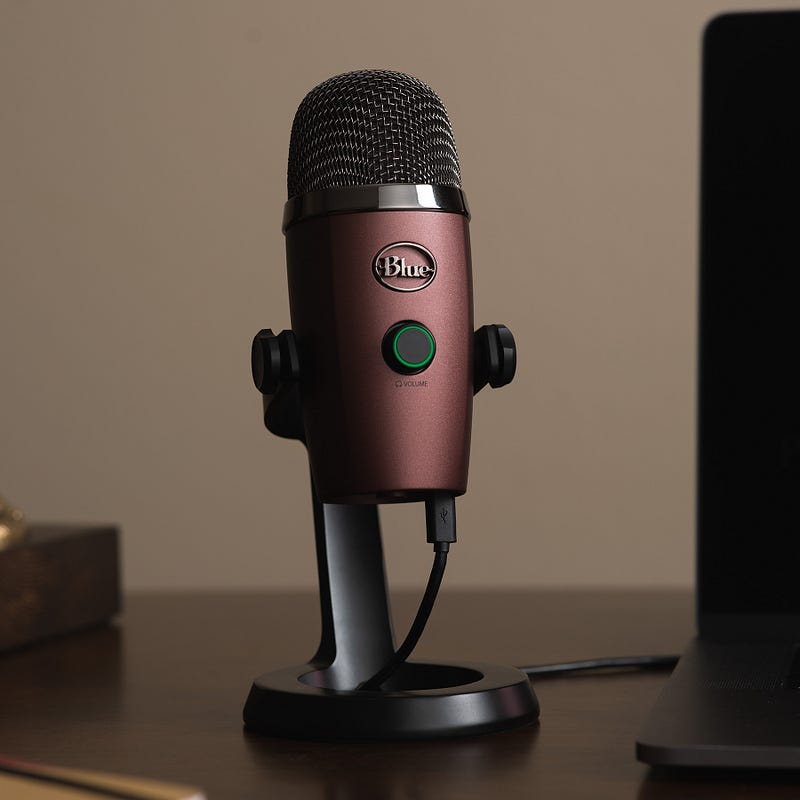
However, the sound quality from the built in microphone in my headphones didn’t quite meet my personal standards. After researching reasonably priced microphones, I purchased the Blue Yeti Nano, an entry-level mic that was well recommended by a number of podcasters. The difference in sound quality was immediately recognizable—making the purchase worth every penny.
Investing in podcasting equipment doesn’t have to be super expensive. It’s possible to just jump in and start podcasting, and then to level up as you go.
Keep in mind that just because you have cool tech, doesn’t necessarily mean you know how to use it. Even after getting my Blue Yeti Nano, it took some trial and error to figure out how to work it properly. For example, the microphone needs to be facing the correct direction, and there’s an optimal distance one should be from the mic in order to for it to properly pick up your voice.
The Blue Yeti kit I purchased also came with a pop filter, which prevents the popping sounds that can occur from a quick rush of air when someone is speaking — something I have a tendency to do. At first I avoided using this tool (due to the extra setup), but I’ve slowly adapted to its use.
What I Still Need to Learn
Other tools and technologies are also available, such as even better microphones and isolation shields that help to filter out any background noise from being picked up while you’re recording. It would be interesting to further explore what affordable technologies are out there in order to keep ramping up the sound quality of the podcast.
Lesson Two: Sound Quality — Edit Your Audio
Even with the best recording equipment, the recorded audio will never be perfect. There is always room for editing and cleaning up the audio file into improve the listening experience.
A variety of podcast editing software is available, designed to meet different needs. When I learned about and started using Audacity, it was like a light shinning down from above. Audacity is free and open-source software designed for both digital audio recording and editing. Although the systems looked a bit intimidating at first, after reading a few tutorials, I was able to pick up and use some of the basic editing tools.
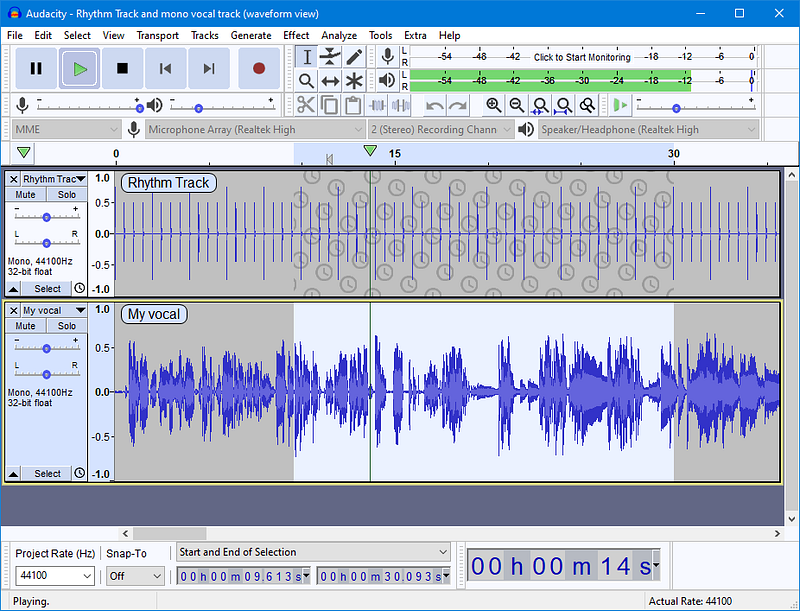
After recording interviewing poets through Zencaster, I pull the raw audio files into Audacity. From there, I listen to the complete audio recording to remove mistakes, extraneous ums and ahs, and overly long pauses. I also look out for external noises (such as the sound of a chair moving or the clink of ice in my glass), which are also edited out.
The final result is a much cleaner sounding file—and hopefully a better experience for the listener.
What I Still Need to Learn
Audacity has a multitude of additional features and tools that I currently don’t understand or use. It would be worth diving into some tutorials and classes in order to further understand my capabilities in working with the program.
Lesson Three: You Can’t Control All the Things All the Time
No matter how much fancy of high-tech equipment you have on hand, things can always go wrong while you are recording. Audio starts crackling for no apparent reason. Your headphones or microphone stop working. The software program crashes, loosing all your data. Technical difficulties are inevitable—and I’ve come across a number of them since I’ve started podcasting.
Working with or interviewing guests presents additional challenges. For example, I cannot control what kinds of technologies that my guests will have access to. If I’m very, very lucky, they will have their own external microphone — however, it’s much more likely that they will only have access to the inbuilt microphone in their computer or headphones. All of which is understandable.
Background noise is also something that the guest cannot always control. Sometimes they have a quiet room to record in. Other times, they may have to record in a shared or public space, in which family, children, or pets may make an appearance. In one case, a fire alarm started beeping just as my guest and I were about to start recording. All their efforts to locate and turn off the high-pitched beeping sound were to no avail. Since we didn’t have another time that we could easily record, we conducted the interview with continuous beeping of the alarm in the background and I did my best to limit its impact on the recording in post.
Another situation I’ve run into was having the internet go spotty, causing the call to continuously drop out. After much struggling, the poet and I completed the interview—only to discover that the software had somehow managed to only record my half of the conversation. As a result, we had to complete the interview over two separate sessions, and I cobbled together the audio files during editing.
Challenges are inevitably going to arise. It’s important to be adaptable when these come and find creative solutions, even if it means rescheduling the interview or scrapping the audio and starting over.
What I Still Need to Learn
Troubleshooting is a skill I would love to further develop—and part of that involves gaining better understanding the various technologies that I’m working with.
If that fails, I would benefit from learning alternative recording methods. Right now, I’m solely reliant on Zencastr. If the site happens to be down or having problems, then I’m stuck. Therefore, having a backup plan for recording (such as using Skype or Zoom for the call session and recoding in Audacity) would be invaluable.
Lesson Four: Develop Your Interview Skills
Prior to joining the podcast, I had been hosting Poet Spotlight interviews on my blog. These interviews were always conducted via email in a text based format. Over time, I learned how to develop better questions for authors, which primarily stemmed from reading and engaging with their books and researching the author’s previous interviews and work.
Switching to the podcast format required a different consideration as to how I handled author interviews. In addition, to preparing for the interview with a preset list of questions, I had to learn to become an active listener, as podcasts lend themselves to a more spontaneous conversational style. I needed to learn how to come up with new questions on the fly, building on what the author was saying.
I also recommend listening to some of your own podcast episodes after they have been published. Not everyone can stand listening to their own voice. But if you can, listening to a few your episodes from the point of view of the audience provides insight into how you perform during an interview or show. One thing I noticed while listening back is that I had a tendency to repeat the same transition phrase over and over between each questions I asked. Realizing that allowed me to switch up my approach in the next interview.
What I Still Need to Learn
Although I feel I have improved since joining the podcast, I can always improve the way I host and develop the casual conversational tone of the interviews. I admire podcasts in which the hosts seem to be able to create a relaxed atmosphere with their guests, one that helps them to come out of their shell.
One way to building this rapport may be to add a video conferencing element to the calls. Up until now, all of the podcasts have been audio only, which can sometimes make it difficult to notice conversational cues, such as when the other person has stopped speaking. Adding a video element may ease some of that awkwardness—or it may add to it. Either way, it would be an interesting experiment to try.
Lesson Five: Be Consistent
Consistency is an important factor in developing your skills in almost any craft. In podcasting, there is the added need for this, as it’s important to release episodes on a schedule, so that listeners know when to tune in. Many podcasts achieve this once a week, while others aim for every other week or even once a month.
Working with the New Books Network, I don’t have complete control over the exact day that an episode is released. Marshall Poe manages a huge amount of podcasts, covering 90+ subjects, disciplines, and genres, and generally releases new episodes in the order he receives them.
My personal goal with New Books in Poetry has been to record, edit, and deliver a new podcast to Marshall at least once a month. Based on my schedule this is a reasonable goal.
In addition to providing listeners with content, I have found that the more consistent I am with recording, editing, and turning in episodes, the more comfortable I am with the process. If too much time passes between recording episodes, I find myself back a newbie-level of nervousness and anxiety that makes it difficult to settle back into the routine.
What I Still Need to Learn
Maintaining consistency has been one of my biggest challenges—and the pandemic years combined with increased personal projects have stressed my capabilities in this regard to an extra degree. I’ve barely been able to put out a handful of episodes over the course of the last year. Therefore, one of my goals moving forward is to develop a routine that will get me back on track with putting out at least one episode per month.
Final Thoughts
Working with the New Books Network, I’ve learned a bit about hosting, recording, and editing podcasts. However, there is so much more to learn in terms of producing and releasing episodes—and podcasting provides so much breadth in terms of the kinds of creative formats, styles, and stories that it can evoke. I aim to continue learning the medium, possibly even launching my own show at some point in the future.
If you are also experimenting with podcasting, I would love to know more about the projects you’re working on and what you’ve learned along the way.