
Five reasons I left my high-paying CMO job to write tech white papers from Italy
How one former Chief Marketing Officer (CMO) is reinventing himself for the post-pandemic economy
Like it or not, the world is changing. Fast. And the marketing employment landscape is no exception, which affects me — a marketing professional — personally.
Here is my account of the radical changes I’m making in my life and career, not just to weather the current storm, but to use it as a catalyst for growth.
It’s more than a pandemic survival guide for marketers or even a personal business plan. It’s a blueprint for finally realizing my dreams. I hope you find it instructive.
Reason 1: Summarily Dismissed
I could say I was let go or laid off, or that my position was eliminated. I could even say it was a reduction in force. But the simple truth is this: I was fired.
On May 8, 2020, two days before my 54th birthday, the CEO founder of the tech startup, where I’d headed marketing for two years, called to break the news. She was very gracious, thanking me for all my hard work, but firmly said it was time for the company and me to part ways.
Never having been fired, I’d always imagined it would be a devastating experience. It wasn’t. Honestly, my ego was a little bruised, but more than anything, I was relieved. After 27 years of continuous employment, I was free.
Nonetheless, my first impulse was to find a new job. ASAP. After years of steadily working my way up the corporate marketing ladder, I thought it would be foolish not to cash in on my experience and salary potential with another job.
My second thought was this: “What if I don’t?”
After a few days of sitting with the idea, talking with my husband and other people I trust, I realized that I have a ton of skills and experience. And I can do whatever I want. Also, I had to admit that I hadn’t been happy at work for a long time. Moreover, the more I thought about it, the idea of polishing up my resume and finding yet another position as a marketing executive made a little ill.
Yesterday, a friend told me that he sees life as something like a “cosmic self-correcting GPS.” You set the destination, and if you make a wrong turn, it will automatically recalibrate to get back on track. I agree.
Reason 2: Everything has Changed
“COVID has changed everything.” You hear that all the time. And there’s certainly a lot of truth to it. But the fact remains that real change — meaningful change — happens on the inside. And so, despite the global timeout that COVID had imposed on us, there seem to be plenty of people who have learned nothing, have reflected on nothing, and continue to barrel ahead undeterred.
For me, being forced to slow down has led to a veritable renaissance of new ideas and projects, as well as a tenfold increase in personal productivity. Indeed, the pandemic has made me question some of the fundamental assumptions about my life, including where I want to live, what I want to do, and how I want to do it. And this reflection has paved the way for several significant life changes. All at once.
As a gay man who grew up outside of Philadelphia, surrounded by what I thought was “tawdry suburban melodrama,” I have always preferred large cities. Not because I’m a snob, but because the pre-internet suburbs were a lonely place for a gay boy.
Big cities offered greater opportunities for employment, community, and companionship. I found that in cities, first in Philadelphia, then in Rome, and then in Washington DC, where I’ve lived for nearly 30 years.
In fact, until this year, I assumed I’d lived there forever, often saying, “I’m going to die in this house.” When my husband brought up the idea of moving someplace more affordable, I’d respond half-jokingly by asking, “Do the liquor stores deliver there?” The implication was that if I were ever forced to live anywhere but a big city, I’d have no friends and nothing better to do than drink.
Thus, until the pandemic came along, city living was non-negotiable. Like my sexual identity and my career, it was one of the fundamental assumptions on which I based my identity.
But just as losing my job allowed me to see my career differently, COVID has allowed me to reevaluate where I want to live. Due to social distancing, many of the benefits of physical proximity that cities offer have disappeared. And some of the significant downsides, like the high cost of living and limited space, remain.
And now, on the employment side of the equation, there are far more opportunities for remote employment; employers have learned that they don’t need the physical presence of their employees.
And on the social side, thanks to virtual conferencing technologies like Zoom, we can keep up with our friends — even having, for example, virtual meals and parties with them. It’s not the same, but still, it’s close. Almost anything we did socially, we can now do virtually. Geo-location now has less relevance.
And recognizing this fact, my husband and I have put our beautiful house in Washington, DC, on the market. For now, we are moving to Rehoboth Beach, Delaware.
Reason 3: Remembering Who I Am
Often, when leading in-house marketing for a company, particularly a startup, the lines between marketing and other roles are blurry at best. By necessity, marketing is intimately involved with the other teams, especially product strategy, sales/business development, and customer success.
When the lines blur too much or disappear entirely, marketing can spend the majority of its time focused on everything but marketing. And lose its ability to be effective. In my case, when this happened at my former company, I eventually, almost inevitably, came to question my abilities.
In the days and weeks after losing my job, I’ve had plenty of time for self-reflection. During this time, I’ve had to come face-to-face with a number of my limitations. I’ve also had the pleasure of acknowledging the value, depth, and breadth of my experience, as well as rediscovering the things I love about marketing.
After taking stock of my core talents, I saw they fall into three categories: 1) creating original content, 2) establishing meaningful connections, and 3) coming up with innovative growth strategies.
In other words, I’m a problem solver. If you hand me a marketing problem, I will come up with a solution. Then, unlike marketers that want to give advice or manage others, I will roll up my sleeves and do the work.
And in doing the work, I draw on a background that is far from ordinary. My first love was fine art, and I was lucky enough to study and work abroad for several years. Unable to make a living at art, I turned to business, first, as a legal assistant and then in marketing.
I earned a master’s in marketing and, after ten years in the publishing industry, another master’s, this one in journalism. Along the way, I consistently acquired new research, writing, and digital marketing skills. In this regard, I’m something of a hoarder. But a hoarder of valuable skills.
Temperamentally, I love challenges. They ignite my imagination, and I love learning and working with others. But it’s also true that I’m no wallflower. I’m outspoken and can be intolerant of mundane ideas, posturing, jargon, and inauthentic people. So be it.
Reason 4: This is not a Dress Rehearsal
In life, as in art, originality and authenticity are rare things. (Despite the capacity people have for both if only they would tap into it.) When I was in art school, my favorite photography teacher often asked, “Does this image exceed your preconceptions on any level?” If not, he said, it was just mimicking something else and not worth discussing further.
My problem with most of the so-called “content marketing” I see these days is that it decidedly does not exceed my preconceptions. It neither surprises nor delights. Nor is most of it valuable or informative on any level. Indeed, all the formulas, including software designed to create content, engagement, and growth, have rendered it all boring, banal, or insipid. In some cases, talented writers and marketers have turned into hacks and shills who do little more than heap digital garbage onto the already teeming landfills of consumer-oriented refuse.
I don’t know about you, but that’s not what I wanted to be when I grew up.
So, with all this in mind, I went back to the drawing board and asked myself what I like to do. And what I want to do next. The answer was simple. I enjoy researching and writing white papers and other useful content. I also love helping others. I especially enjoy using my problem-solving and marketing skills to help entrepreneurs and small business owners realize their dreams.
The way I figure it, I can make a decent, portable living writing white papers for tech companies, and maybe doing some consulting. And thanks to the pandemic, and what I’ve learned from it, I can do that from the beach. And probably, even from Italy.
Reason 5: Italy has Changed
You wouldn’t know it to look at me and certainly not from my name, but I’m of Italian descent on my mother’s side. Also, when I was 20 years old, I went to Rome for the first time, to study art. In truth, I didn’t study and made almost no art there, but I did discover the real art of living. That’s why I fell in love with in Italy.
When I was 23, I moved back to Italy. This time to study Italian with a half-baked idea of becoming an international flight attendant. A crazy idea, since I hate long flights almost as much as the idea of serving overprivileged travelers. After studying Italian for two months in Perugia and meeting only one Italian, I packed up and moved to Rome. There, I was able to find work as an artist’s assistant, living and working alongside Italians. That’s when I really learned to speak Italian.
In pre-internet Italy in the early ’90s, few people spoke English. At the same time, the AIDS crisis was just taking hold in Europe, and everyone was scared. The homophobia was so rampant that even the most flamboyant gays, even in the art community, were closeted. Well-adjusted, openly Italian gay men were as rare as American coffee.
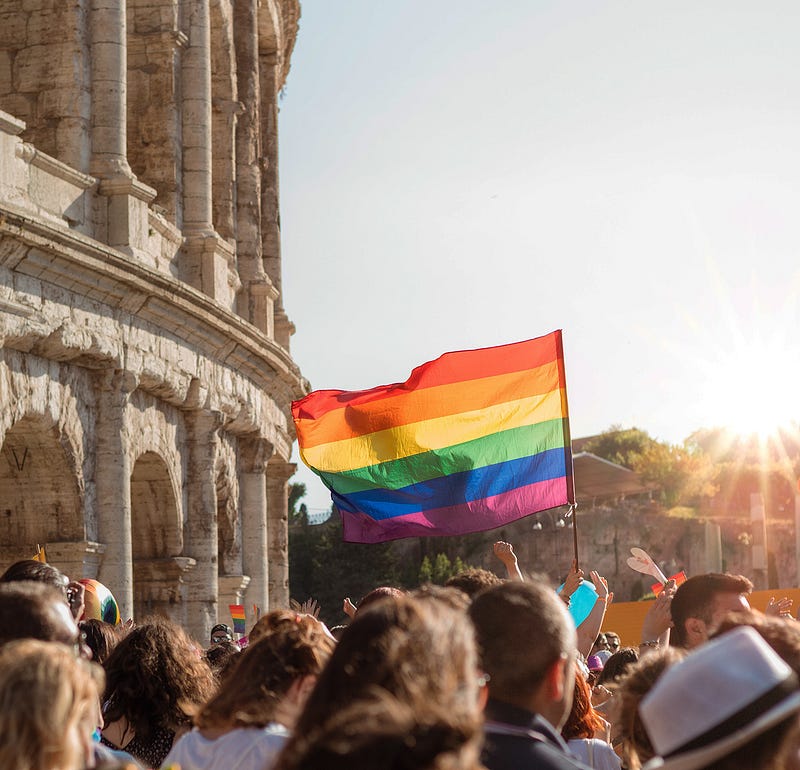
Although I was young and resilient, used to hard knocks, the homophobia nonetheless made me decide to leave Italy. I’ve been back dozens of times since then. In the intervening years, Italy has made massive progress in the area of tolerance and LGBTQ rights.
Thanks to the Internet and social media platforms, an entire generation of Italian LGBTQs has grown up with a much higher level of social acceptance and openness.
For me, everything in Italy is more beautiful, more interesting, and more… distinctly Italian. Beyond all the clichés about food, fashion, history, art, and, yes, crime, Italy is a complicated country. This complexity is evident if you contrast the industry of Milan and the north and then turn your gaze to the slums of Naples or, for that matter, farther south, where thousands of years of peasant culture is alive and well. Italy, on the whole, is like an opulent and wrenchingly sad tragic opera. The beauty of life there is stunning, but at the same time, the sadness of it can make your eyes well with tears.
I could make a list of the many practical reasons my husband and I have decided we’d like to spend part of the year living in Italy. For instance, there’s the climate. And the food. And the cost of living. But the truth is we all have our own happy place. Mine happens to be Italy. With most of the barriers removed, what was once just a dream, may soon become a reality.
As a relatively new writer on Medium, I hope you will join me on new adventures. I love to connect with other writers, content creators, marketers, and free thinkers. My website is goV2b.com.


