
FIVE MINUTE FINANCE: SEC SAYS FTT IS A SECURITY, SBF OUT ON BAIL, INVESTORS & SOCIAL MEDIA
Sign up for The Tokenist’s free daily newsletter and never miss a breaking development in macro finance.
The 5-minute newsletter on the important stuff in finance — explaining what’s going on, and why.
Let’s see what’s going on this week:
- Important Precedent Set by Legal Proceedings in FTX Case
- The Future of Centralized Exchanges Proving Solvency
- Paxful Delists ETH, Concerned with Proof-of-Stake
- Bitcoin Miner Difficulties: Core Scientific Goes Bankrupt
- The Relationship Between Investors and Social Media

SBF’s Top Lieutenants Plead Guilty
- FTX’s Gary Wang, Alameda’s Caroline Ellison Plead Guilty to Federal Charges, Cooperating with Prosecutors (link)
- SBF Released to House Arrest in $250M Bail Package (link)
Copy trading bots from the top traders. Try it for FREE.
SBF Verdict Draws Closer, as Regulatory Agencies Sneak Turf War
After getting extradited to the US from the Bahamas, Sam Bankman-Fried is potentially facing over 100 years in prison for eight federal fraud charges.
To await trial at his parents’ home in California, federal judge Gorenstein granted SBF the largest pre-trial bail in legal history: $250 million.

FTX founder Sam Bankman-Fried goes home after arraignment in New York City on Thursday. Image credit: ED JONES/AFP via Getty Images
Only a fraction of the bail collateral (bond) had to be secured, and it was, thanks to SBF’s well-off parents and two other wealthy backers. With stakes so high to secure the verdict on “a fraud of epic proportions”, as told by Assistant US Attorney Roos, turncoat deals were also secured.
Caroline Ellison (Alameda co-CEO) and Gary Wang (FTX co-founder/CTO) pleaded guilty on the biggest hits: conspiracy to commit wire fraud, wire fraud, conspiracy to commit commodities fraud, and conspiracy to commit securities fraud. Their pleas were signed on Monday.
Separately, both the Securities Exchange Commission (SEC) and the Commodity Futures Trading Commission (CFTC) filed complaints on the plea-bargained duo. Outside of counting charges and the jail time received by the FTX/Alamada miscreants, there are some even more important developments for the crypto space.
It turns out, the SEC classified FTX’s native FTT token as a security.
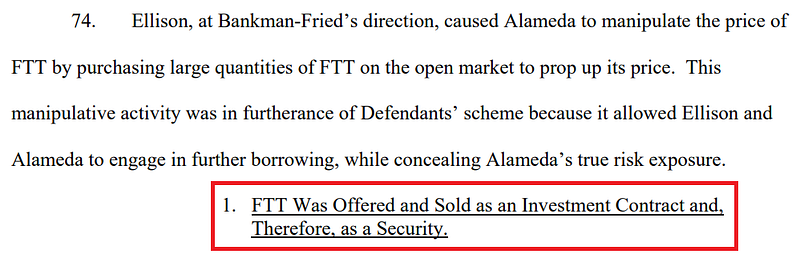
Like retail chains issue coupons, centralized exchanges (CEXes) typically have these tokens as discounts on trading fees, thus incentivizing users to trade more on that particular exchange. Often enough, users simply hold CEX tokens to boost the exchange’s liquidity in return for a small yield.
Across all exchanges, CEX tokens are worth ~$48.3 billion, with Binance’s BNB token holding 81% of that value. Now that the SEC declared the deceased FTT token as security, it creates a new source of insecurity (pun intended) for venture capital firms, social media influencers, and others who have promoted CEX tokens.
But also for more decentralized tokens that could fit the securities mold. For instance, the SEC won a case against LBRY file-sharing blockchain, powered by LBRY Credit (LBC) tokens.
The company is now offering a $20 million reward to the SEC if they can clearly explain how to launch a public blockchain without being punished.

On the other hand, in its complaint against the fraud duo, the CFTC declared Bitcoin, Ethereum (ETH), and stablecoin USDT as commodities.
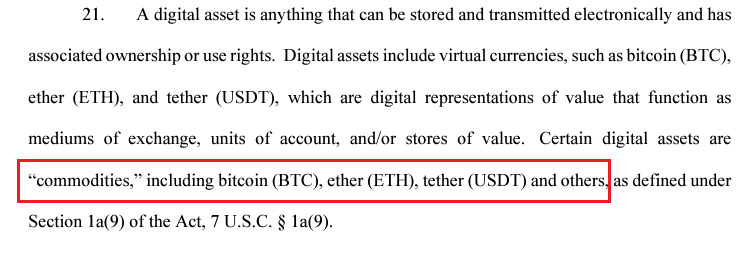
Previously, the SEC Chair, Gary Gensler, had hinted that ETH is also a security, just like FTT.
“The investing public is hoping for a return [on ETH], just like when they invest in other financial assets we call securities,” -Gary Gensler on CNBC’s Squawk Box.
The battle to dominate digital asset realms has been a long-standing one. For 2022, the SEC received a $2.69 billion budget. In contrast, the CFTC’s budget is 7x lower. Therefore, acquiring an entirely new asset class to regulate could translate to huge potential for the agencies’ growth.
We are yet to see which agency will prevail, and if this will be done through legal precedents, passed laws, or some feedback combination of both.

How Can Centralized Exchanges Prove Solvency?
- How Bank Runs Became the Ultimate Proof of Reserves for Exchanges in 2022 (link)
Going Public, Going Proof-of-Reserves, or Going Bank Run?
After losing customers’ funds totaling some $8 billion, SBF helped enrich the crypto vocabulary — through the concept of proof-of-reserves.
It was the first band aid to the gnawing question — how can the industry grow without knowing where the next FTX is lurking?
All the big centralized exchanges, Binance, Kraken, BitMex, Gate.io, Coinfloor, HBTC…rushed to prove their reserves, so as to show to the public they are not a hidden FTX. In simple terms, users could verify their funds through Record IDs, thus accounting for their balance within the exchange’s own total balance.
In turn, the exchange’s balance could be verified by third-party auditors. Paris-based Mazars auditing firm did that for Binance, by executing transactions across its wallets. However, these were just agreed-upon-procedures (AUPs), not full audits.
As such, AUPs can’t show if users’ funds are tied to exchange’s liabilities. And liabilities are, well, incredibly important when it comes to the solvency of an exchange.
Moreover, even if users’ funds are 1:1 backed, who is to say they cannot be funneled out at any moment, just like SBF did from FTX to Alameda? Only a thorough audit would tell who controls users’ private keys. An audit could determine the wallet address of an asset — but what about the location of its private key?
It is for this lack of true proofing that Mazars ended up exiting the crypto space, having withdrawn Binance’s AUP audit.
“Mazars has paused its activity relating to the provision of Proof of Reserves Reports* for entities in the cryptocurrency sector due to concerns regarding the way these reports are understood by the public,”
Armanino, in charge of auditing FTX US and Kraken, had also quit the crypto field. Rendered less credible, proof-of-reserve backtracking resulted in a lot of Binance users questioning the solvency of Binance. The result was a liquidity stress test for the world’s largest exchange, in charge of 75% of global trade volume.
Akin to a bank run, Binance users withdrew $6 billion worth of crypto funds. But it was a short-lived one, now halted, with Binance now holding $54.7 billion worth of assets.
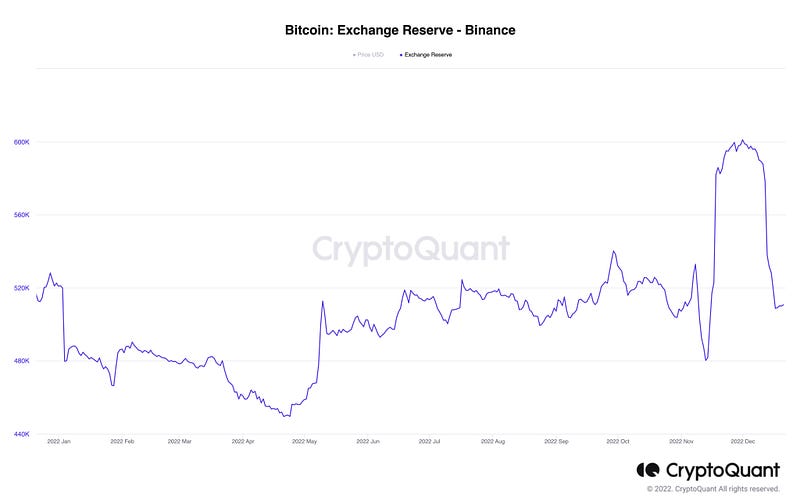
Despite sharp selloffs this month, on a 2022 timeline, not much has changed for Binance’s bottom line. Image credit: CryptoQuant
Without accounting for liabilities and private key oversight, proof-of-reserves is now less in vogue.
So what’s the alternative? How can crypto users know which test will prove the solvency — and trustworthiness — of a centralized crypto exchange? For the time being, it appears as though a bank run is the only real test out there.
The alternative is going through the costly and lengthy process of becoming a publicly-traded company in the US. Coinbase (COIN) went through it, subject to required annual full audits, and quarterly financial statements.
It’s safe to say that BlackRock picked Coinbase for this very reason, as a crypto entry point for institutional investors.

Paxful Removes ETH, Citing Proof-of-Stake Concerns
- Peer-to-Peer Crypto Marketplace Paxful Removes ETH From Platform (link)
How Will the Crypto Market Respond?
Do you remember when Elon Musk tweeted, on May 13 2021, that Tesla suspended Bitcoin payments?
BTC price dropped by 30% that week, from $56.7k to $43.4k. It wasn’t just the canceled BTC integration that was the culprit but largely the reasoning for it. Musk implied that Bitcoin’s proof-of-work is too energy intensive and not green enough — implying Bitcoin has an obvious conflict with Tesla.
Therefore, Musk implicitly said that Bitcoin has no future until this changes.
A similar dynamic is now happening with Ethereum. For the first time in crypto history, a major crypto company pulled back from the cornerstone of decentralized finance — Ethereum (ETH).
The CEO of Paxful, Ray Youssef, removed ETH from the company’s marketplace, citing “economic apartheid”, which is propelled by Ethereum switching from proof-of-work to proof-of-stake.
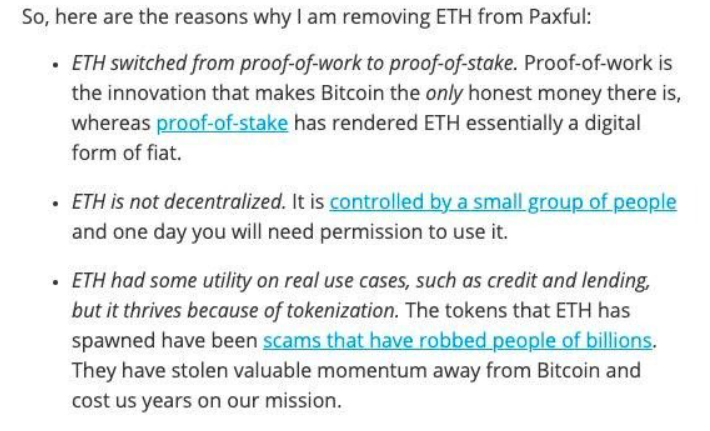
This reasoning is in complete contrast to the energy and environmental concerns surrounding proof-of-work vs. proof-of-stake, as the latter typically requires 99% less energy.
To illustrate this PoW vs. PoS kerfuffle, Greenpeace environmental group launched a $1 million campaign to turn Bitcoin to proof-of-stake and to effectively deplatform BTC from institutional investors.
Bitcoin proponents claim that the energy cost is worth every penny because staked blockchains, in which energy is replaced with capital, are more susceptible to centralization and control.
A report from Kraken calculated that a PoS network worth $100 billion could be overtaken with an entity holding a $33 billion stake (33%). Right now, Ethereum’s TVL (total-value-locked) is $29.8 billion.
Ray’s Paxful is a peer-to-peer trading platform, having traded $35.1 million last week. With ETH removed, Paxful is now offering trade in just three coins — Bitcoin and two stablecoins (USDC and USDT).
The market responded with a similar ETH dip we’ve seen when Musk tweeted about Bitcoin. However, Ray’s influence doesn’t appear to have the same depth and staying power.
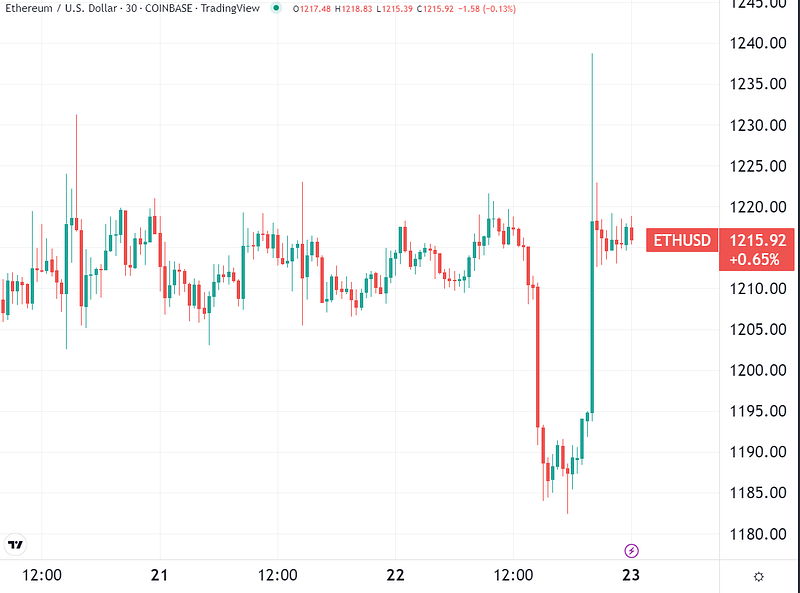
Following Paxful’s ETH withdrawal on Wednesday, ETH price briefly dropped -2% the next day. Image credit: Trading View.
Nonetheless, Ray broke the staked wall with this decision, as the first company to go against the prevailing narrative.
It remains to be seen if other market participants will follow Paxful.
Year-to-date, both BTC and ETH have performed neck-and-neck, having lost 64% and 66% of value respectively.
Enjoy 5MF? Click to forward it to three friends.

Bitcoin Mining is Deep Into Crypto Winter
- Core Scientific Files for Bankruptcy as Crypto Winter Bites (link)
- Why 2023 Will Be a Test of Resilience for Bitcoin Miners (link)
Core Scientific Bankruptcy, How Bitcoin Mining Will Respond
One of the largest Bitcoin mining companies in the US, Core Scientific (CORZ), just went bankrupt.
This wasn’t really a big surprise. In October, CORZ shares plummeted by 76% when the company announced it suspended principal and interest payments.
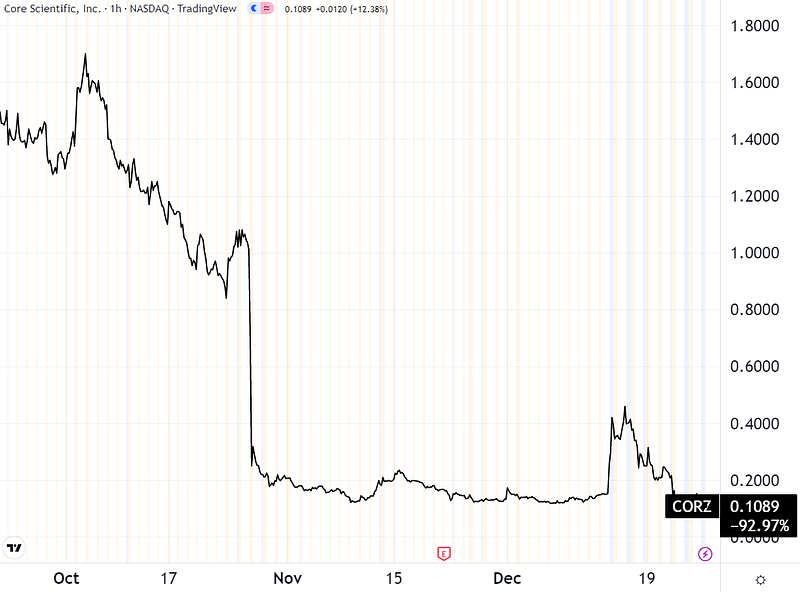
B. Riley Financial’ $72 million injection last week didn’t cushion CORZ’ fall. Image credit: Trading View.
Even before that, it was clear that Core Scientific wedged itself between expanding mining operations and paying off liabilities. When the bear market hit in May, and BTC price fell, CORZ was the biggest BTC dumper, having sold nearly 10,000 bitcoins.
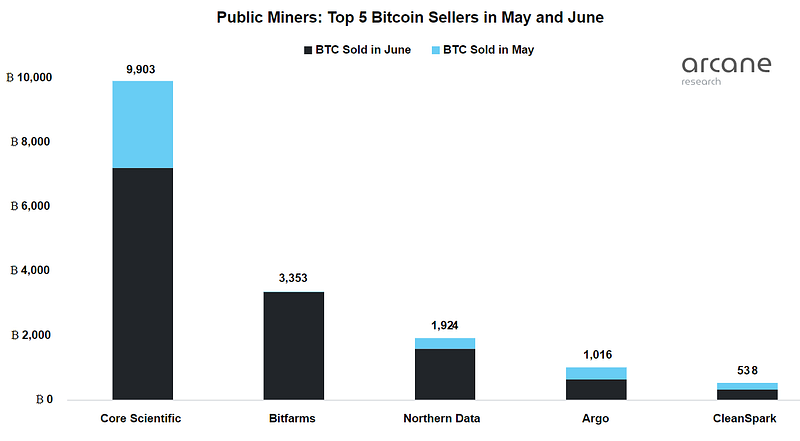
Image credit: Arcane Research
In its bankruptcy filing, Core revealed a $434.8 million net loss for Q3, left with merely $4 million in liquidity. This is more than Core’s still unpaid debt from bankrupted Celsius Network at $7 million.
Will other Bitcoin mining giants go under as well?
It depends on their liabilities. Riot Blockchain plans to expand further, from present 7.7 EH/s to 12.5 EH/s next year. Likewise, Marathon Digital is aiming for 23 EH/s from the current 7 EH/s. To contextualize these numbers, 1 exahash (EH) equals 1 million terahash, representing the invested computing power (and security) in the blockchain network.
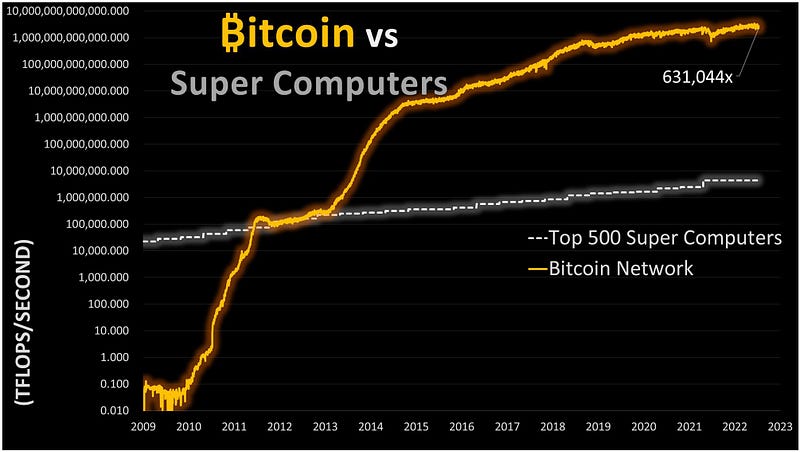
Bitcoin network’s computing power measured against super computer power. Image credit: @blockbain
This makes the Bitcoin network the most secure payments/storage system in the world. But how can this security continue if there is danger of mining companies going bust?
Such a scenario is integrated into Bitcoin’s code. To understand how, we have to get a little technical.
Bitcoin Mining Lesson Incoming
Obviously, if the BTC price drops, Bitcoin miners receive less money. The current block reward is 6.25 BTC (~$104k), with the block consisting of hundreds of processed transactions.
In a hypothetically free market in cyberspace, miners compete between each other to validate these transaction blocks. The higher their hashrate power, the higher the likelihood they will solve resource-intensive mathematical equations to be rewarded with the ability to verify transactions on the network — and subsequently earn block rewards. But as miners invest more hashing power, the difficulty of those mathematical problems (and likewise receiving rewards) goes up, creating a competitive environment which was originally designed to prevent centralization.
Miners are then faced with decreased profits, in addition to lower BTC price, despite feeding the network with the same computing power (which requires a costly amount of energy). Inevitably, this dynamic causes miners who cannot maintain unprofitability for long to unplug. In turn, this lowers the total hashing power of the network.
And with lowered hashing power, Bitcoin mining difficulty also drops. Specifically, this is auto-adjusted every 2,016th mined block, or about every two weeks.
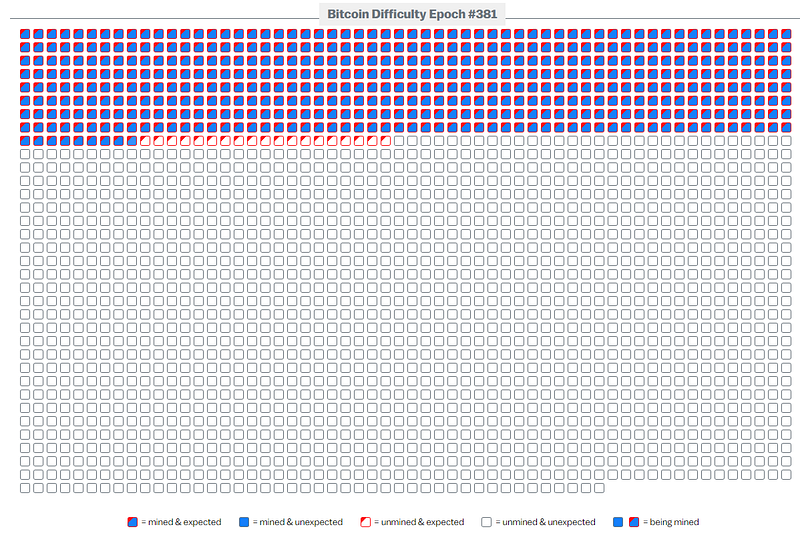
After 13 years since Bitcoin launched, we are in the 381th difficulty epoch. Image credit: bitrawr
In short, the Bitcoin network auto-aims for the equilibrium to maintain a 10 min average block time. If blocks are mined faster than that, difficulty increases. And if it takes longer than 10 minutes, the difficulty decreases.
In the worst case scenario, if more miners unplug (go bankrupt), this automated elegance then drops the cost of mining itself. Miners who have stayed in the game then receive a burst of profits, as we have seen with previous cycles.
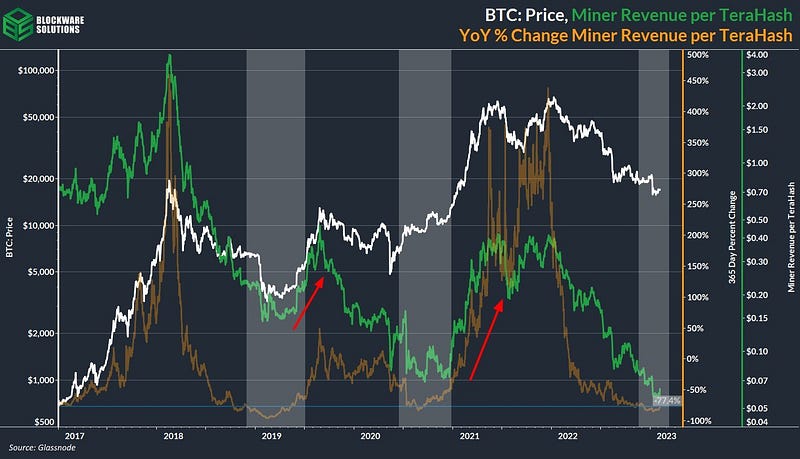
Between cycles, miners shore up and streamline their operations. Image credit: Blockware Solutions
In short, the trick in Bitcoin mining is to not overextend with debt during a bullrun, for buying more cutting-edge mining rigs. Rather, have enough liquidity to stay the course in a bear market.
This is clearly easier said than done though, as we’re seeing with Core Scientific.

Easier Trading = More Risk-Taking
- Young Investors Prone to Risky Investments, Rely on Social Media for Tips: Survey (link)
YouTube and Reddit are Now the Leading Sources for Financial Tips
When it comes to youth, folklore is divided between two adages. On one hand, “youth is wasted on the young” seems fertile. But on the other hand, “youth is the time to take risks”, is equally wisdom-worthy.
The latest FINRA report clearly outlines younger investors as hungry for gains, the sooner the better. Covering ~30k respondents, the survey shows younger investors (18–34) as more likely to engage in risky trades than the older age group (35–54):
- Higher option/margin trading, at 36%/23% vs. 21%/12%
- Higher interest in risk-on assets like cryptocurrencies, at 62% vs. 41%
- Higher interest in “meme-stock” trading, at 39% vs. 19%
- Higher risk-taking for substantial returns, at 24% vs 13%
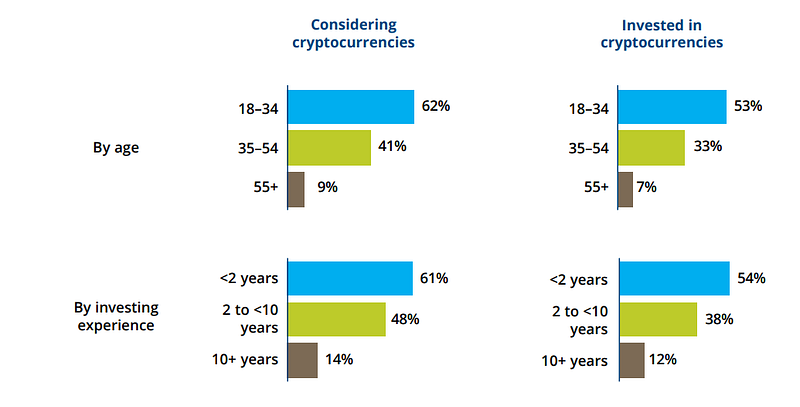
Younger investors prefer more volatile assets for potentially quicker gains. Image credit: FINRA
The 18–34 age group overwhelmingly prefers mobile apps, at 78%, while also having the most diversifying sources for financial tips, at 67% for 6 or more different investment sources.
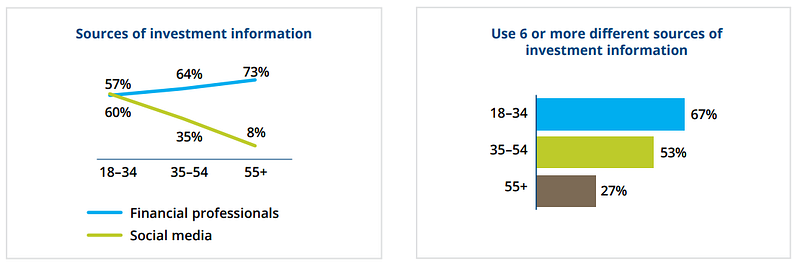
Overall, Youtube is the leader in investors of all ages for financial tips, followed by Reddit, Facebook, and Twitter.
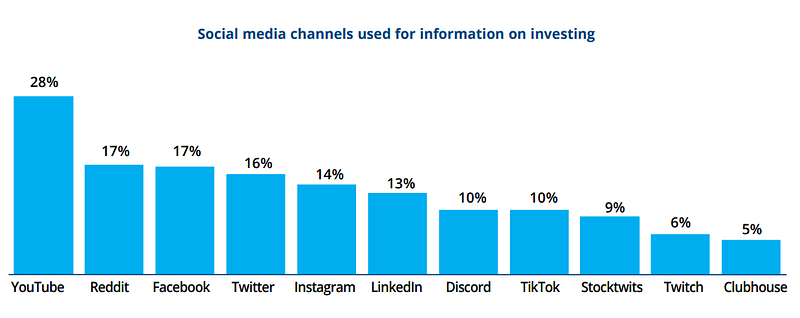
For young investors (18 -34), Youtube’s leading role is even more pronounced at 56%, while Reddit takes second rank at 41%.
This is to be expected given the fact that Reddit’s legendary r/WallStreetBets grew to 13.3 million users in the last two years, after it took 9 years to grow to 1 million just prior to the GameStop/AMC short squeeze in January 2021.
Unfortunately, diversified social media channels have their work cut out for them in the education department. Of all age groups, the 18–34 bracket is the least likely to correctly answer financial quizzes.
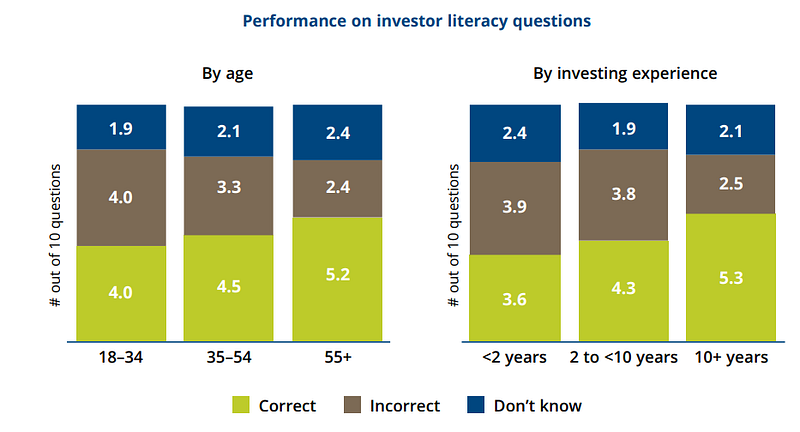
Males are more likely to have higher financial literacy, having answered correctly 5.2 questions out of 10 vs. females at 3.9 out of 10. However, those who have over $250k portfolios have the highest hit-rate, at 5.3 correct answers.
What’s clear with the younger demographic is that — despite the fact that we’re not all really gonna make it and stonks don’t actually only go up (as we’ve learned in 2022) — social media and trading are continuing to merge closer and closer.
Tweets of the Week
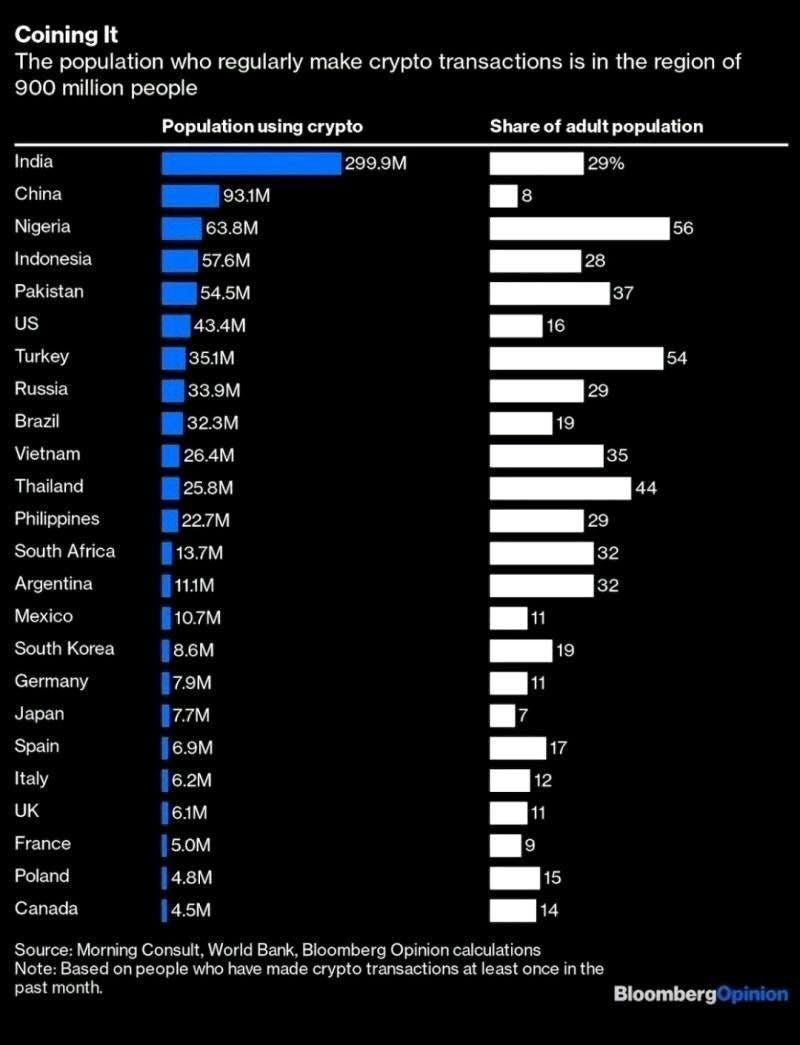
“Crypto is dying”
Well, 900m+ people would disagree with you.
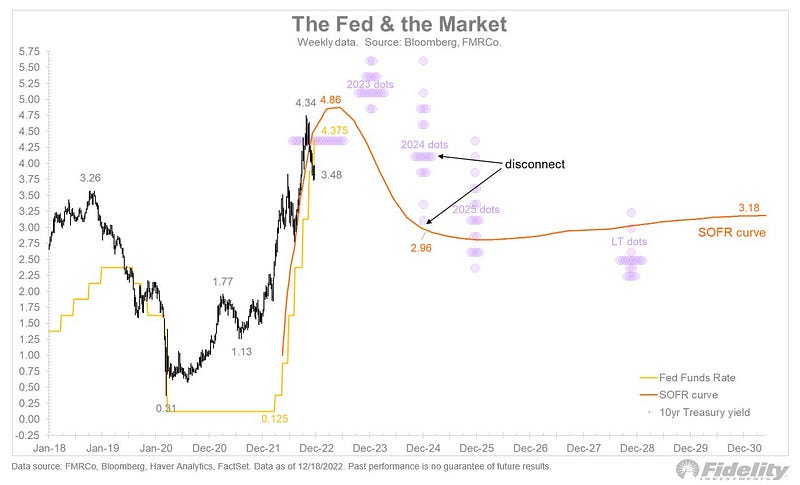
The market is expecting the Fed to take rates up to 5%, and then almost immediately start cutting them, all the way back to the neutral zone of 3%. Is this a reasonable expectation? 🧵

A demographic catastrophe.
The US, Europe, Japan & China make up ~70% of global consumption.
The prime-age population in these major regions has started to decline and won’t rise again for many decades.
This is the biggest (long-term) driver of demand destruction.

📉The Demographic Decline of America.
For first time EVER, there’s more People Living Alone (37.9M) than Households with a Child (33.9M)
BAD NEWS for future of Society and Housing Market.
1. Something strange is happening — people are starting to borrow from the Fed!
This only happens in moments of significant liquidity stress — like 2008 or 2020.
But supposedly the market is “awash” with excess liquidity right? So what is going on?👇👇
Join Five Minute Finance Newsletter.



New to trading? Try crypto trading bots or copy trading