
Writing prompts
Five Cherished Reads Of 2021
A look back at some of the books I read last year
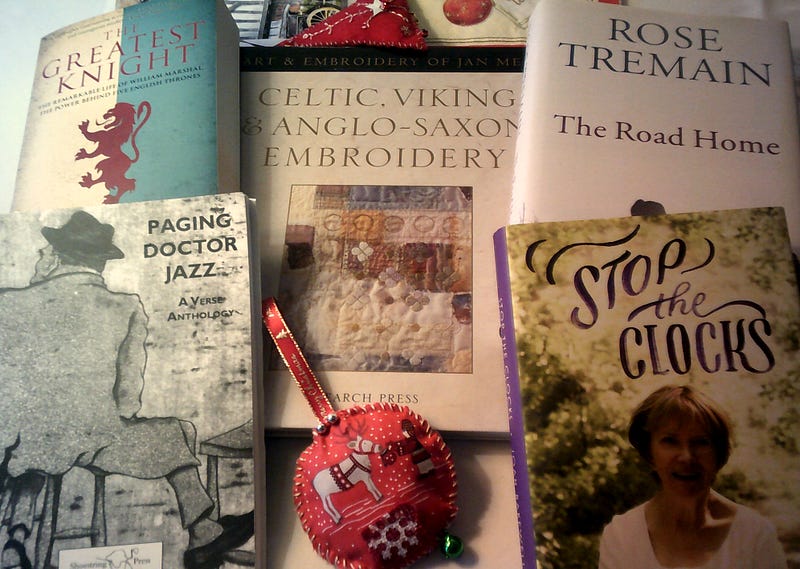
Ellie Jacobson at Flint and Steel asked what our most cherished reads were for 2021. I tend to read biographies and rock music, but there were reasons why I widened my choices last year– research and visiting historic sites and shrines in Britain. These are my cherished reads.
‘The Road Home’ Rose Tremain Published by Chatto & Windus, 365 pages This is a moving story about loss and grief. A man whose wife dies, has no work in his own Eastern European country, and who relocates to England to make a fresh start.
Although terribly homesick, still mourning his loss, and ill-prepared to make the transition, he remains positive about every day. He finds work in a new trade, slowly learns the language, and moves forward each day, planning his future. He makes friends, finds lodgings and a new girlfriend. He overcomes every obstacle, never loses faith, living his new life with meaning.
Tremain’s writing seems effortless, and from the first page, I found myself immersed in her world.
A truly incredible book about a man whose focus is providing for his family and doing the best he can despite all the hardship he has endured. It is a story about choices, and the best book I’ve read in quite some time.
‘Paging Doctor Jazz — A Verse Anthology’ compiled by John Lucas Published by Shoestring Press, 114 pages The introduction tells how Jazz became more popular in Britain as a result of American servicemen bringing their records and instruments with them during the period of the Great War (1914–18), and how the music evolved afterward, often with much opposition.
In 1922 the Welsh tried to ban its spreading menace with a headline: “Welsh Invoke Curfew Laws As One Way To Stop Jazz.”
In 1955, when Englishman Humphrey Lyttelton’s band turned up to play at Birmingham Town Hall a banner read — ‘Go Home Dirty Bopper’ — because alto-saxophonist Bruce Turner played in the style of America’s Johnny Hodges.
100 poems speak about the American and British greats — from Bix Beiderbecke, Fats Waller, Louis Armstrong, Charlie Parker, to Acker Bilk and the Trad Jazz Scene of the 1950s.
The musings evoke a state of being in some dark smoke and alcohol-fuelled jazz club, where only the lonely, or the dedicated disciples of the beat go in the wee small hours to come alive when the day is done.
A taster. Matt Simpson describes Julie London’s voice in ‘Only A Thimble’…. “A molten mezzo with a sixty-a-day come-hither voice.”
‘Stop The Clocks — Thoughts On What I Leave Behind’ Joan Bakewell Published by Virago Press, 296 pages Joan Bakewell is a writer, an outspoken political commentator, and mad about the arts. Educated at Cambridge University, she has been a copywriter, studio manager, journalist, and has written four radio plays. Now in her 80s with over fifty years of experience in radio and TV broadcasting, she is still working.
A Member of the House of Lords, Baroness Bakewell of Stockport (Manchester) is the British government’s Voice of Older People.
The book is a reflection of her life, all that she has lived through, getting old, and looking back on British history during her lifetime. The changes that affected her, and the nation over the decades, and what she will be leaving behind when she dies.
I enjoyed her candid view about tackling old age, and the advice she offers. It wasn’t depressing, was an easy read, and a page-turner.
She begins her book — “I am one of the oldest people I know. My generation is dying off, moving over to make way for the next…”
‘The Greatest Knight’ Thomas Ashbridge Published by Simon & Schuster, 444 pages William Marshal (born 1146 AD) has been dubbed “England’s greatest knight” — and probably the most loyal. He served five English kings from Henry II through to his grandson Henry III and was 72 years old when he died.
He rose through the ranks, becoming a celebrated tournament champion, baron, politician, and, ultimately, regent of the realm. He was made the Protector of the Kingdom (of England), regent for the young King Henry III of England.
In 1217, as a 70-year-old he had to fight in the frontline and win the Battle of Lincoln against rebellious English barons and their French ally, the future King Louis VIII.
He had helped negotiate the terms of the Magna Carta, the first bill of rights in 1215. His actions saved England from civil war and set us onto the road of who we are as a nation today.
‘Celtic, Viking & Anglo-Saxon Embroidery’ Jan Messent Published by Search Press, 144 pages A colourful introduction to the art and embroidery of the period, Jan takes the reader on a brief historic survey and appreciation of the artistic style from the 5th — 11th centuries AD and the Domesday Book era of 1068AD.
A member of the Embroiderers’ Guild, Jan uses this book as a ‘How-to’ guide, showing the reader examples of textiles she has created and how to make them. A plentiful supply of colour photographs shows what textiles, beads, threads, and other items she used for her creations — anything from scissor and needle-cases, book coverings, purses and pouches, to how to make a Bayeux Tapestry box, decorative cushions and wall-hangings.
My textile group has not met up for over a year, but now Lockdown restrictions have been eased in England, we hope to meet up sometime in the New Year. Jan Messent’s book has given me a lot to think about and trying to aspire to her level will be quite a challenge.
Thanks to Ellie Jacobson for gifting readers and writers the Flint & Steel publication.