
Five Books Lose to a Procedural Coup
What Actually Happened in the MATSU School Board Meetings
My attention was drawn to an article a friend shared on Facebook this morning, coming from NBCNews.com with the eye catching headline “Alaska school board pulls ‘Great Gatsby’ from curriculum”. The headline makes it feel like a small town sensation with a big name book, but the actual story has broader implications, and points at deeper issues that go beyond whether an book that’s almost 100 years old should be studied or not. What these actions mean, and how this came about are both causes for concern, and I will devote some time to explore this in a forthcoming article.
Here, however, I want to examine what actually happened there, and explore in short why the procedure used is problematic. First let’s take a slow and painful look at what actually happened — the information is comparatively simple to access, and it tells a story in itself. And if you find yourself wanting to claw your eyes from their very sockets (and you probably will), please, just skip to the last paragraphs at the three magic dots.
Let’s join the story at a routine meeting of the School District Board held in Palmer AK (and over phone conference), on April 8th. The matter of approving the High School English Elective Curriculum and Reading List Part I came up on the agenda (1h56 on the video). Fairly routine, the most controversial thing I noticed was how much the College Board seems to like the poetry of Matthew Arnold. A Powerpoint was presented by Assistant Superintendant of Instruction, Amy Spargo, exploring the how and the why of developing that curriculum. It is a carefully considered list, if a little bit disappointing in terms of diverse content — which they acknowledged. This proposed curriculum had been discussed with school stakeholders, was approved by the MatSu Borough School District Program of Studies, and was largely unchanged from the ones taught in previous years. It is the kind of section that you expect to be a simple rubber stamping. There was to be one meeting to hear the presentation, and the following week a vote would be conducted, and so for all the electives that were to be discussed in the forthcoming weeks.
In the Board’s discussion after the presentation, however, that things take a turn. Ryan Ponder was first to speak, concerned that the poetry might be too deep for High Schoolers — somewhat understandable. He then asked why the New York Times was being used as resource for journalism and for creative writing classes, “instead of something more fair and balanced”. Mr. Ponder appeared to have initially missed the other local media sources listed, and continued to demonstrate his great concern over the influence of the New York Times, as well as his concern that the Board would be responsible for any new items on the list.
Next up was a question from Jeff Taylor about the challenging or controversial nature of some of the books listed. Asked by Board VP Jim Hart for a list of the controversial topics, the Ms. Spargo listed five books:
Catch 22 — Joseph Heller The Great Gatsby — F Scott Fitzgerald Invisible Man — Ralph Ellison I know Why The Caged Bird Sings — Maya Angelou The Things They Carried — Tim O’Brien
Ms Spargo promised to send a document exploring these controversies to all on the Board. Mr. Hart followed up asking why it needed to be a one week turn around on these reviews, not two. Ms Spargo’s answer was the schedule was necessary to provide an opportunity for the Board to individually consider all of the electives. Mr. Hart continued that that it was too quick a turn around, and that people wouldn’t have a chance to have time to review the materials being discussed. Board member Dr. Sarah Welton noted it had earlier been said that the list of novels were shared with parents, and other stakeholders in January. Ms Spargo noted that stretching it to two weeks would not be sufficient to cover the material either. In the end, without any further discussion or the need for a vote, it was accepted that all elective votes would take place two weeks after the initial presentation, pushing the vote on this until April 22nd.
Jump forward two weeks to the meeting on April 22nd. Once we get to the matter of the English Elective Curriculum, Dr. Welton starts by seeking clarification from Ms. Spargo that it is the New York Times’ curriculum for high school classes (The Learning Network), not the newspaper itself that is being used. Mr. Ponder once again asked about New York Times articles being used in the curriculum, followed by Ole Larson asking the same question but slightly differently — both times, Ms. Spargo’s response was essentially that there are examples from the NYT in the materials, and but they are not required to use them. She noted again that there was more than one media source included in the list. It was clear that none of her responses were adequate for Mr. Ponder, as he asked once more, concerned that it was also being used in creative writing.
Next up was controversial books, a concern to Mr. Taylor, who would rather that books with controversial subjects were not in a curriculum. Ms. Spargo explained why those books were chosen, arguing that the proposed curriculum allowed for higher order thinking and critical examination of these works as a portal to understanding that not everyone thinks the same — with a discretionary choice given to parents to overrule the chosen book. She also noted that the greatest number of objections from the public on any of the electives was over the use of The Bible for Literature and History. Mr. Taylor remained unconvinced. Board VP Jim Hart spoke of his research into the books, and how three of the books were probably PG13, but I Know Why The Caged Bird Sings and Invisible Man were too much. In particular, he drew attention to references to incest he had read in the Cliffnotes (he referred directly to reading the Cliffnotes — presumably the extra week he had asked for was not enough time for him to do the actual reading). He also tracked his concerns about being brought into the Equal Opportunities office if he read them at work. For contrast, he spoke of the Bible as literature as controversial for the religious reasons, but it was a choice you went into with both eyes open. Presumably he is as unfamiliar with the fact that these works are also listed as electives, as he is unfamiliar with Genesis Chapter 19, particularly from verse 30 onwards.
The Board President, Thomas Bergey, asked for clarity on the opt-out option with this elective, to which Dr. Welton said that these courses will only be offered if enough people want them, and that at any point the student’s parent can object to a book and another would then be offered in its place. Mr. Larson jumped back in with his concern that many of the parents would just agree to the course, and not bother to read the books in question. He also referenced the previous example of “a heck of a controversy” last June over a teacher who had made “a poor choice” in some of the books he had used in class.
That story was of the objections of a few (Mr. Bergey, Mr. Larson, and Mr. Ponder), to the teacher in question — Jason Marvel — being selected by the District Superintendent of Schools as the next principal of Wasilla High School, an appointment these board members sought to rescind. His promotion was questioned in light of complaints from 2004 and 2010 about his choices for reading material in class — Blindness by Jose Saramanga, and a quote on a Jimi Hendrix poster. The appointment was upheld, but it certainly has not been popular with Mr. Larson, Bergey, or Ponder.
Mr. Hart came in again at this point, arguing that if he were to read these books in the workplace, he would end up in court. He spoke a lot about the professional environment, and seems to think that these electives are conducted to prepare people for the workplace. After him, Mr. Ponder was there to talk of everyone’s trust in each other, and generally say nothing in a lengthy fashion, before again raging on about the inclusion of the New York Times on the curriculum.
Dr. Welton, one of the two dissenting members of the Board, came to speak of the importance of quality learning materials, including the New York Times. She continued on to the value of talking about the issues that crop up in these books, not least the importance of giving children the opportunity to know that they are not alone. And of course, to respond, Mr. Ponder came back in to ensure that we knew his problem with the New York Times was still present, but exclusively for its place in the Creative Writing course, not the journalism one. He also complained about the lack of parent involvement, and how these elective courses were being forced on everyone.
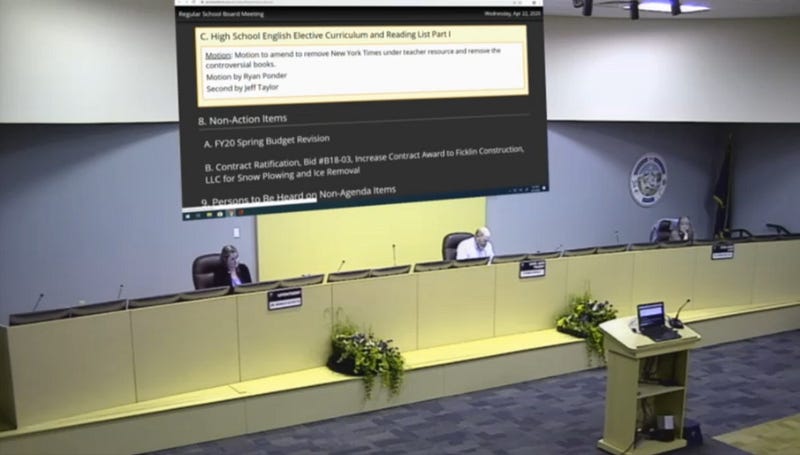
Mr. Larson and Mr. Taylor supported the idea of an amendment, and Mr. Ponder moved to remove the five books and the use of the New York Times as a mentor text and resource under Creative Writing. From here, it was just 2m30s to the conclusion of a vote on the amendment. There was a call for public comment, which drew no response, and then for Board discussion (there was none), before moving to the vote. The amendment was approved on a 5–2 split, only Dr. Welton and Mr. Kelsey Trimmer dissenting. Moments later, the Board unanimously approved the remainder of the curriculum.
And so, certain books and a free online resource are removed from a curriculum. All appropriate procedure was followed, and everything smacked of careful bureaucratic democracy. It ran almost as tediously and drama free as these meetings should do. But the holes in this due process were manifest throughout. I noted the urgency to delay the vote by a week in the first meeting switched practically to a race to a vote on an amendment when the chance arose.
Particularly duplicitous was the call for Public Comment. During this part of the meeting, it appeared that there were a total of 4 in the room, including the Board President Mr. Bergey, Assistant Superintendant M Spargo, Dr. Walton, and a representative from Ray Associates taking minutes. This is to be expected for such meetings during this Covid-19 crisis. Damningly, at the beginning of the meeting — the third point on the agenda — it was noted that, under emergency measures, “School Board meetings will be held telephonically and there will be no physical access to the building”. The minute reads on “Members of the public wishing to provide testimony telephonically must sign up no later than 3pm the day of the meeting”. Any public comment on this amendment would have had to be signaled before 3pm that day, and if we accept that the amendment occurred organically during the meeting, then there was no opportunity for public comment — Mr Bergey’s request was simply ticking a procedural box. When there was such concern two weeks before over the speed at which it happened, where was the concern to allow time for consideration of the amendment here?
Ultimately, by the time the vote comes, it is a foregone conclusion. When Mr. Bergey asks for further Board discussion, he is met with silence. Mr. Trimmer and Dr. Welton, the two holding out against the excision, have nothing left to offer. And what would have been the point in continuing the debate anyway? Expert testimony and experience based knowledge submitted by experts responding to the questions — from Mr. Ponder in particular, and Mr. Taylor and Mr. Larson were not deemed acceptable, and any refutation to the unsubstantiated concerns were disregarded before — why would it change this time. Mr. Hart had asked for the extra time to examine the books in more depth, but the moral outrage he felt at two of the books was in his own words based on Cliffnotes. And even though he deemed the other three to be PG13, he made no attempt to defend them when they were lumped in with the two he took issue with.
It seemed as though at least four of the five who voted for the amendment had made their decision before the meeting, and they came to win the debate, rather than learn from it. When it came down to it, over the two meetings, Mr. Ponder only raised concerns about the New York Times app the Learning Network, but was happy to ditch the five books. Mr. Larson and Mr. Taylor did not seem fussed by the Learning Network, but supported that being removed. Mr. Hart clearly said that three of the five were not a problem, but supported the removal of all five.
A large part of the implementing of this Not-A-Ban was ensuring that everything was done to the letter of democratic procedure, but did it reflect its spirit? Maturely applied democracy is at the best of times a difficult thing, where we try to ensure that we are doing the best we can to offer the most good for the greatest number of people, and the least harm for the rest. Arguably, if it is done well, most of the time we are saddled with at best consensus, and on average the faint disappointment of compromise. To achieve these indifferent outcomes, we have a responsibility to do our research, to take the tedious advice of experts, and to read the important things we don’t want to. If we coast along on the Cliffnotes version of it, we aren’t trying hard enough, and are probably more focused on not being caught treating it like a game to win or lose.
There is a follow up to this story entitled “When Books Are Pawns”


