
Situational Note-taking: First-order Analysis and Second-order Analysis
A short note (Sept 25, 2023)
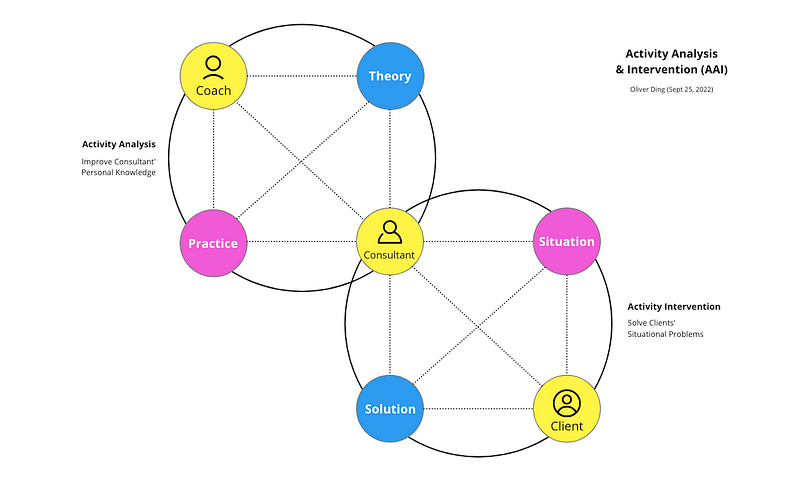
Today I am working on making a model for the Activity Analysis & Intervention (AAI) project.
The above logo was designed on September 12, 2023.
The idea of “Activity Analysis & Intervention (AAI)” was born on July 15, 2022. It was inspired by Curativity Center’s Applied Knowledge Curation. You can find more details in The ARCH of Synergy Effects.
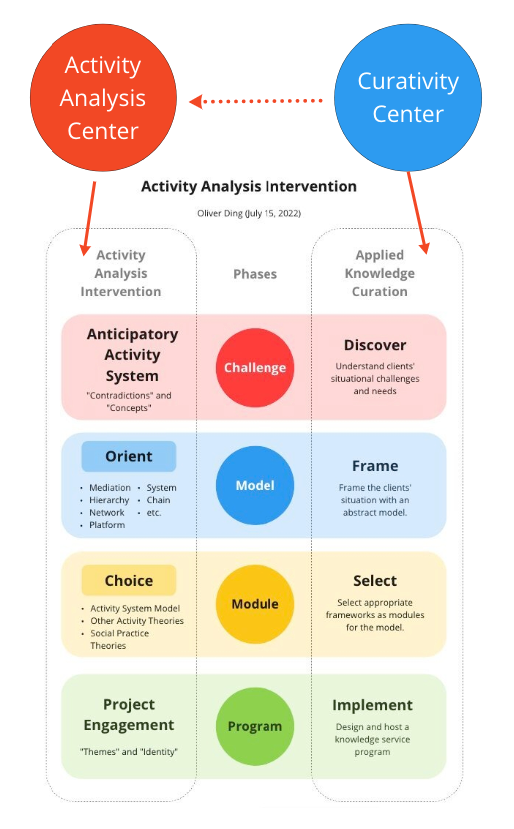
This morning, I wanted to make an independent page for the idea for further reference.
Based on the above diagram, I made a new diagram for AAI.
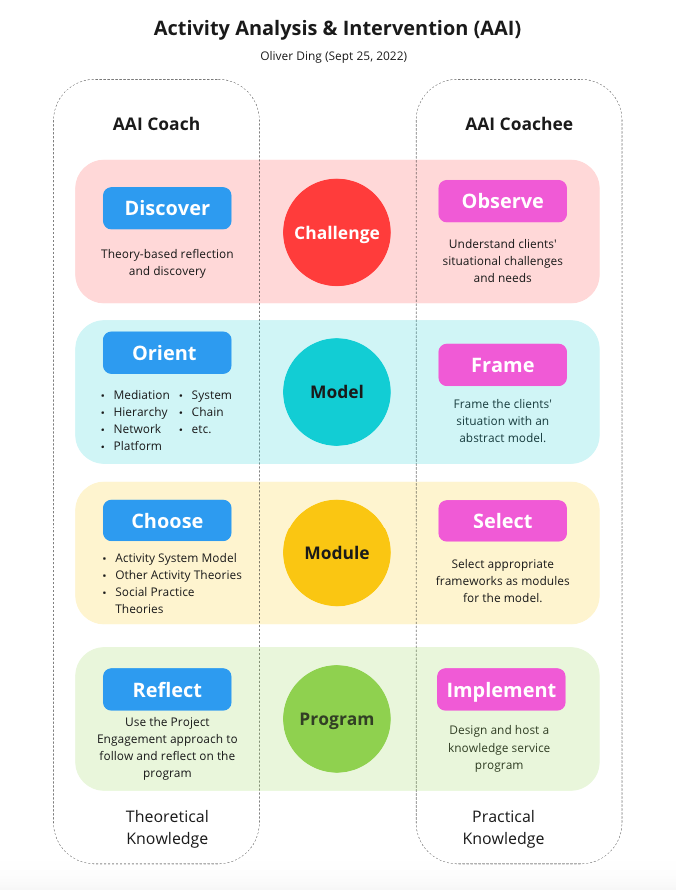
The new version uses Coach and Coachee as two sides. While the AAI Coach works on Theoretical Knowledge, the AAI Coachee works on Practical Knowledge.
I also defined two types of activities of AAI:
- Activity Analysis: Coach — Coachee
- Activity Intervention: Coachee — Clients
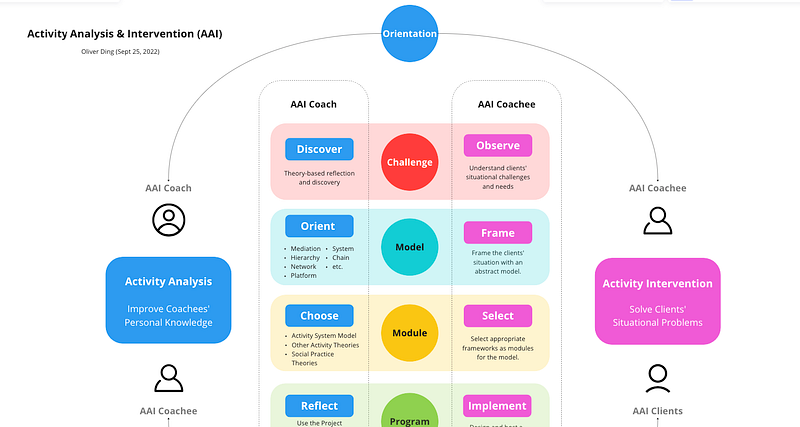
The term “Activity Analysis” is used to refer to Improve Coachee’s Personal Knowledge while the term “Activity Intervention” is used to refer to Solve Clients’ Situational Problems.
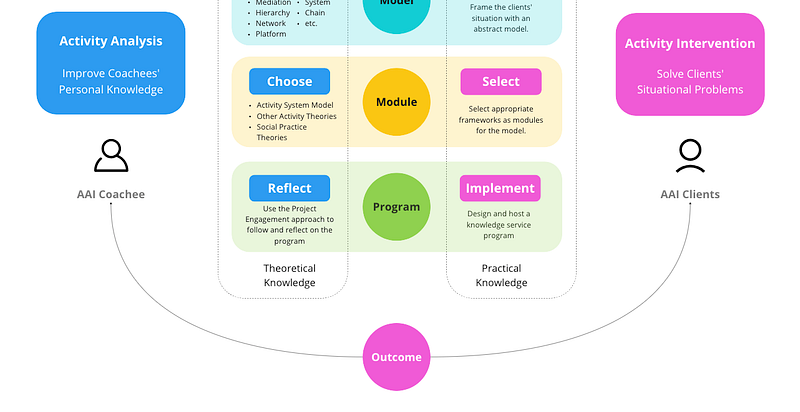
Both “Activity Analysis” and “Activity Intervention” contribute to the final Outcome.
After lunch, I used the Activity Circle model to make a new diagram to represent the relationship between the Coach, the Consultant, and the Client.
Several months ago, I used the Activity Circle model to generate a framework called Knowledge Circle when I was working on researching Ping-keung Lui’s Knowledge Center.
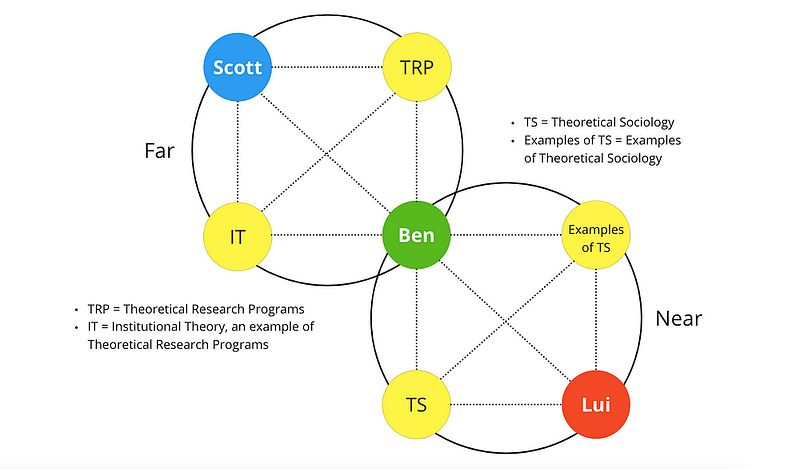
After dinner, I got a new idea about the model. I realized that I could use “First-order Analysis” and “Second-order Analysis” to name two types of activities of AAI.
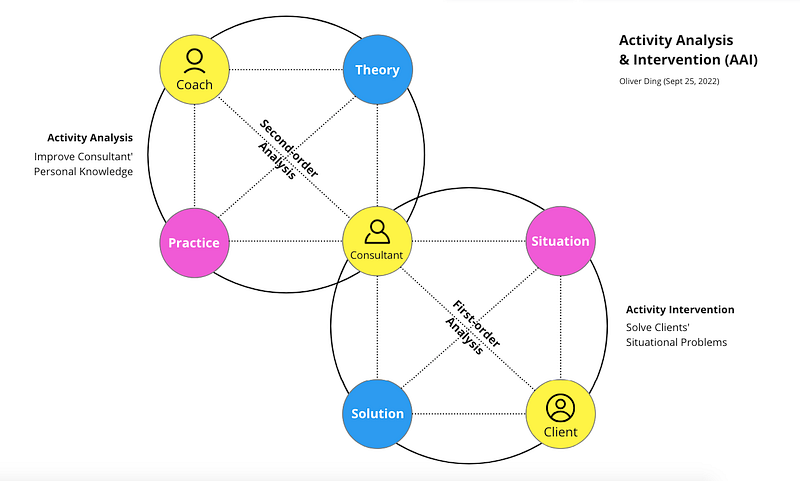
It means there are three types of activities in the AAI project:
- First-order Analysis: Consultant — Client
- Activity Intervention: Consultant — Client
- Second-order Analysis: Coach — Consultant
This is a significant insight because it brings a new meaning to the name “Activity Analysis Center”.
I also associated the new meaning with the logo of AAI. See the picture below.
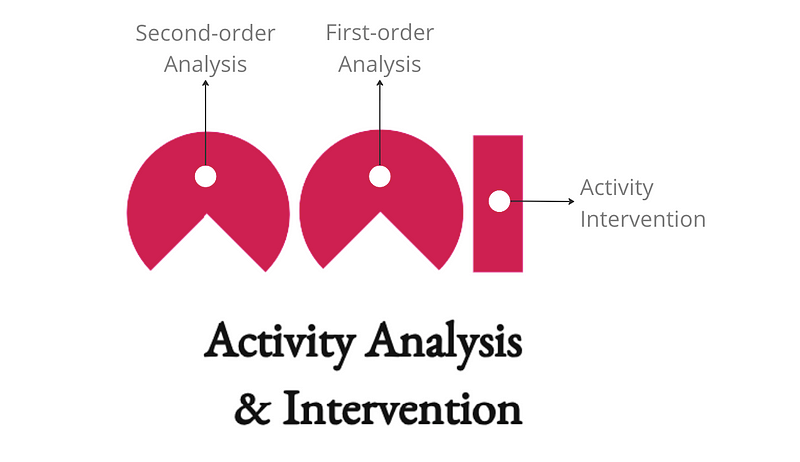
Before today, I didn’t use the term “Activity Analysis” as a unique theoretical concept.
The Activity Analysis website is an upgraded version of the Activity U project which is a knowledge curation project of CALL.
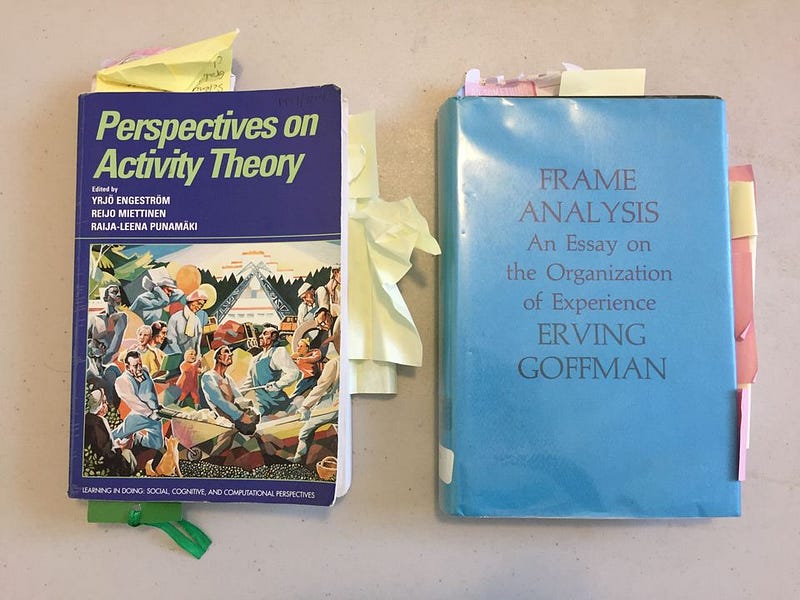
The name of the website is inspired by two books. The word “Activity” is adopted from Perspectives on Activity Theory while the word “Analysis” is inspired by Frame Analysis.
- Activity: looking at human activities and social practices. - Analysis: linking theory and social research.
The website is designed for people who want to conduct studies of human activities and reflect on their own daily life world with theoretical perspectives.
The idea of AAI was inspired by Applied Knowledge Curation. You can find more details in The ARCH of Synergy Effects.
“First-order Analysis” and “Second-order Analysis” bring new meaning to the term “Activity Analysis”.
Now I could use “Activity Analysis” as a theoretical concept and develop a new method.
What would the new method of “Activity Analysis” look like?
I used Eric Berne’s “Transactional Analysis” as a reference. Eric Berne developed Transactional analysis as a psychoanalytic theory and method of therapy wherein social interactions (or “transactions”) are analyzed to determine the ego state of the communicator (whether parent-like, childlike, or adult-like) as a basis for understanding behavior.
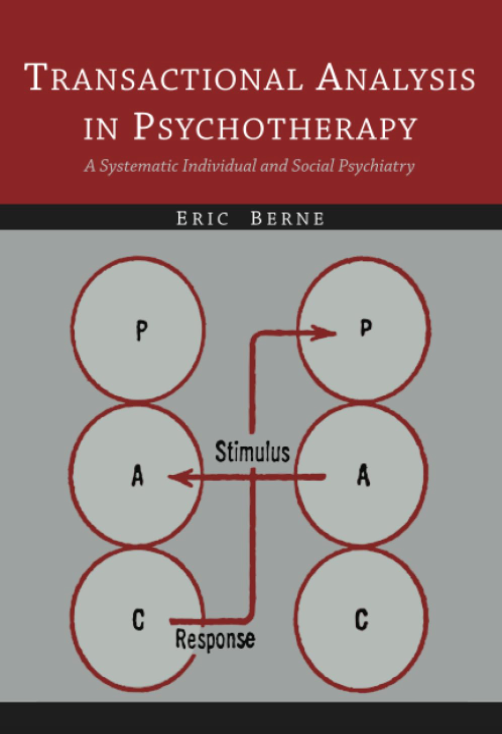
For me, the new method of “Activity Analysis” means a new approach to developing a person’s Tacit Knowledge such as Self, Mind, Life, Mindset, etc. by analyzing the person’s Activities.
The method and related tools are inspired by Activity Theory.
Developing Tacit Knowledge is the primary theme of my 2022 book (draft) Knowledge Discovery.

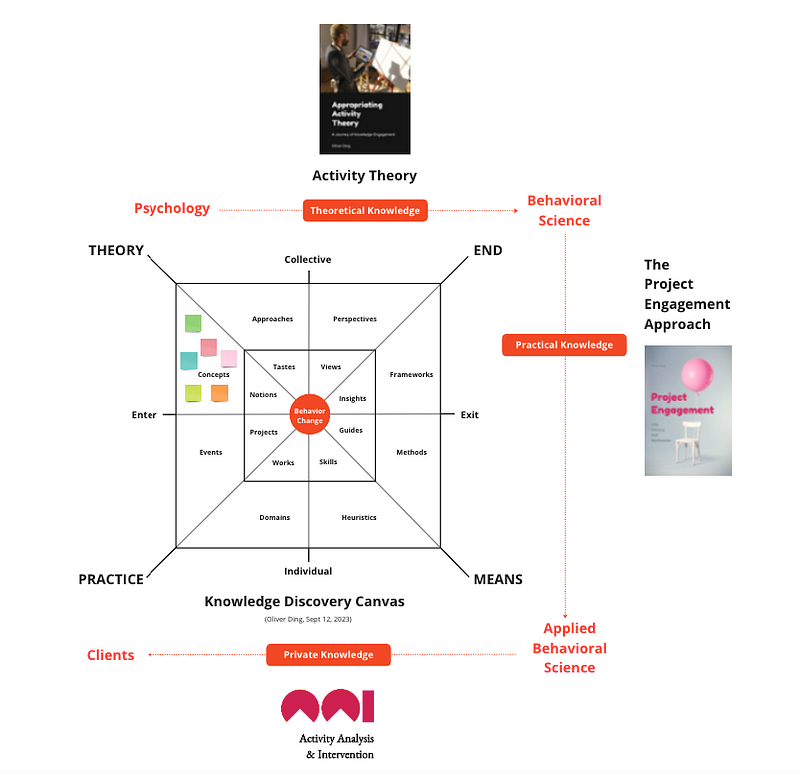
The Knowledge Discovery Activity is defined as the following diagram that represents the basic model of Activity Theory: Subject — Mediating Tool — Object.
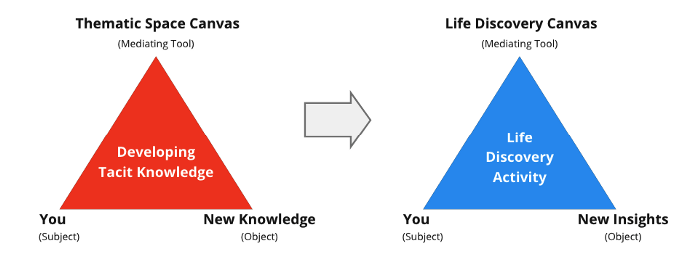
I consider both “Developing Tacit Knowledge” and “Life Discovery” as Activities. From the perspective of Activity Theory, Thematic Space Canvas(/Knowledge Discovery Canvas) and Life Discovery Canvas are both Mediating Tools.
Moreover, what I found is that “Life Discovery” can be understood as a subcategory of “Developing Tacit Knowledge” if we consider the target of knowing about a person’s own life development. The process of discovering new insights for life development is a process of Developing Tacit Knowledge.
The same logic could be applied to other activities of a person’s life domains.
On Sept 8, 2023, I developed the following Mental Tuning Framework. I didn’t mention Activity Theory in an article about the framework. Now we can connect it with Activity Theory.
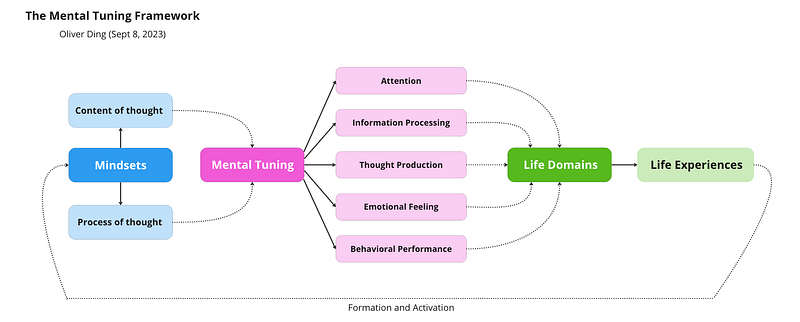
Activity Theory sees a person’s mind as a developmental process within real-life activities. We can use Activity Theory to understand “Life Domains”.
We can also connect the AAI with the Mental Tuning Framework. In this way, “First-order Analysis” is about understanding a person’s “Life Domains” and his/her “Life Experiences”. “Second-order Analysis” is about the process of “Mental Turning”.
Let’s return to the original diagram of AAI. If the person is a Consultant, then “First-order Analysis” is about the Consulting Activity between him and the Client, while “Second-order Analysis” is about helping the Consultant Develop Knowledge about the Consulting Activity.
We have noticed that the Consultant also offers First-order Analysis and Activity Intervention to the Client. This is the original idea of AAI.
Activity Theory, especially the Activity System Model, has been used to research organizational innovation, workplace, education, design, etc. It is a powerful tool for understanding work.
The Consultant could use Activity Theory and related theoretical knowledge to help the Client solve the work-related problems.
The new idea of AAI has a three-hierarchy structure. It echoes the Applied Meta-learning framework. See the diagram below.
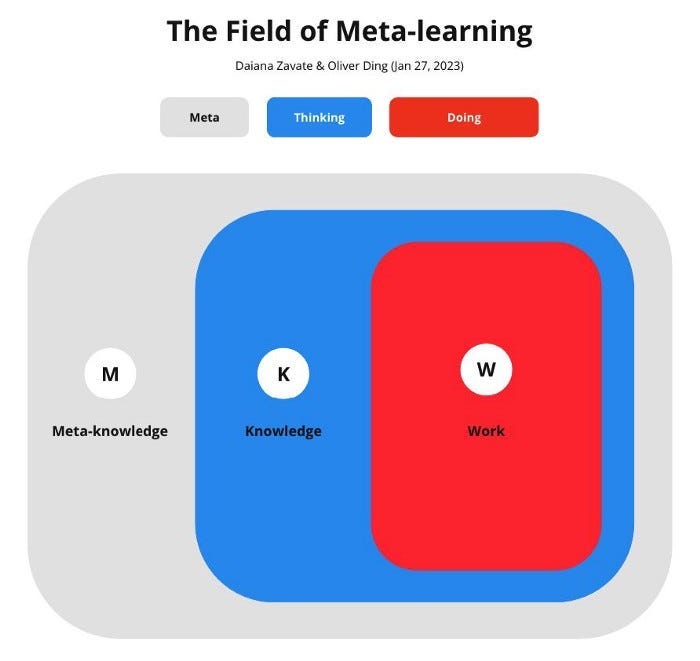
The above diagram was the outcome of a thematic conversation about “Strategic Exploration”. You can find more details in TALE: A Strategic Designer’s Creative Journey.
The thematic conversation can be seen as a demo of “Second-order Analysis”.
This three-level hierarchy can be used to represent a Thematic Engagement project:
- Form (meta-knowledge): Theme (Knowledge Engagement)
- Content (knowledge): Activity (Thematic Conversation)
- Activity (work): Project (A Thematic Conversation project about “Strategic Exploration”)
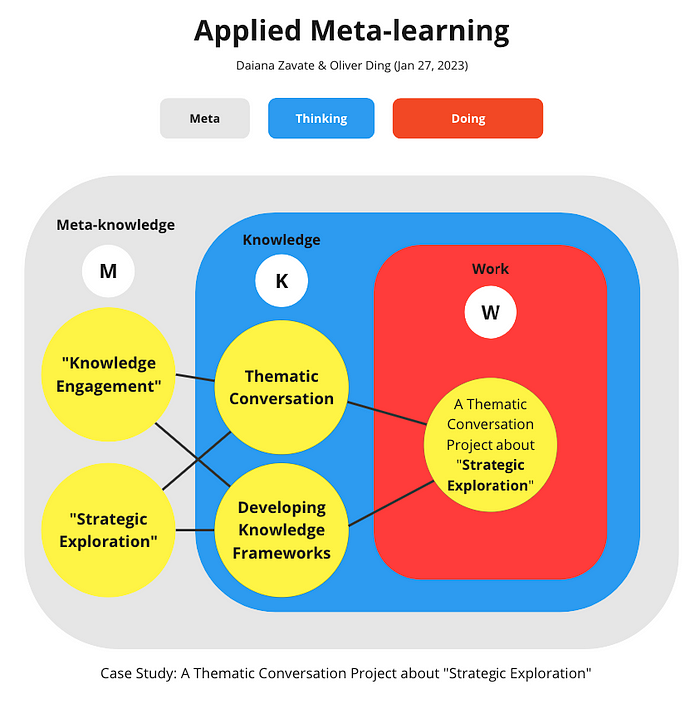
The above diagram presents the visual structure of the above idea.
“Themes” are a special type of Meta-knowledge in the “Meta” zone. We have two primary themes for this project.
- Daiana’s primary theme: “Strategic Exploration”
- Oliver’s primary theme: “Knowledge Engagement”
From my perspective, this project can be seen as a process of Developing a Knowledge Framework. The significant insight I developed from this project is the function of Thematic Space for developing a knowledge framework. You can find more details in The Dynamics of Thematic Space (v2.0).
From Daiana’s perspective, the project produces the following things:
- A concept called “The Field of Meta-learning”.
- There are three types of processes within the Field of Meta-learning.
- A three-level hierarchy of structure of the Field of Meta-learning.
- An epistemology for Strategic Exploration.
- A diagram that represents the structure of the Field of Meta-learning.
- A map and a mapping method for discussing related issues.
We can see this thematic conversation project as a rough example of AAI.
- First-order Analysis: Daiana focuses on “Strategic Exploration”
- Second-order Analysis: Oliver focuses on “Knowledge Engagement”
During the process, I discussed issues about diagramming and conceptual development. The same technique can be applied to AAI.
This is just a short note.
Why do I call it Situational Note-taking?
Because this idea was born from a diagramming situation.
More Situational Notes
- July 29, 2023 — Situational Note-taking: Capture Significant Insights Outside the Room
- Sept 2, 2023 — TALE: The Thematic Engagement Approach to Social Cognition (short note), Themes of Practice: Concept, Activity, and Cognition (long article)
On Sept 10, 2023, I wrote a short note about Situational Note-taking on Linkedin. The note collected the following old posts.
- Feb 5, 2022 — Information, Places, and Actions
- April 21, 2022 — The Deep Analogy Board — Activity Theory (story, board)
- Jan 19, 2022 — Activity, Attachance, and Replacement
- Jan 25, 2022 — A “Strategy-as-Curation” Weekend
- July 27, 2023— The ECHO Trip
- August 5, 2023 — Platform Ecology (v3.1)
- August 30, 2023 — A Cup of Joey @ Houston
- August 30, 2021 — D as Diagramming: The Path of Creative Life