
Make America Sane Again. The rising mental health crisis in America
One in five adults is living with mental health issues.

Mental illness is way too common in the United States. Statistics show nearly one in five U.S. adults live with a mental illness. This is America’s silent but raging pandemic. Common people, the elderly, children, and Olympic athletes, no one is spared from the fire of this fury.
In 2019, there were an estimated 51.5 million adults aged 18 or older in the United States with Any Mental Illness (AMI). This number represented 20.6% of all U.S. adults.
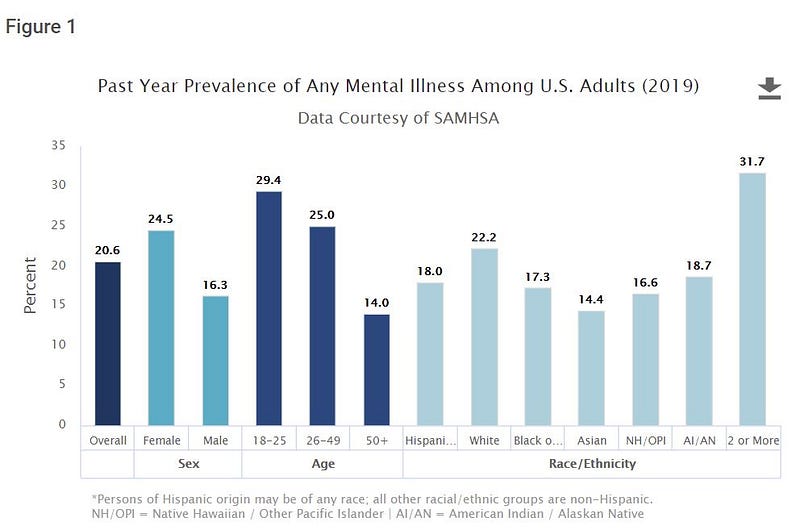
Here are more facts from that survey:
- The prevalence of AMI was higher among females than males.
- Young adults aged 18–25 years had the highest prevalence of AMI.
- AMI was highest among adults of mixed race, followed by White adults.
- The prevalence of AMI was lowest among Asian adults.
America is in a terribly sad state. No pun intended.
My family lives in a quiet, well-to-do neighborhood and one evening my husband and I started counting all the mentally disturbed neighbors in our cul-de-sac. We counted 3 people among the 6 families we know. The number may be higher, but we’ve never met the other families, despite living here for over 5 years. They barely venture out of their homes.
We are not judging our neighbors.
We are simply sharing a disturbing fact, reflected in the National Institute of Mental Health’s data, that 1 in 5 American adults is afflicted by some form of mental illness.
How did the world’s coveted superpower, end up with such high rates of psychosis?
When I hear of the mass shootings happening in everyday places, by trigger-happy, mentally disturbed, 20-year-olds, I’m compelled to stop and notice. It’s happening too frequently, and we cannot afford to ignore it.
The mental decay of the American population is a glaring indication of the imminent decline of this nation. We can debate this issue all day, on political grounds alone, but the truth is, sad people don’t make a happy and prosperous country.
20% of the current U.S. population is mentally distressed.
I’m no expert, but as a mother raising a child here, this sobering statistic bothers me, and I decided to delve deeper into this subject.
Major factors that affect a nation’s mental health
I researched these alarming facts that directly impact the mental health status of the American population.
- Declining Marriage Rates & High Divorce Rates = SAD & LONELY SINGLES
The U.S. marriage rate has declined, and the divorce rates have increased, among older Americans. In 2015, for every 1,000 married adults ages 50 and older, 10 had divorced — up from five in 1990.
Healthy marriages are good for a couple’s mental and physical health. They are also good for children. It’s common knowledge that growing up in a happy home protects children from mental, physical, emotional, and social problems. However, over 40 percent of married couples in the United States divorce. As a result, both children and divorced adults, suffer mental trauma.
2. Excessive dependence on Opioid Drugs = MENTAL HARAKIRI
The misuse of and addiction to opioids, including prescription opioids, heroin, and synthetic opioids like fentanyl, is a serious problem affecting the health of many Americans (National Institute on Drug Abuse [NIDA], 2018a).
Across America, “Individuals, communities and health care systems are struggling to cope with substance use, misuse, and substance use disorders” and the problem is becoming deadlier than ever. In October 2017, the Trump administration declared the opioid epidemic a national public health emergency (Mercia, 2017).
Recent UN data show that although America has around 4% of the world’s population, it experiences 27% of the world’s drug overdose deaths (United Nations Office on Drugs and Crime, 2016).
Individuals who exhibit mental health conditions like anxiety and depression are three times more likely to use opioids.
3. Poor Nutrition and Chronic Inflammation = LOW OMEGA-3 STATUS
95% of the U.S. population is low in healthy levels of Omega-3s.
Great for heart health, Omega-3 fatty acids are also involved in a wide range of physiological functions and play a fundamental role in the development, and functioning, of the brain.
In humans, dietary deficiencies of omega-3 fatty acids are associated with an increased risk of developing various psychiatric disorders, including depression, bipolar disorder, schizophrenia, dementia, attention-deficit/hyperactivity disorder, and autism.
Eicosapentaenoic and Docosahexaenoic acid has been linked to the maintenance of mental health, and their deficits have been implicated in the pathophysiology of mental disorders.
4. Poor Physical Health = COGNITIVE DECLINE
More than 42% of the U.S. population is obese as per CDC 2017–18 reports. Several comprehensive reviews have suggested that between 20% and 60% of persons with obesity, and extreme obesity, in particular, suffer from a psychiatric illness. These percentages are typically greater than those seen in the general population.
It’s no surprise that the pandemic has only worsened the physical health condition of millions of Americans. Poor physical health directly impacts mental health.
5. Inherent racism and exclusion = PSYCHOLOGICAL TRAUMA
Racism and cultural segregation are rampant issues in America. From Black Lives Matter Movements to Asian Hate Crimes, there’s no doubt that people of color experience life differently in America. They face overt racism and prejudice way too often, leading to mental health issues that are deeper than what others may face.
Racism is a mental health issue that causes trauma. And trauma draws a direct line to mental illnesses and needs to be taken seriously.
The combination of all these factors is systemically sabotaging the mental health of Americans. Though the roots of mental volatility begin at home, its growth is compounded by external factors in a person’s immediate environment. These are the real issues in America that need immediate attention.
The greatness of America lies not in being more enlightened than any other nation, but rather in her ability to repair her faults — Alexis de Tocqueville
Putting guns into the hands of mentally distressed people is like adding fuel to fire. The issue is not so much about the possession of guns but more about the poor mental condition of the brain that pulls the trigger.
Before chanting slogans saying, Make America Great Again! We need to revive the cerebral health of its citizens and focus on making America Sane Again.