
Fireflies: Losing the Magic Light
Light pollution is causing the environmental imbalance
When we were small, and my parents wanted to escape from my sister and me for an evening, they would invite an elderly couple to come to our house to babysit while they were away.
The journey back in time is too long to remember names, but I clearly remember that the-old-man had lost the four fingers of his left hand, which must have been in an industrial accident.
I never fell for his story that he had cut them off while shaving, but my kid sister was always a little more gullible than I was, and so I am not so sure about her to take on this.
The Old-Magician
We were too young to find his mutilated hand gruesome. Instead, we were fascinated by it. Dressed in our robes and flannel pajamas, we would crawl onto his lap and examine his hand while his wife read us bedtime stories.
On what was to become his most memorable visit, he opened his good-hand to reveal six tiny glowworms glimmering in his palm.
As kids, we were entranced, and his status as a mysterious magician was greatly augmented. He gently dropped three worms into each of our outstretched palms as though we were little beggars taking alms.

As his wife read us the usual stories, we would engulf the worms between our two hands and then peer at the green glow they emitted through the gap between our thumbs.
It was delicate work for tiny hands, and I am not sure that all the worms survived the ordeal.
Rediscovery Upon Moving to France
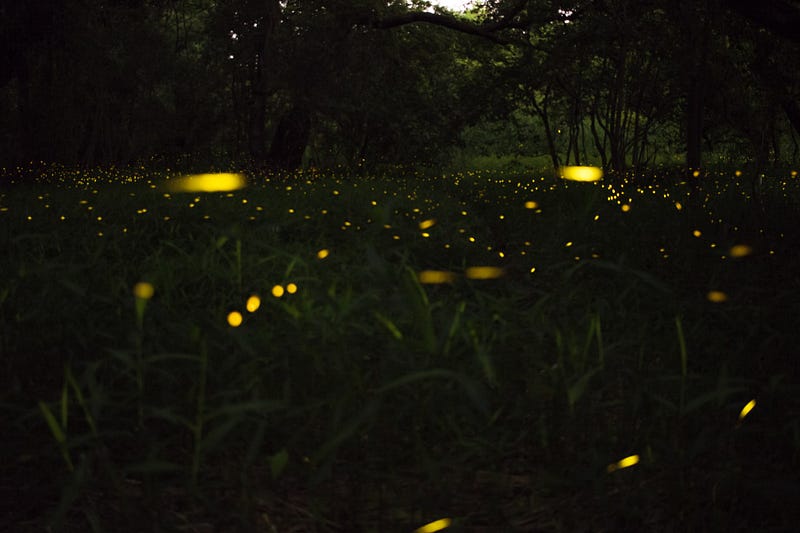
Decades later, upon moving to France, I spotted some worms throbbing their green bioluminescence at one another during a warm summer night.
The sight instantly took me back to my childhood in Africa, and the effect was quite haunting. It was like, stumbling on the plain girl from down the street after years had gone by and discovering that she had morphed into a rare beauty.
A bittersweet feeling of rediscovery tinged with the regret of having failed to pay more attention when the opportunity existed.
Fireflies and glow worms are related to one another but function slightly differently.
The glow worms we have here in Europe are the adult females of the species, and they emit a steady green glow that tells predators that she does not taste nice, while at the same time acting as a guiding light to the flying male.
The female cannot fly and instead must shine her light in an enticing invitation.
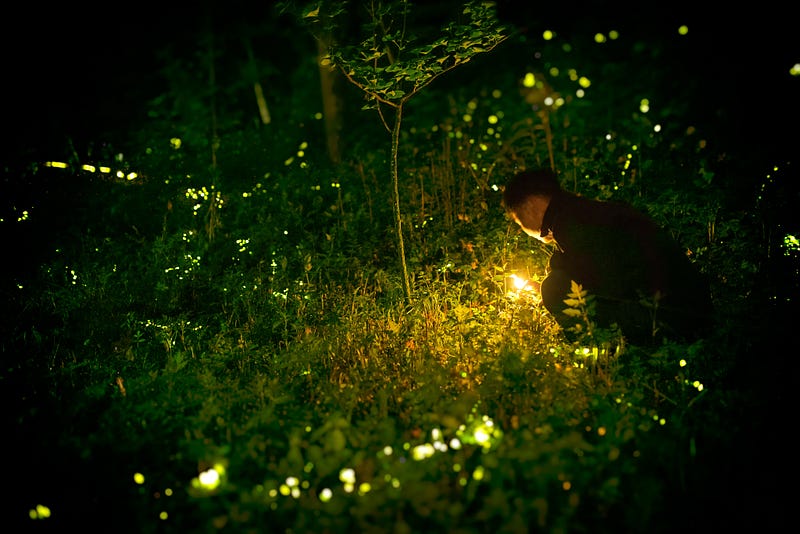
In the US, you are more likely to come across fireflies where both males and females can fly, and they can both emit a flashing light as an invitation to mate. Each species has its own secret code of flashes that ensure that they attract only beetles of the same species to their little love-trysts. There is one exception to this rule.
One type of female firefly imitates the flashes of likely targets. And when the amorous male arrives, she promptly eats him in yet another act of female treachery that the natural world is so good at inflicting on us vulnerable males.
The World of Fireflies
Altogether there are more than 2000 species of fireflies throughout the world. All are members of the beetle family. The adults tend to live for a few short weeks, during which time they mate, and the female lays her eggs in shallow excavations in the earth.
The eggs hatch three to four weeks later, and the larvae that emerge are voracious predators of small snails, slugs, and other insects. They bite their prey numerous times and inject a digestive toxin that causes its body to start to dissolve. There are reports of them riding comfortably on snail’s backs as they patiently wait for them to succumb.
Their light is generated by a process called bioluminescence, generally on the lower abdomen. Scientists have yet to learn how the beetles manage to regulate the differing rates at which the different species flash.
The product used to generate this light is called luciferase, which is derived from an enzyme and generates no heat. It is not only glow-worms and fireflies that have mastered the use of this enzyme.
It is also used by some fish, squid, snails, and bacteria. It has even become useful in the world of medicine and forensics, where it can help in locating traces of blood residue.
Goodbye Fireflies
Unfortunately, this is the almost inevitable part of the story where we are forced to look at where man has inflicted his mark on one of nature’s wonderful little marvels.
Both firefly and glow-worm numbers have gone through a massive decline in recent years.
Here we see all the familiar suspects at play; pesticides and loss of habitat have had their usual devastating effects but so too has light pollution — a slightly more unusual culprit, but one which is proving deadly in this instance.

Light pollution is often overlooked in a modern world that is so beset by man-made disasters, but our desire to drive back the darkness is having calamitous effects on some creatures. Fireflies are just one of them.
One study suggests that light pollution has been increasing globally by 2.2 percent since 2012.
The result is that one-third of the population of both the US and Europe can no longer see the milky way, but perhaps that is a subject I will leave for another article. What we know is that excess light is making finding a mate much more difficult for those who rely on a flash of light rather than a wink of the eye, and a couple of shots of tequila.
Thank you for reading.
Read the following curated article published in The Masterpiece to know how to rewild your surroundings.


