
Fine Dining: Socially Constructed Morality
“Morality is simply the attitude we adopt towards people whom we personally dislike.”
— Oscar Wilde
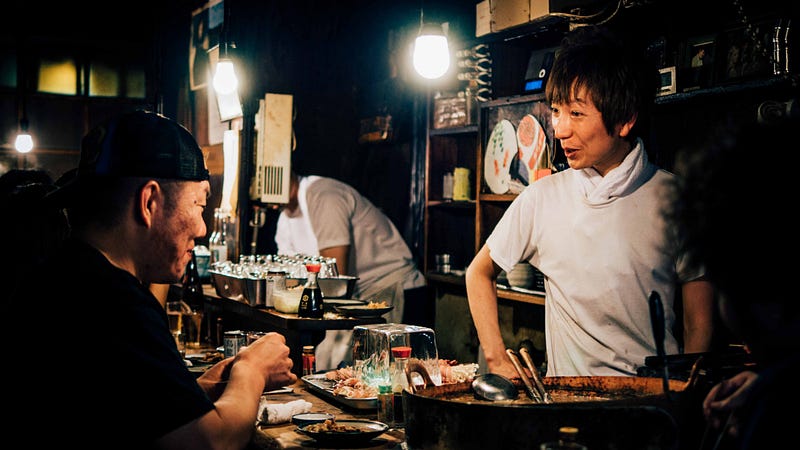
At what point in life are we subjected to a contract of how one ought to behave under the preliminary action of what is good and what is bad?
In regards to the values associated with free will we are at no point in our lives to be held accountable of unfavorable actions, yet still we are judged for our demeanor. What purpose we derive from the actions in life are surely to be filtered by what our minds determine as good and bad, right and wrong. With deterministic values we find an objection to free will in that the filtering of action surely brings about the demise of free will itself.
How is one held accountable of morality when no right or wrong path is placeable upon the table of their actions? This is the epitome of the server’s dilemma. The server enters all actions under the guise of social judgement and therefore merits their freedom of choice of action to the jaws of the general public.
When a server is judged harshly by one patron we place this judgement on our future endeavors so that we are constantly under the assumption that all who enter the restaurant are members of the jury to our trial.
To the general public the actions of the server must adhere to the whims of their will. So as not to constitute an ever changing landscape of moral values we then must set in place a standard of right and wrong. Any action made by the server outside of the favorability of the patron is seen as heresy. The patron is placed in the position of how the server’s action must be judged and punished.
The absurdity of this song and dance comes from the misunderstanding of the importance of purpose within a restaurant. The question must first be answered before judgement be passed; why is the patron and the server interlocked in this conflict? Easy enough, the server needs to make money, the patron needs to eat.
Absurdity is born on the assumption that the amount of dollars spent on a meal is to be reflected, not in the action of satisfying hunger, but in the action of satisfying the patron’s will. Without a price tag on the items being bought and the service being provided we find the breaking down of social morality. What is it to be served and what is it to serve, outside of moral convictions, becomes an unjustifiable sequence of action.
Our entire model of good and bad, right and wrong is based on the promise of willful determination and through the course of predetermined right action. Our entire system of morality is completely controlled by the promise of reward. So, how can it be said with certainty that man should act in good faith for the sake of good faith?
Can we place this understanding of action on any other form of social engagement? In regards to religion I find that this social morality can also be attributed. Ask any server how they feel about the sunday lunch crowd when the truly divine grace the doors with their presence. The servers will tell you of how they were treated by the folks, who wish for eternal bliss through worldly actions. The servers will tell you how rude and incompetent these people seem to be. Is the social construct placed on the lives of servers placed on us all by God only in the return of divine reward and fear of divine punishment?
Now we find the other side of social morality in that the server is placed low on the totem pole of the construct of social governance. If the server steps away from the boundaries of social morality they do not find themselves burning in hell. They find themselves one step closer to homelessness. Most of the people I have met serving are not in the business of saving money for what little they make most be spent on the essentials for survival.
If survival is the goal of service from the servers perspective then we find that social morality is only to be followed through the means of monetary reward. In regards to the sunday crowd I suppose they left out the part in service that day about the social obligations they must adhere to when being waited on, even if those waiting on you are not worthy of divine reward.
Thank you for reading. Peace and love to you and yours.
If you’re feeling extra kind today and wish to help out, based on income, a struggling writer then you can buy me a coffee!
I make money directly from your donation to my link above.
You can also subscribe to get a notification whenever I post! Up to you though, I know emails can be annoying but they help me build an audience and that would be cool if you were a part of that.


