
Finding Your Wat in Cambodia
It's a step back into ancient history.
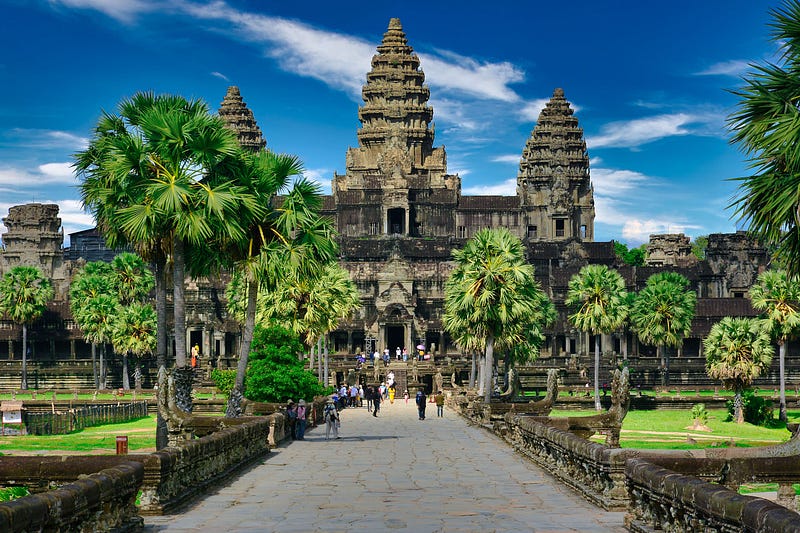
This is the fourth part of my tour to Vietnam, Cambodia, and Thailand.
The day began with a drive across Ho Chi Minh City (Saigon) back to the airport. The one congested main road through town slows the pace of traffic.
Our flight to Cambodia arrived in Siem Reap on the opening day of a spanking new, huge airport. This vast facility was built to handle the millions of tourists each year who flock to the Angkor Wat complex. A wat is a Hindu or Buddhist temple.
The airport workers were welcoming and proud of their cavernous and empty new space. They offered each visitor a traditional Cambodian Karma scarf, a gingham scarf that can be used as a bandanna, baby carrier, or even a blanket.
Red and white gingham scarves were once the notorious symbol of the Khmer Rouge regime. The Karma scarf now symbolizes Cambodian “strength, courage, and resilience.”
Although the government of Cambodia is considered a constitutional monarchy, the power has been lodged in Prime Minister Hun Sen for 38 years. This is a dictatorship with mostly poor people and a corrupt government.
Our visit to Cambodia was centered on the visits to the massive religious complex of Angor Wat and the two other temple sites located nearby. The verdant green fields we passed on our hour-long bus ride belied the horrific history of 20th-century Cambodia.
“The Killing Fields” refer to sites in Cambodia where more than 1,000,000 people were killed and buried by the Communist Party of Kampuchea during the Khmer Rouge rule of the country from 1975 to 1979.
Multiple books and movies have documented the grisly era. Angelina Jolie directed a chilling film adaptation of the memoir First They Killed My Father by Loung Ung for Netflix. I recommend the book and film.
After about an hour’s drive, we arrived at the shores of Tonlé Sap, part of the Mekong River system, our first stop. We boarded an old-fashioned boat to tour the largest freshwater lake in Southeast Asia.
We got a close-up look at many of the people who live as fishermen on houseboats docked along the banks of the waterway. The houseboats were used to compensate for alternate flooding and drought conditions. When the water levels started getting too low, they moved their houses.
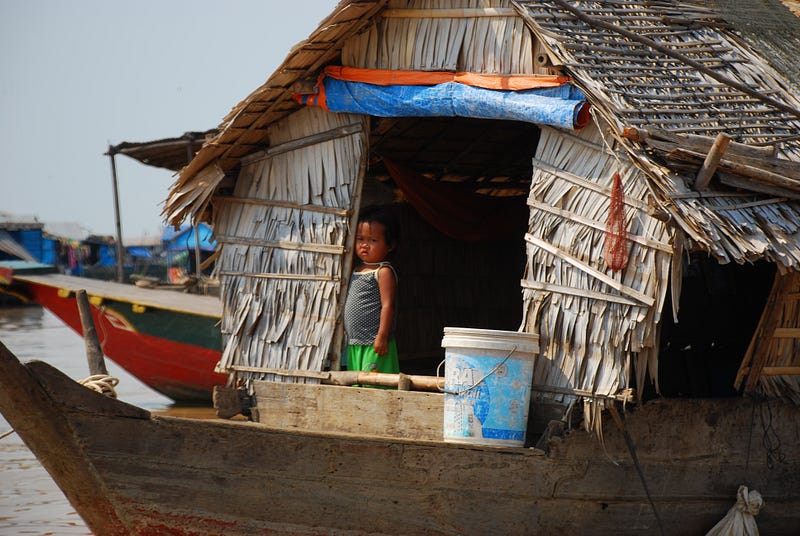
Many of the locals are Cambodians of Vietnamese origin who have lived in floating villages on the lake for many generations. They had to flee to Vietnam during the Khmer Rouge but returned to the area after the downfall.
The lake has more than 200 freshwater species that support and feed the people who live in the area.
Various churches, restaurants, and meeting halls line the banks of the waterway. The people are poor and live a simple existence. They smile and wave as the boats of tourists float by. I suspect they tolerate the money pumped into the local economy.
Staying Overnight in Siem Riep
From there, the group drove to the city of Siem Riep. As the city closest to the Angkor Wat complex, a tremendous base of hotels, restaurants, taverns, and shops has grown in the area.
We checked into a lovely and historic hotel. Our evening dinner was served with a lively show of Khmer classical dances, percussion, and folk dancing. We needed to rest up for a full day of touring.
Located between the Tonle Sap Lake and the Kulen Mountains in Cambodia, Angkor contains the remains of several capitals of the Khmer Empire. Angkor served as the seat of the ancient Khmer Empire, which flourished from approximately the 9th to 15th centuries. The area was believed to contain a population of one million people, the largest preindustrial city in the world.
After the fall of the Khmer empire, the Angkor temples were abandoned and reclaimed by the jungle for centuries. Many of the temples at Angkor have now been restored and welcome over two million tourists each year. We were scheduled to visit three of them.
Visiting the Ancient Wats
Ta Prohm was the first site we visited at Angkor, with trees growing out of the ruins. If Angkor Wat and other temples are a testimony to the genius of the ancient Khmer builders, Ta Prohm reminds us of the awesome power of the jungle to take over when men step away.
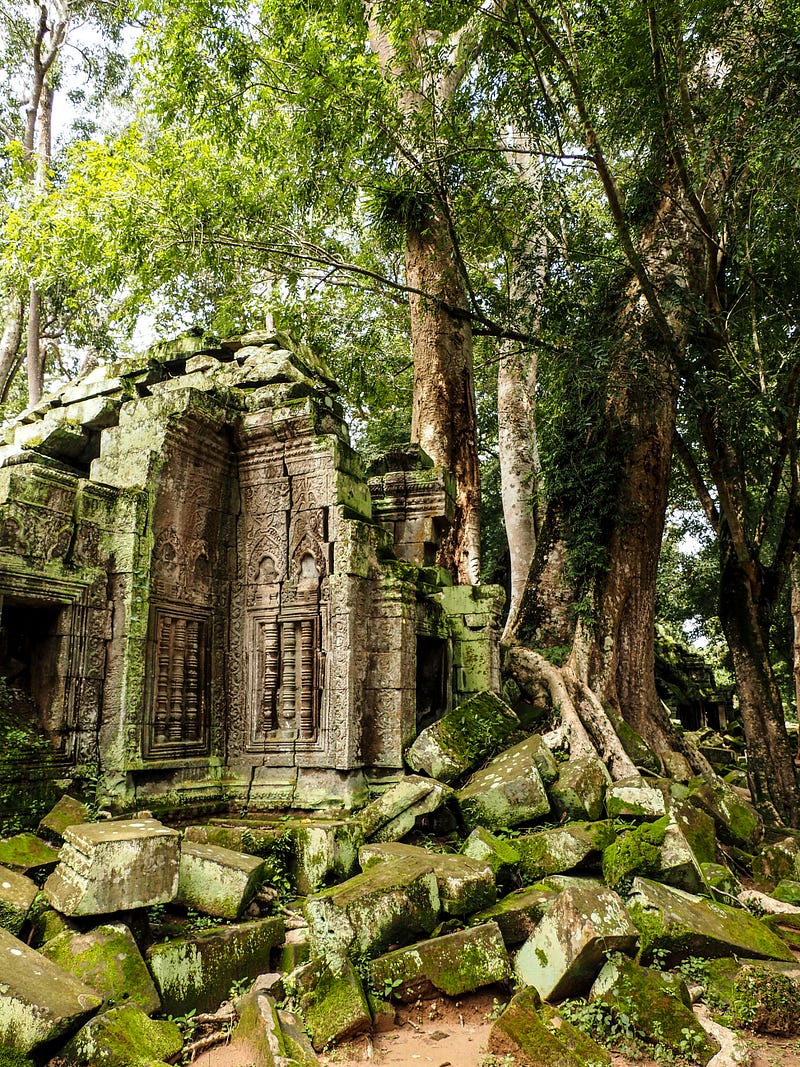
Built-in 1186, Ta Prohm was a Buddhist temple dedicated to the mother of Jayavarman VII. After the fall of the Khmer empire in the 15th century, the temple was abandoned and swallowed up by the jungle. Giant trees soaring among the temple ruins show the fierce power of Mother Nature.
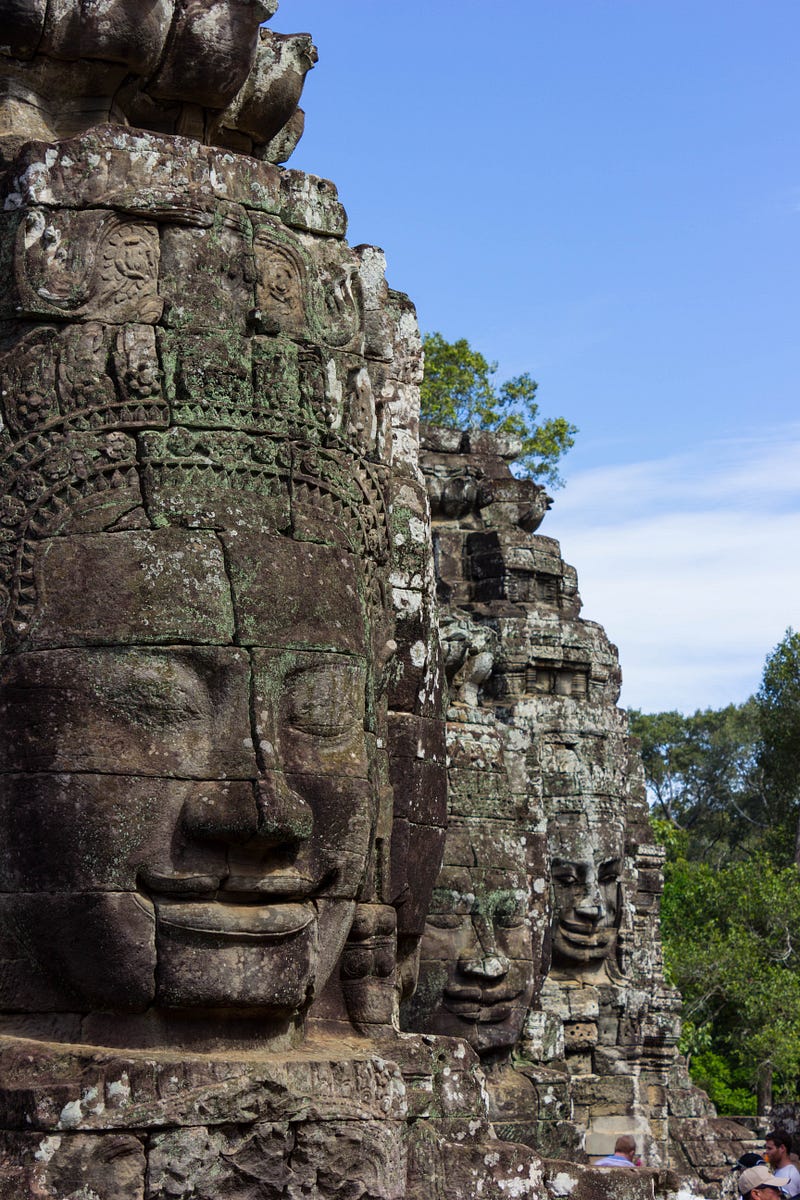
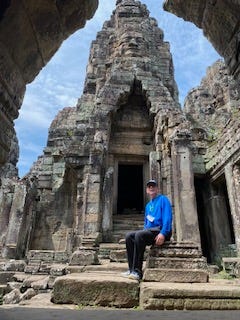
After a short drive, we reached the Bayon Temple of Angkor Thom, which features a sea of over 200 massive stone faces looking in all directions.
The smiling faces, thought by many to be a portrait of King Jayavarman VII himself or a combination of him and Buddha, were also built in the 12th Century. If I had not seen this right before Angkor Wat, I might have foolishly thought that this was the most magnificent temple in Cambodia.
Angkor Wat (meaning “City Temple”) is the most magnificent and largest of all Angkor temples. It is most certainly the granddaddy of them all. The structure occupies an enormous site of nearly 500 acres.
This arrangement reflects the traditional Khmer idea of the temple mountain, in which the temple represents Mount Meru, the home of the gods in Hinduism.
It was built under the reign of King Suryavarman II in the first half of the 12th century. Artworks carved into the temples have helped historians document the local history, as no written documentation has survived. The site later became a Buddhist temple.
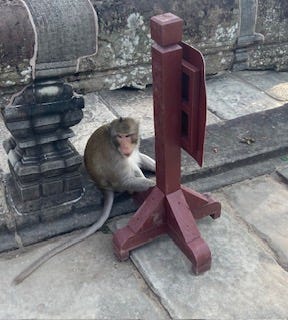
The complex is massive and takes several hours to tour. A few mischievous monkeys in the area will certainly pick food or other items out of open bags or backpacks. Even though thousands of tourists stream in, the area is so large that it never feels crowded.
Tuck-tuck taxis, powered by motorcycle engines, brought us out of the Angor Wat area and back to our hotel in Siem Riep. It was a perfect retro transportation ending to a step back in time to ancient Cambodia.
The experience rivaled, in my mind, the overwhelming scale and grandeur of my visit to the Great Pyramid complex in Giza.
In the morning, we would take the long bus ride back to the airport and start our tour of Thailand. Stay tuned.


