
Finding the Presence of God
Notice when you see compassionate hospitality amidst your transitions.
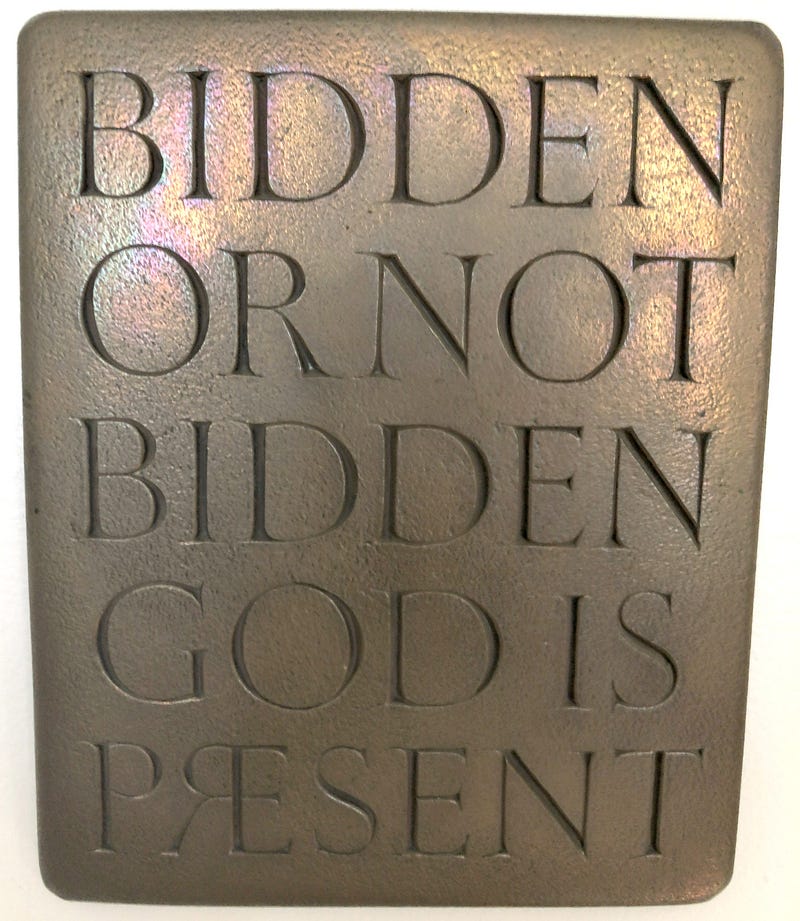
There is a plaque on the wall of our home that says “Bidden or Unbidden, God is Present.” We don’t use the word “bidden” in our language but it means ‘Called upon or not, God is still here.’
The influential psychologist Carl Jung and his wife Emma liked the saying so much that in 1906, they had it carved over the front door of their home in Switzerland. Carl later saw to it that it would be etched on his gravestone.
But God being present, whether or not we request it, doesn’t refer to a loud-mouthed relative who crashes family gathering as an unwanted presence. God is anything but an unwanted relative. We usually ask God for help when we are in trouble. When we are hurting and want things fixed.
Carl Young wasn’t the author of the saying but he read it back when he was 19 years old in his classic Latin studies. He found it in the writings of Erasmus,¹ the Renaissance scholar and humanist.² And Erasmus found it from the writings of the ancient Roman poet Ovid³ who cited the oracle of Delphi.⁴

¹ 1466–12 July 1536. Erasmus was a classical scholar who wrote in a pure Latin style.
² Collectaneas adagiorum, a compilation of passages from classical authors published in 1563.
³ Publius Ovidius Naso (20 March 43 BC — AD 17/18), known as Ovid.
⁴ Literary works before the common era. Ovid 20 March 43 BC — AD 17/18.
The ancient story goes that one day, the gods Zeus and Hermes⁵ went from house to house, disguised as ordinary peasants. They were asking the town’s people for a place to stay for the night. Everyone rudely turned them away until they finally came to the ramshackle cottage of the elderly couple Baucis⁶ and Philemon.⁷ Although the couple was incredibly poor, they welcomed the two strangers into their house and shared what little they had with them. They were the only ones in their town to offer hospitality to these disguised gods Zeus and Hermes.
⁵ Jupiter and Mercury, the Roman names for these Greek gods.
⁶ Meaning “tender.”
⁷ Meaning “loving disposition.”
After serving their guests dinner, Philemon noticed that although she had refilled their wine cups many times, the wine pitcher was still full. Realizing that their guests must be gods, she and her husband begged the deities to forgive their impoverished home and surroundings.
Zeus said that he was going to destroy the town and all the people who had turned them away because they had not offered hospitality. Zeus told the couple that they should climb up the mountain with him and Hermes and not look back until they had reached the top.
At the mountaintop, Philemon and Baucis looked down and saw that their village had been destroyed by a flood. But Zeus had turned Baucis’ and Philemon’s little cottage into an ornate temple.
The kind couple was also granted a wish. They chose to stay together forever and to be guardians of the temple. (That was politically astute.) They also asked that when it came time for one of them to die, the other would die as well. (Kind of romantic.) So upon their deaths, they were changed into an intertwining pair of trees, one oak and one linden.⁸
⁸ Baucis and Philemon do not appear elsewhere in Greek myths but the sacred nature of hospitality was widespread in the ancient world.
Accordingly, Hebrews 13:2 says “Do not neglect to show hospitality to strangers, for by doing that, some have entertained angels without knowing it.” The possibility that unidentified strangers in need of hospitality could be gods in disguise was ingrained in first century culture.
Recall the Noah’s ark flood story where the entire world was drowned by an angry Creator. Perhaps today’s clergy might use these passages in reference to our congressional inhospitable approach to the Hispanic immigrant children fleeing for their lives. It’s no wonder we are haunted, from our childhood, by the parental and mythological stories of punitive divine wrath coming our way if we are not welcoming to strangers. But how did Carl Jung see his favorite phrase relevant to his time at the beginning of the last century?
He said, about the sign, “It is a Delphic oracle. It says: yes, the god will be on the spot, but in what form and to what purpose? I have put the inscription there on my house to remind my patients and myself, that: ‘The fear of the Lord is the beginning of all wisdom.’” (Proverbs 9:10)
Recall the Genesis 19 story of Sodom and Gomorrah. After Lot and his wife showed hospitality to two strangers, these guests turned out to be “angels” who destroyed their city for their violent in-hospitality.⁹
⁹ As an aside, our culture has horribly botched the biblical context of that story about Sodom. The people were burned up in judgment because they were going to gang rape the two angelic guests , as was customary, in that ancient culture. They did this whenever they conquered another army. After winning a battle, they would customarily rape them, and treat them like objects (like women in that ancient culture) as they marched them along in chains in what they called a “triumph parade.”
It wasn’t their sexual orientation — just their tradition of torture and violence. So the word “sodomy” today is a total misreading of the Genesis story and the ancient historical context.
And we should never forget that Lot, himself, should go down in history as the most heinous coward as he offered the mob his daughters, just to get them to stop knocking at his door.¹⁰
¹⁰ See my Medium article on the passage.
In our times of hardship and transition, we wonder: ‘where is God?’
Each of us have different perceptions of the nature of God. Our sense of God depends on (1) the extent of our spiritual quest; (2) the extent of our scriptural studies and (3) the diversity of our religious education. Our ideas about God are also influenced by (4) our parents’ teachings and (5) the intensity of our life experiences.
Some of us, because of our parents and our judgmental and punitive early religious experiences, just have a list of what we do not want our God to be. Most of the time, we leave it all up to the professionals who teach us theology for a few minutes during religious rituals. Right?
But listening to multiple scriptural passages or from reading the many passages, one of the big attributes of God is omnipresence. God is said to be everywhere.
Finding God in Hospitality in Our Transitions
We find a greater sense of the reality of the presence of God when people are being compassionate–when others are kind. And when is it that human compassion stands in most noticeable relief? We often sense God’s presence when we are in transition.
The Need For a Massive Recall
Perhaps we should keep this in mind in light of the massive recall that should be going on around the world. It affects one in six of us males. Let’s do some math. If we numerically divide ourselves in half by gender and then divide the males by six. That’s one sixth of the number of all males on this planet.
Now if we were talking about an automobile recall, it would be that many cars that should be recalled from our parking lot: cars that are unsafe to drive. But what is defective in us males that would warrant such a massive recall?
You guessed it, of course I’m talking about the male prostate gland. One out of every six of us males will get prostate cancer. What is even more chilling is that it’s one out of six of us white males but if you’re African American, it is one out of four!
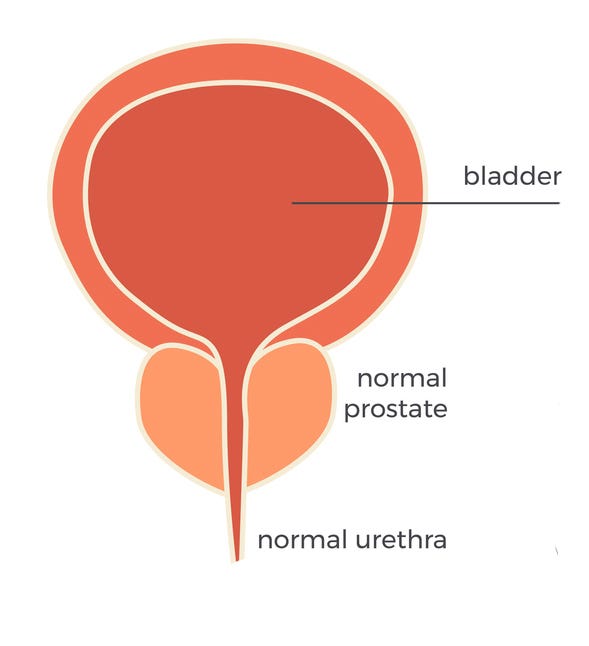
The Maker should have recalled this defective part centuries ago. A successful class-action suit has yet to be achieved. There are clearly design flaws. The main fluid-draining conduit runs right through the middle of this little walnut-shaped gland but it is integral to one of the higher orders of human experience. Location, location, location.
If you get any swelling or irritation in this flawed part, you’re stuck with the ridiculous drama of having to know the location of every public drainage facility for miles around. Clearly Google or Apple and all of their Silicon Valley partners should have resolved this problem by now. They should have an ‘app’ for this fix.
The same could be said of 12% of women stricken by breast cancer. A similar recall should happen for the brain defects in those who blithely dismiss the worthiness of 47% of the rest of the world who don’t measure up, in their judgment, to their station in life. “Takers,” they say, as opposed to “the job creators like us.” Didn’t society move beyond the 19th century classism portrayed in the PBS series Upstairs Downstairs?
The prostate cancer, with which you’ve been diagnosed, lingers on like a giant outdoor billboard plopped down on your front yard. The huge billboard says YOU HAVE CANCER! To our dismay, the giant billboard also appears in every living space of your life: at home, work and at leisure. CANCER no less. . . . ME, for crying out loud.
So with your new diagnosis, you are clumsily lurching in and out of all of Kubler-Ross’ s stages of facing Death and Dying: Denial, Anger, Bargaining, Depression and Acceptance.¹¹ But if we stay stuck in the denial stage, we die.
¹¹ Elisabeth Kubler-Ross, On Death and Dying: What the Dying Have to Teach Doctors, Nurses, Clergy and Their Own Families. Scribner, 1969.
Living in Transition
Regardless of your grasp on reality, this diagnostic brings a renewed sense that life is now very temporary. No matter how many years you’ve enjoyed the comfort of your personal lifestyle and all of its familiar coffee shops, sporting events, favorite shopping malls and TV shows. Like the song says, “This world is not my home, I’m just a-passing through” Like it or not, EVERYTHING changes.
So with cancer, hanging out in every corner of your life, there’s a real sense of loss. You are jolted into realizing that you are now in the ever-shortening last stage of your life. Your life is going to change. Life will never be the same as before.
Your First Ink Job: Everyone Loves a Tattoo
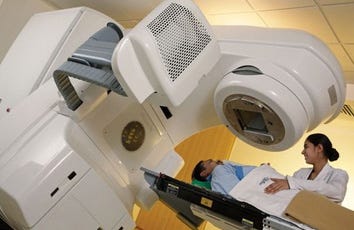
Before you have your prostate radiated to kill the cancer, they put you naked on the front end of a CAT imaging scanner to carefully give you three tattoos. They place these little black dots on your body: one just above your groin and the another two — one on each hip. They tattoo you in preparation for when you will be placed in the IMRT machine (shown above). Daily, for forty-five days, they use these tattoos to aim the IMRT¹² so that it accurately delivers the radiation only to your prostate. You feel like a lab rat. There is little dignity in this procedure but you’ll do anything to survive.
¹² IMRT stands for Intensity Modulated Radiation Therapy. It is a state-of-the-art radiation delivery system that is used to treat difficult-to-reach tumors. Western New York Cancer Care Center has 3 of these 5 million dollar machines at their Harlem Road clinic alone. The Pinterest image (above) is from BLK Super Speciality Hospital. It is a Triology Tx Linear Accelerator with cone beam CT for Radiation Oncology — Triology Tx is equipment used in providing Image guided radiotherapy (IGRT), Intensity Modulated Radiotherapy (IMRT) and Gated Radiotherapy.
Curiously, these three tattoo dots are permanently on you and may someday cause an examining coroner to wonder. Thankfully, being radiated for prostate cancer is painless. It is a miraculous treatment.
As you are sitting in the patient waiting rooms, you cling to trust. At the cancer care center, the attendants wear white coats but their uniforms are not necessary. These five million dollar IMRT machines buzz their merry way around your half naked body like R2D2 on steroids dispensing radiation. We know the staff working these radiation machines are competent or they wouldn’t be allowed to manage such a large financial investment of medical machinery. As far as I’m concerned, they can ditch the white coats and wear T-shirts and jeans if they’d like. For that matter, they could come to work wearing superhero costumes like Batman, Spider-Man, Wonder Woman or The Hulk.
As a patient, you have large amounts of hope and that’s the holy grail of the healing process. Yet you know life will not be the same from this point on. Any unrealistic hope for permanence must always give way to reality.
“Life is what happens when you’re making other plans.” Reality always holds all the winning cards. And with whatever cards you’ve been dealt, you optimistically call the other side of your transition “the new normal.” You say to yourself, “I’ll get through this! Other people have had this.”
At Cancer Care Center of WNY it’s a battle zone.¹³ You see a lot of suffering and pain on the faces around you. You see the fear, the pain and the depression. Sometimes there is brokenness. There are folks shuffling in and you wonder how it is that they are still on their feet. You can tell they have other medical problems that will necessitate even more extensive care in the time ahead.
¹³ The Cancer Care of Western New York is located at 3085 Harlem Rd #200, Cheektowaga, NY 14225 (716) 844–5500.
One day, in the waiting area, I saw an elderly woman brought in for therapy in a wheelchair as many are. Shortly after arriving, she began to cry. She was weeping from her unbearable pain. Whatever was the cause, maybe her cancer had metastasized to the bone, the enormity of her internal pain could not silently be contained in her frail body. Fortunately, staff rushed over and helped her into an examination room for immediate pain management. In this woman’s pain and despair, the nurses showed compassion and intervened.
Despite all the suffering you see around you, you stay focused and resilient. Your energy and fortitude, in the midst of all that is going on around you, is remarkable.
When you received your cancer diagnosis and then went through the forty-five days daily radiation treatments, you realized that you, and all the other patients there, are in the midst of a transition. Each of us has experienced transitions throughout life only this one is much more ominous.
We Experience Transitions Throughout Life
We’ll experience transitions in our relationships, in our careers and certainly in our health. You and I will even change our thinking on some things we once valued above all else. Some of what we once passionately pursued will be abandoned for other things we’ve come to value as more important. As the old Simon and Garfunkel song said, “When I think back on all the crap I learned in high school, it’s a wonder I can think at all.”
As much as we like to embrace our seemingly unchanging world, it all changes. It is constantly changing and we simply can’t control most of it. But what we can control is our response to our own transitions and that of others around us.
Finding God in Or Transitions
When we think back through our transitions, we remember the difficult ones. But who were the people who helped us most in those trying times?
They were “significant others,” right? It was a partner, friend or relative who was particularly present with us when things got out of hand and when it was most scary.
In my experience, my wife Linda was a constant presence throughout my cancer radiation treatments. She listened to me when I made no sense. She ‘talked me off the cliff’ when I was frantic with worry. She stayed with me to help me get more information. She was there to take in and absorb my frustration, my denial, anger, bargaining, depression and ultimately my slow and reluctant acceptance of the way things landed. She was “my person” as the Christina and Meredith characters portrayed (in ABC’s Grey’s Anatomy). My wife Linda has been my “person” for 50 years. She has been the presence of God in my life.
I also realized the divine presence in the nursing staff when I was undergoing radiation therapy. It was always the little acts of kindness that helped me make it through the ordeals.
Career Transitions
I was a Protestant minister, on and off, for fifteen years. I loved that work and the many ways I could participate in the learning and healing process. The teaching, the counseling, the writing and all those opportunities to be creative were at the center of my career life for 60 to 80 hours a week. But I was burned out.
This is no news flash but like each of you, sometimes clergy would like to do something different in their career and their lives. Why would they be any different? I needed to get away from the seemingly endless hours of funerals, crisis counseling and the usual petty skirmishes over which color to paint the lavatories. The pitched battles and the bloodletting over whether to invest in the youth groups were draining. Then there was the search for a miracle to pay for needed building repairs.
One year, I changed careers. I went into technology and communications. At first, people were utterly shocked that I’d make such a change. Early on, I discovered that nothing had changed within me. I found the obvious truth that customers seeking marketing or technical help, need the same focus and caring attention as those who were once my parishioners. Obviously different contexts and delivery of services but the same focused listening and human caring is needed.
So how is that relevant to this reflection on the presence of God?
People seem willing to look all over the place for this treasure. They will spend hours launching prayers into the heavens. They will travel halfway around the world to visit a monastery in India or to take part in a mission trip to Belize. The last place most people look is right under their feet, in the everyday activities, accidents, and encounters of their lives. What possible spiritual significance could a trip to the grocery store have? How could something as common as a toothache be a door to greater life? No one longs for what he or she already has, and yet the accumulated insight of those wise about the spiritual life suggests that the reason so many of us cannot see the red X that marks the spot is because we are standing on it. The treasure we seek requires no lengthy expedition, no expensive equipment, no superior aptitude or special company. All we lack is the willingness to imagine that we already have everything we need. The only thing missing is our consent to be where we are.”¹⁴
¹⁴ An Altar in the World: A Geography of Faith by Barbara Brown Taylor (First Harpercollins, Paperback Edition Published 2010 ISBN 978–0–06–137047–2.
If you do believe that God is present in your life, even when God seems to be the farthest thing from your mind, how is God’s presence relevant to you now? Where is God as you put down this article and assume the transitions that you know about and the coming ones that will utterly take you by surprise?
Despite all the irrelevant judgmental religiosity you may have seen through your years from institutional religion, where is God present in your life now? No matter how boringly traditional or intolerant some of the religious communities may have been through your years, doesn’t it come down to how little time you and I actually have left? And quite frankly, you’ve had it with the trivial drama and the phony piety. You haven’t got time for the pain. You want and need God to be real and present. So where will you find the reality of the presence of the living God?
It is when we are off balance that we are more receptive to God’s presence.
I believe that you and I find the presence of God in the midst of our transitions. We find God when others are compassionately present with us in our fearful times of transition. We will also find God as we are compassionately present with others in their transitions. That’s because we are most receptive to compassion in the moments we find ourselves off balance. It’s in our times of vulnerability and when we know that life will never again be the same. It is then, in those quiet moments, that we come alive to who “our Person” is. It might be your life’s partner. It may be a caring healthcare professional.
When we wake up with gratitude that someone has really been there for us, emotionally, intellectually, physically — what we are walking up to is the presence of God’s Spirit Who has come to us in those moments. God’s Spirit compassionately, patiently, knowledgeably . . . embodied in the person right in front of our eyes.
Maybe it’s someone who has been with you all these years or someone else who has mysteriously appeared on the scene, seemingly out of nowhere. They were there, right when you needed them. Maybe God has been showing up in your life in the presence of a caring medical professional or even another patient as you wait your turn for your cancer treatment.
Think back through your transitions. You remember those who were there when you needed them. They appeared even when you hadn’t sought their help. It was God making an appearance when you were in that transition. “Bidden or unbidden.” That’s why you have the faith you do. You have found God to be a loving Presence in your life and you know you’re not making this up.
God isn’t any more present with us in one moment or another. God is always by our side when we quietly pray, when we’re cussing out the driver who cut us off and when we’ve just received the life-changing news that life can’t go back to the way it used to be.
Bidden or unbidden, God is present. So deal with it, Jung is saying.
Despite our usual mediocre mindfulness of what a big deal God is, … despite our personal lack of perception of the reality of the presence of God, . . . God is here–really!
Maybe that’s why Bob Dylan said of our culture:
We make everything from toy guns that spark To flesh-colored Christs that glow in the dark It’s easy to see without looking too far That not much is really sacred”¹⁵
¹⁵ From Dylan’s 1965 “It’s Alright, Ma (I’m Only Bleeding)” song from his Bringing It It All Back Home album.
So what is sacred in your life? Where is God now for you, whether or not you’ve called upon God? And Who is God in your life?
Here is the difference that cultivating and deepening your mindfulness of the Presence of God will make in your life. You will transform your life from waiting for the other shoe to drop to becoming the author of the novel of your life. Instead of living your life, waiting for something outside of you to change and motivate you to change — put on your existing shoes and move directly through your next transition. Create your own next transition, as far as it is within your abilities. Make your own changes for your life. Move into the challenges that you can create. You’re standing right on the big X. If you compassionately respond to the transitions right in front of you, and those going on in the lives of those around you, you will experience the living presence of God. And you can’t have a more exciting and fulfilling life than that.
