
Finding the Audacity to Assume Your Own Brilliance
Or: What I learned from Andy Warhol
My daughters and I went to the Carnegie Museum of Art and the Andy Warhol Museum in Pittsburgh recently. There are a couple things I haven’t been able to get off my mind since.
(Before I get into that, though. I also learned that Carnegie is pronounced car-NAY-ghee, not CAR-nuh-ghee. It rhymes with ‘Hey, gee’, not ‘Peggy.’ And it hurts my brain to say it right. This must be what people feel like when they’re told it’s Nev-A-da, not Nev-ah-dah. But, I digress.)
There were two pieces of art at the Carnegie Museum of Art that struck me.
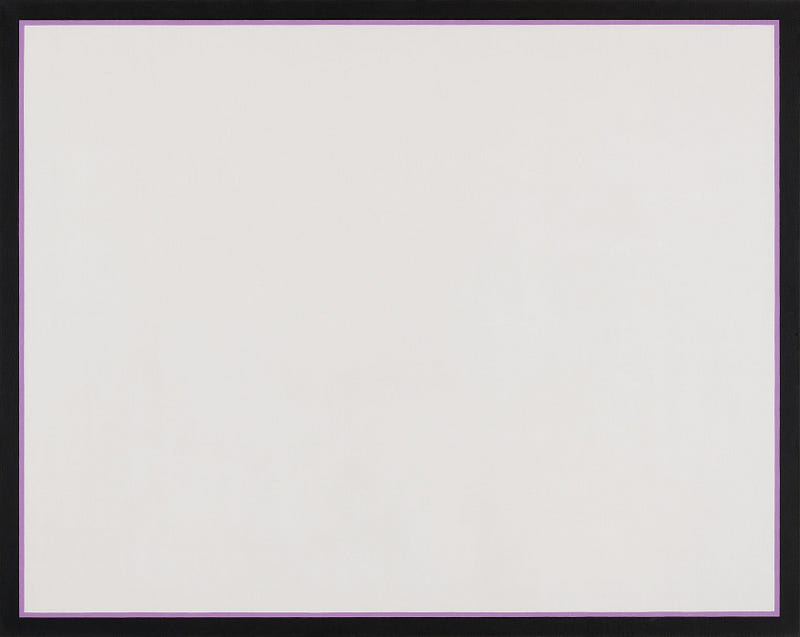
One is a large (maybe five feet square) canvas that’s painted white with a thin border of black around the edges that’s trimmed with an equally thin border of violet purple.
It’s an oil on canvas painted by Jo Baer in 1966/1967.
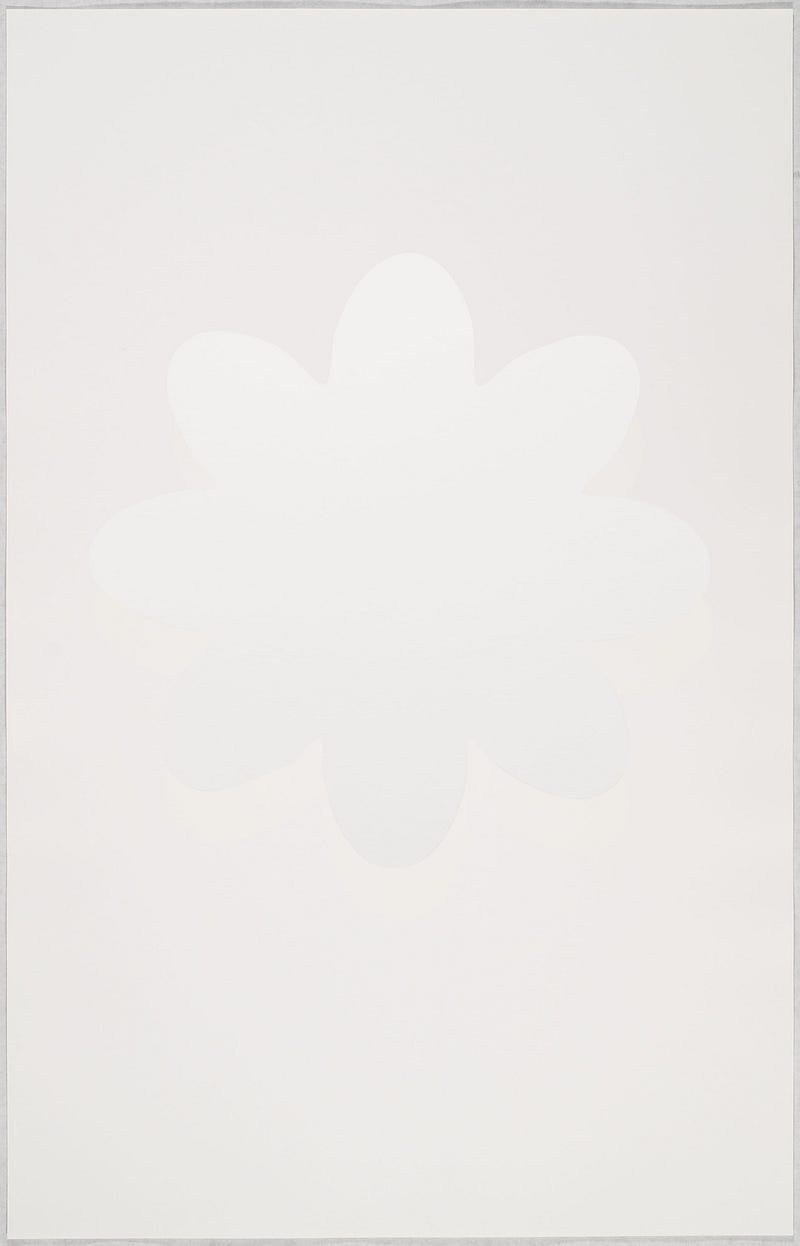
The second is a 2006 screen print by Polly Apfelbaum. When I saw it, it looked to me like a framed sheet of white paper. I thought to myself — oh, that’s weird. They must still be putting this exhibit together.
But there was a plaque next to it that named it ‘Monarchists.’ So, I was wrong.
It wasn’t until I was writing this piece and looked up an image of that print that I realized it wasn’t a framed sheet of white paper. There’s a white printed flower on it. (That flower is Apfelbaum’s signature design.)
Standing in front of this piece at the museum, I couldn’t see the flower at all. To me it looked like a framed sheet of copy paper.
I can’t get it out of my head that there are, essentially, two pieces of art at the Carnegie Art Museum right now that are, for the most part, just — framed white space. White paint. White paper.
I was struck by the sheer audacity involved in being an artist.
This was a revelation to me. Because it got me thinking.
I love art that makes me feel like I can create something. As I write this, the strongest thought in my head is: I’m not an artist. But I like to make art. I like to paint or sketch or glue paper to other paper.
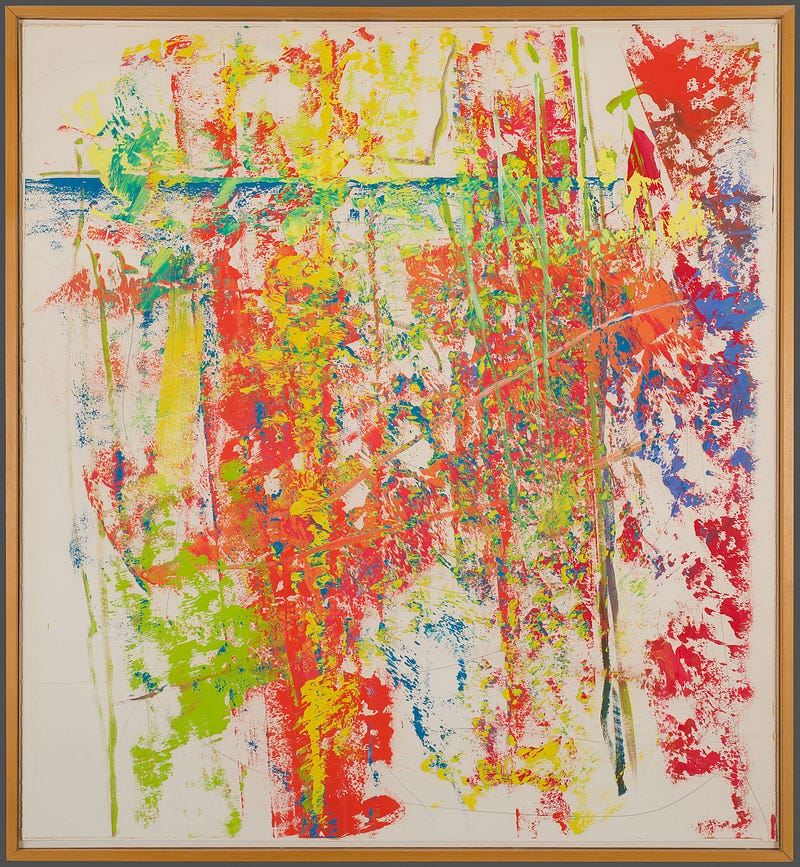
I love art that makes me feel like maybe I could be one. Like this 1986 Gerhard Richter painting. It makes me want to make something.
On the other hand, there’s this painting by Mary Cassatt. It is stunning. But it doesn’t inspire me to paint. It actually reinforces the idea that I’m not an artist. I’m an art lover. But I could never do this.
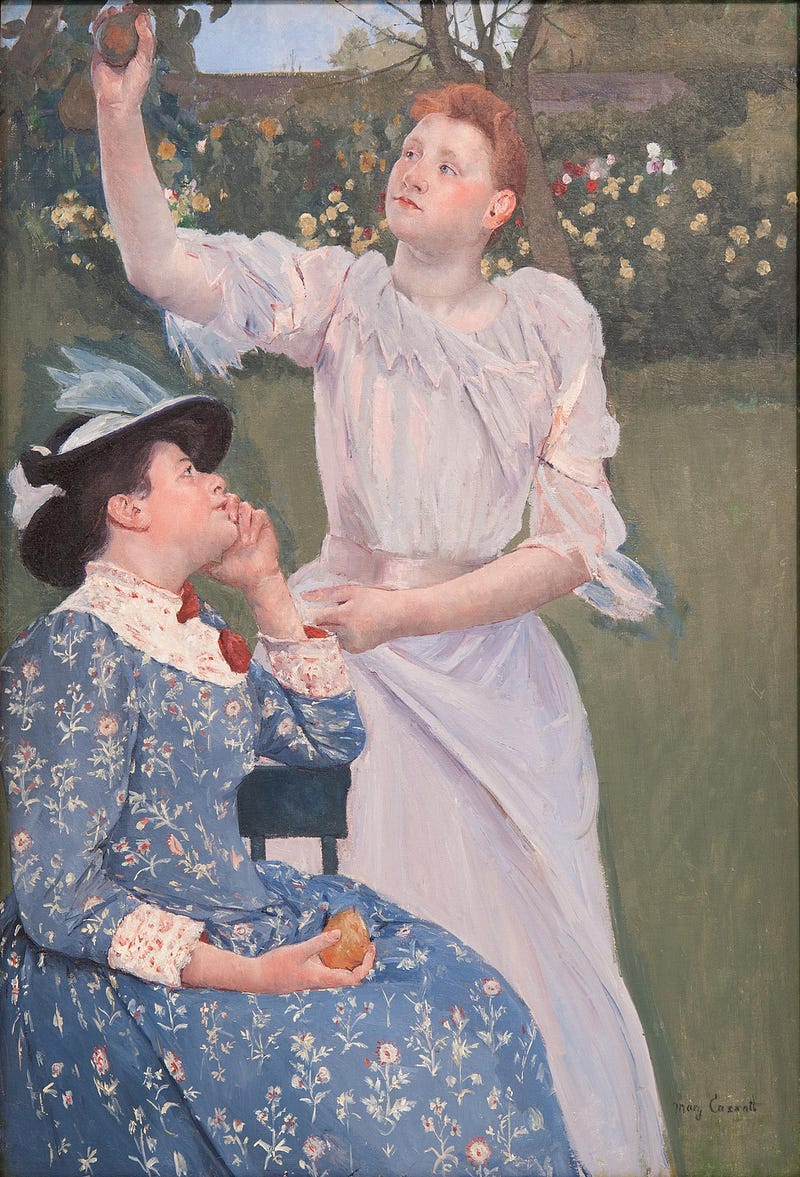
I’m so far from being technically able to create something like this, that I don’t even want to try. I lack the audacity — the willingness to take bold risks — it would take for me to even decide to attempt to paint this way.
In other words — I’ve already decided that I can’t. So I don’t.
I get that same feeling with writing sometimes.
If I read something that’s utterly perfect to me, I start to wonder what in the world I think I’m actually doing with words. But it’s different. I can meet that self-doubt with a decision to up my writing game.
I believe I’m a good writer. So, even when I’m hit with self-doubt, I’m not derailed. I’ve already developed the audacity it takes to be a writer.
That’s part of why I love Andy Warhol so much.
The man spent the last 15 or so years of his life collecting his stuff. In boxes. He called them time capsules. They contained everything from rare fine art to (I swear) used condoms and toenail clippings.
There are more than 600 of these time capsule boxes at the Andy Warhol museum.
A plaque at the museum said that he envisioned people buying his boxes after he died. Like mystery grab bags. Imagine being the lucky guy who bought the used condoms and toenail clippings box.
If this isn’t the embodiment of sheer audacity, I don’t know what is.
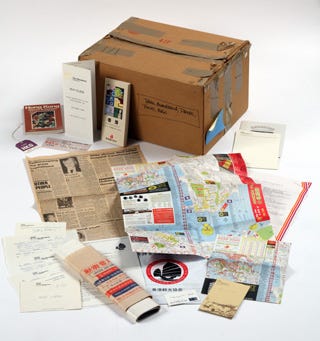
I left the Andy Warhol museum with a deep desire to make something. I leave ready to create something. Warhol taught me that there is brilliance in everyone and that the key is to give yourself permission to own it.
Those white pieces at the Carnegie Art Museum, in combination with immersing in Warhol for an afternoon, got me thinking about a question that has shifted my mind in ways I wasn’t quite prepared for.
What if the only thing holding me back is the belief that I’m not brilliant?
Let’s unpack that a little.
Andy Warhol was brilliant. A genius, even. At least in part because he believed he was and behaved like he was. The man collected his garbage in 600+ boxes because he truly believed that the masses would consider them art and want to own them.
And he was right. Someone, at some point, believed that those boxes were too precious to be sold to 600+ people. They belonged in a museum. And someone else paid $30,000 just to be the guy who opened the last box that was inventoried by that museum.
Jo Baer found the audacity to present a white-painted canvas with a black-and-violet border to an art museum.
Polly Apfelbaum decided that a simple white flower printed on white paper — that isn’t visible when you’re standing in front of it — belonged in her Carnegie Art Museum collection.
I can’t tell you how many times I’ve said that I’m not an artist.
I’m not good at it. I can’t draw/paint/whatever. I’m a terrible artist. How many times did my brain need to hear that, before it accepted it as truth?
But what if right now, today, I decided that I’m a fucking virtuoso?
I’m not just an artist. I’m an art phenom. A prodigy.
What if I lived my life as if I was an artist. I called myself an artist. And then I started making art.
What if I had the audacity to assume my own brilliance?
What if you did?
I can tell you this much.
When I was in the tenth grade, my English teacher wrote you could be a writer on an essay and that one little statement changed my life.
Because I believed her. I was fifteen and that one tiny bit of encouragement stuck in my gray matter. I could be a writer stuck around long enough to become truth.
So I started writing — not for school. For me. And I basically never stopped. Now I’m a full-time professional writer. I’ve had novels published by Penguin and Macmillan.
So, believing that I could be a writer has worked in my life just as well as believing I’m not an artist has.
Our brains have to filter through an outrageous amount of data every second of every day.
Your reticular formation is located in your brain. And one of its jobs is habituation. Habituation is the process your brain uses to choose what stimuli to ignore.
Because it has to ignore some, for you to survive.
Habituation is why we don’t smell the cat pee in our own carpet. It’s why other people’s eating sounds make me want to hurt someone, but my own don’t bother me at all. It’s why gradually lighting a room doesn’t startle us the way that flicking on the overhead all of a sudden does.
Because the brain has to filter through so much every moment of everyday, it has a system for picking out the most important stuff.
So, what if the reason I’m not an artist is because I’ve trained myself to believe that I’m not?
I’m not a lot of things. In fact, I’m not most things.
But most of those things, I’m not because I decided not to be. I’m not a doctor, a lawyer, or a social worker because I made a decision at some point not to pursue those vocations.
I’ve never said — I’m no good at law or social work or medicine. I’m aware that the reason I’m not any of those things is because I decided to be a writer and a teacher.
So, I’m not a lawyer because I don’t want to be one. But I’m not an artist because I’m not good at art.
Can you see the difference?
What if we have all built invisible walls around ourselves.
If we tell ourselves we can’t do a thing often enough, our brains decide it’s true and that reticular formation locks it away as something to filter out.
I’m not a doctor because I made a decision not to go to medical school. I didn’t spend much time thinking about it. Actually, no time. Because I’ve never actually wanted to be a doctor.
I still made a decision, if only by choosing to do something else.
But — as I sit here writing this and thinking about why I’ve never wanted to be a doctor, one thought is the most prominent.
I never wanted to be a doctor because there’s too much math. And I’m not good at math.
I hate math. I suck at it. I had to take THREE remedial college math classes before I finally, finally passed the one class (a pretty basic algebra course) that I needed to graduate with a liberal arts degree.
I didn’t make a decision to not be good at math. I just kind of decided it was true, after it hurt my brain a few times. Math just bounces off, without even trying to penetrate my gray matter.
I can remember hating math as far back as elementary school when I couldn’t memorize the times tables as quickly as I wanted to. So — if something involves math, it runs into that invisible wall my reticular formation has built for me around the word ‘math.’
It looks like this: Math? Nope. I can’t.
There’s no invisible wall for doctor. So instead of feeling like it’s impossible, I just feel like I don’t want to. I could, but I don’t want to go to medical school in my fifties anymore than I wanted to when I graduated high school.
It looks like this: Doctor? No, I don’t want to.
That’s the difference. I don’t lack audacity around being a doctor. I just had to filter out possibilities and writing/teaching won out. But I absolutely lack audacity when it comes to math.
Being a doctor — I don’t want to, so I don’t. Math — I don’t think I can, so I can’t.
Many people have walls around writing.
I’ve heard the same response probably 10,000 times when I tell people that I’m a writer. Some variation on ‘I can’t write.’
My brother is a natural storyteller. I’ve tried to get him to write a book and he consistently says — I’m not a writer.
So: Write? Nope. I can’t.
Not: Write? No, I don’t want to.
His brain believes he’s not a writer, so even the idea of writing something that someone else might read feels nonsensical to him.
Which is similar to how I feel when I think about creating any kind of art that anyone outside of myself might look at.
Ridiculous. No way. I’m not an artist.
But, I actually did try to put my art out there once.
I made an art journal and put it on Etsy for $100. Someone bought it.
Someone paid me $100 for a artisan notebook that I made. You know what happened next? Nothing.
I didn’t do it again. I tried to slip past my invisible wall — and even though it worked, I ran right into it again.
I’m not an artist. I can’t make art. Even if I did have one fluke sale. There are real artists out there and eventually everyone will realize that I’m a fraud.
Because I’m not an artist.
I don’t have the same mindset for writing. If I publish something and it doesn’t do well — I write something else. And I publish it. Because somewhere along the way, I decided that I was an actual writer.
And failure is just part of the process.
So, here’s the big question.
What if I have the audacity to start behaving like I actually am an artist?
Not just an artist. A brilliant artist.
This is a little different from deciding that I’m great at math, music, or languages — because I can do it right now. I don’t have to learn any mechanics.
I can already paint a black and violet border on a white-painted canvas. Or print a white geometric flower on a white piece of paper. Or collect stuff into curated time capsules. Or screen print life-sized Elvises onto canvas.
I have those technical skills.
Here’s what I learned at the Carnegie Art Museum and the Andy Warhol Museum: Art is at least half just having the balls not only to do it, but to believe that you can.
I’ve taught countless people to say out loud — I’m a writer. To own it. Being a writer isn’t about being good. It’s about doing the work. If you do the work, good will come.
And it’s damned hard to do the work if you don’t have at least a little part of you, somewhere, that believes that you’re good at this thing. Or that you could be. That you have the potential to be.
Behave as if you are and you will be. Period.
It’s like travel. If you start north and keep heading in that direction, you will get north.
There’s no wiggle room there. Move northward, you’ll end up northward.
My favorite quote of all time is this one from Ray Bradbury:
Just write every day of your life. Read intensely. Then see what happens.
Those three small sentences have been my north star for years. They break down to three things.
- Do something, regularly.
- Pay attention to other people who have done that thing. With purpose.
- Have faith.
It’s an elegant equation for success in pretty much any pursuit. (Math my brain actually lets through.)
So what if that quote were: Just make art every day of your life. Observe intensely. Then see what happens?
Would I be an artist?
If it was: Just make music every day of your life. Listen intensely. Then see what happens.
Would I be a musician?
Or: Just practice Spanish every day of your life. Converse intensely. Then see what happens.
Would I be a fluent Spanish speaker?
Well, hell. I think I would. I really do.
Write your own Bradbury equation. Let me know what you come up with. I’d love to know what you plan to have the audacity to do.
Shaunta Grimes is a writer and teacher. She is an out-of-place Nevadan living in Northwestern PA with her husband, three superstar kids, Louie Baloo the dog, and Ollie Wilbur the cat. She’s on Instagram @ninjawritershop and is the author of Viral Nation, Rebel Nation, The Astonishing Maybe, and Center of Gravity. She is the original Ninja Writer.
Sign up for her Substack newsletter, Then See What Happens. Or follow her on TikTok.