
The Authentic Eclectic
Finding Peace on the Spectrum: Thoughts on My ASD Diagnosis
Earlier this year, something I’d long suspected about myself was confirmed; my brain operates differently than that of “normal” people. The diagnosis of ASD (Autism Spectrum Disorder) that I received last month brought with it a sense of peace, as it’s led me a bit closer to understanding why I’ve always had such a difficult time with relationships, why I’ve so often been blindsided by life, repeatedly thrown off-kilter to the degree that the center wasn’t even something I could intuit anymore (if I ever really could).
My struggles with mental health have always been at the center of my life. And when I say always, I mean that my intense and crushing sadness and suicidal ideation prompted my mother to start taking me to a psychiatrist when I was 9. I remember feeling guilty about the visits as the doctor was an hour away and I understood it to be an expensive endeavor, but I loved his office with its exposed wooden beams and soft couches. It felt sophisticated and urbane, and he always asked me about the books I loved (CS Lewis was my thing at the moment). Books were the only thing I ever wanted to talk about, so I enjoyed the visits, though I don’t recall there being many.
Four decades later I’m sitting in a very different room, this one a tiny exam cell with cinder block walls painted the color of pale mint candy. The objective for this visit is the same as that long ago one, and dozens in between. I’m still trying to understand the endless war in my mind. The young psychiatrist before me is my fellow soldier, down deep with me in my brain’s trenches, fighting for justice in the battle for the gray matter. Actually, I should rephrase that — the war may not be endless after all. For the first time in my life, there’s been a lengthy rapprochement between the various splinter groups in my brain. I’ve been able, really since the inception of the pandemic, to find some peace and healing. Proper medication and vast amounts of personal work (made possible by the pandemic pause) have put me somewhere I’ve never been — on steady ground. And that peace has given me time to reflect on my life and the mental illness that has been at its core.
From where I stand now, I have a better vantage point. Beyond the depression and anxiety, there’s always been a basic misunderstanding between me and the world. I can see it more clearly, now that I’m not constantly struggling with suicidal tendencies; the bewilderment that so often arises when I realize once again I have a slightly different relationship with reality than most people. It terrifies me, which results in me acting in an odd or jagged, spiky way, which puts people off…and on it goes.
“And as a child, did you have any, let’s say, niche interests?” The young doctor is earnest, typing notes into a computer. My mind flashes briefly to Margaret Atwood’s Alias Grace and her young doctor, similarly endeavoring to peel back the layers of her occluded onion of a mind. I’m rooting for this young doctor. No mystery crime here, though. Just me, a middle-aged woman trying to figure out why things have always been so hard for me when it comes to my brain.
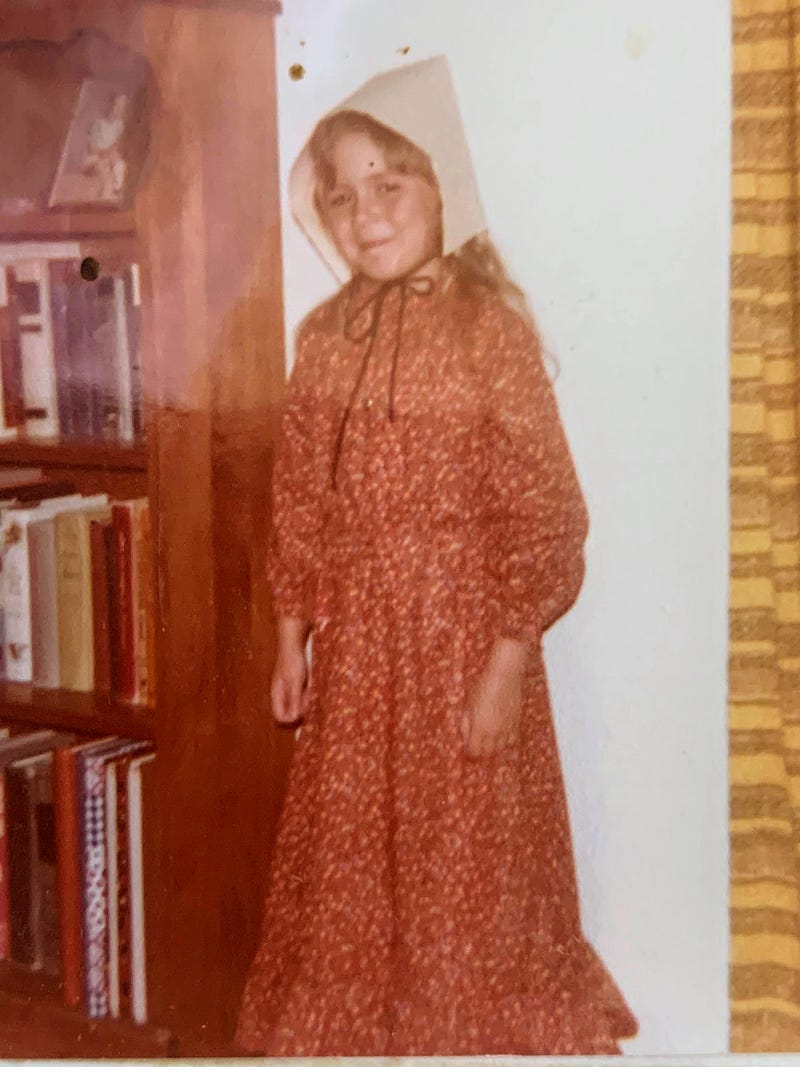
I try to paint for him a picture of me as a little girl, growing up in a conservative, redneck town in Texas: I’m eight years old and I’m obsessed with Little House on the Prairie. I pretend for days on end that I live in pioneer days. I coerce my mother into making me long dresses and bonnets to wear to school, where I live as an anachronism among children who point at me and giggle.
A bit later it’s Lady Diana who has enthralled me, and I spend my spare time learning about the British monarchy from library books. I am a pariah.
As far as academics go, I’m a wizard in English and history. I can always be counted on to weave a good yarn that employs complicated vocabulary on demand, to remember historical details, to create a dramatic mood — to burst out in tears. But math beyond arithmetic is horrifying and threatening to me, as is science — which pains me because I like to imagine a future in which I’m a “lady scientist,” discovering or inventing things that help people.
I tell the young psychiatrist, too, about how I get lost, always have, whether walking or driving, ridiculously easy. I can’t recall geographical layout and am disoriented easily. I’m terrible at judging distances — I’m clumsy and have screwy spatial awareness…my history was tumbling out now, and he was quickly typing as I told all the things that fit in my stream of thought.
It was to be my last in a series of diagnostic interviews. He brought in another doctor, the department head, to briefly follow up on what she understood of my case.
They told me I had Autism Spectrum Disorder (ASD) and offered resources to help me cope with it. I felt seen and understood as I never had before. I felt like I finally had a place to root myself when trying to understand myself with compassion. Throughout my life, my best intentions have been thwarted by my own brain. It hasn’t been (all) my fault.
It’s been a few weeks now since I got the diagnosis, and truthfully, not a lot has changed. But the subtle change is deep. A kinder understanding of myself and where I’m coming from. More patience with myself, and hopefully with other people. I’ve been validated, and that in itself has given me peace.