
SERIES | HISTORY OF ANCIENT WESTERN PHILOSOPHY, PT. 4
Finding One’s Way with Socrates
The Socratic Method in Plato’s Euthyphro
***This post is dedicated to the memory of my father. Thanks, Dad, for helping me find my way.***
Welcome to Part 4 in the series! As entries are added, they’ll be found here:
This installment is the first of several entries devoted to Plato’s earlier dialogues. Here we’ll introduce Socrates’ famous question-and-answer method of inquiry and consider why it’s so effective in imparting wisdom.
Plato was one of Socrates’ most devoted students… and certainly his most accomplished. He was born in 429 BCE — which means he would’ve been 30 years old when Socrates was tried and executed under charges of impiety.
Over the subsequent 50+ years, it’s believed Plato produced more than 30 dialogues and possibly 13 epistles… (although a few of those works may have been forged by others.)
It’s hard to know the exact order in which Plato wrote his dialogues, but the general weight of scholarly opinion has grouped them into four main periods of his professional life: the early, the transitional, the middle, and the late.
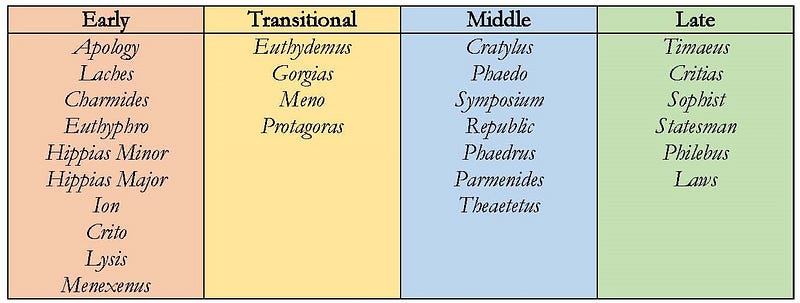
The reason for these groupings has to do both with changes in style and their philosophical focus.
The early dialogues tend to focus on events in the life of Socrates, Plato’s mentor, and they read more like reports on the views of the actual, historical Socrates — which is good because he doesn’t appear to have written his philosophy down. Slowly, over the course of his writing career, Plato’s own views start to creep in — although they’re always put into the mouth of Socrates, the character.
In this series, we’ll be looking at a few of the most popular dialogues from the first three periods of Plato’s corpus. Before we jump in, though, I’d like to mention something you won’t usually find in any textbook — namely, Plato’s terrific sense of humor.
Most scholars recognize what a gifted writer he was, and some even acknowledge that his works should be read on multiple levels simultaneously, the way most great literature should be read.
And, Plato’s work is just as much great literature as it is a great philosophy.
In fact, the ancient historian Diogenes Laertius (3rd c. CE) claimed Plato also wrote dramas and satiric comedies that were good enough to compete in the Athenian festivals — though these have since been lost. But, because philosophers in subsequent centuries weren’t terribly interested in cultivating a reputation for levity, many missed (or willfully ignored) the bawdy wit contained in many of Plato’s works.
To drive this point home, consider that Plato (or Platon as it would be said in Greek) wasn’t even this guy’s real name! According to numerous ancient sources, his real name was Aristocles and “Plato” was just a nickname that meant “broad” — given to him either because he had a wrestler’s broad shoulders or an exceptionally wide forehead.
This reminds me of a guy who played football at my high school. He was 5’2”, but had the broadest chest — and lowest center of gravity — on the team, so everybody called him “Stump”… because he was so hard to move.
Imagine that this guy went on to found a famous school, taught students from all over the world, authored numerous best-selling books, and appeared on all the major media outlets… all while continuing to insist that everyone just call him Stump!
That’s pretty close to what Plato did, and we should respect that kind of commitment to self-deprecating humor!
Plato’s Euthyphro
Now that we’ve got some of Plato’s background down. Let’s turn our attention to his depiction of the last few days of his mentor’s life.
Scholars have settled on the Euthyphro as possibly the first dialogue Plato completed. That’s why the Stephanus margin numbers for this dialogue start at 1.
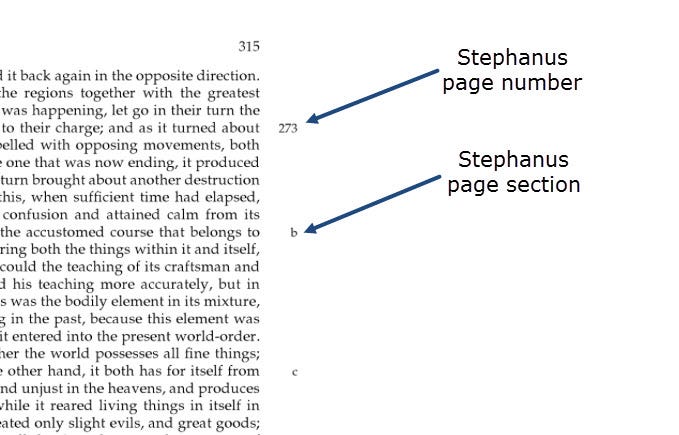
The dialogue itself opens in medias res (in the middle of things) as Socrates bumps into Euthyphro on the steps of the King Archon (a kind of chief magistrate in ancient Athens) on his way to answer the charges of impiety that have been brought against him by three young Athenians, Meletus, Anytus, and Lycon.
Euthyphro expresses surprise that someone would bring a suit against Socrates and assures him nothing will likely come of it.
As we discover, Euthyphro is there because he is bringing a murder case against his own father, who’d tied up a man that killed someone in a dispute until the proper authorities could arrive.
Tying up a presumed murderer wasn’t against Athenian law, but matters were complicated when the bound man died before justice could be served.
Socrates seems pretty taken aback… not by what Euthyphro’s father did, but by the fact that his OWN SON would bring charges against him under such circumstances. After all, most Athenians would agree sons should try to protect their fathers, not prosecute them!
Euthyphro exclaims that trying to cover up a murder — even for one’s own kin — shows a lack of understanding in matters of piety!
***As a sidebar, it’s important to note that in the Athenian legal system, any citizen could bring a suit against any other. Unfortunately, this system was sometimes abused by young men trying to make a name for themselves by successfully prosecuting someone of wide renown. Although there was a penalty for bringing a false (or “sycophantic”) suit, the accused would often pay a ransom to the accuser to have the case dropped before it went to court. This kind of abuse is likely one reason Plato wrote critically about Athenian democracy. (Matthew R. Christ’s The Litigious Athenian is a good source for more details.)***
Euthyphro was a mantis — someone employed in the holy temples of Apollo — so he spent his days thinking about righteousness and all matters holy.
Since he seems to be so sure about what piety truly is, Socrates implores Euthyphro to teach him the nature of piety… so he may better answer the charges brought against him by Meletus and the others.
This is a classic Socratic move — find someone who claims to know X and then ask them to give a clear account of what X is, IN ITSELF.
As we’ll see, Euthyphro fails miserably to give an adequate account of that thing he claims to know so clearly — just like so many others fail in their discussions with Socrates.
Defining Piety
The first three definitions Euthyphro gives don’t really answer Socrates’ question, though, and Socrates continues to probe Euthyphro for an adequate definition of piety. Rather than rehash those exchanges, I’ll just summarize them here:
Definition A: “Piety is prosecuting the wrongdoer.” [Stephanus 5d-e] — But, as Socrates points out, there are obviously other pious acts that don’t involve prosecution. So, this is only an INSTANCE, not a definition of piety, as such.
Definition B: “The pious is what is loved by the gods.” [6e-7a] — But, Socrates reminds Euthyphro about all those stories of how the gods disagree over what acts are just.
Definition C: “To be pious is to be loved by all the gods.” [9d] — But, as Socrates asks, is something pious because the gods love it, OR do the gods love it because it is pious?
This puts Euthyphro in a difficult spot...
The Dilemma
Socrates’ challenge to Euthyphro’s third definition is now famously known as Euthyphro’s dilemma.
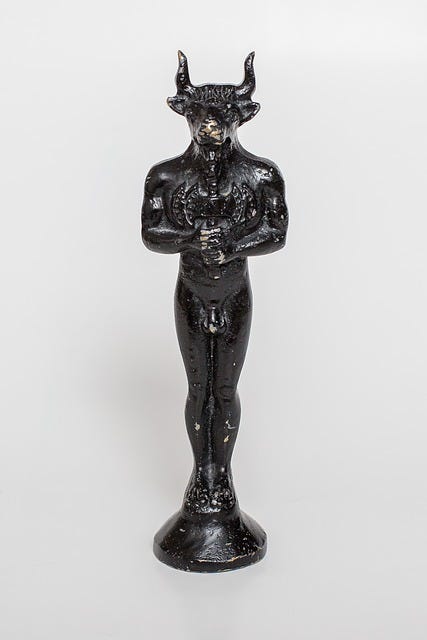
The ancient Greeks likened decisions involving a dilemma to a charging bull. Like the mythological Minotaur, there are two equally dangerous horns and anyone who refuses to choose either side will be trampled underfoot.
If Euthyphro chooses the first horn, and answers that the pious is called pious simply because the gods love it, he will face one set of problems…
First, piety would be rendered a matter of divine whim, which (as Greek mythology attests) could be a pretty volatile affair! Second, divine intervention would be required for people to learn what is pious. You’d have to constantly check in with the gods to be sure they hadn’t changed their minds! Third, the wisdom of the gods would be called into question… for arbitrary choice, without reasons, which is hardly what we’d call wise.
Finally, this side of the dilemma calls into question the objective goodness of the gods… for there would be no fact of the matter about the goodness of piety, it would just be a matter of what the gods willed. But, that’s equivalent to saying “The gods love what the gods love.”
But, if Euthyphro chooses the other horn of the dilemma and answers that the gods love the pious BECAUSE it is pious, he faces ANOTHER set of problems…
First, if the pious is objective, and not merely what is loved by the gods, then it is something that’s outside of their authority. Second, if there are truths outside of the gods’ jurisdiction, then their power is limited, insofar as they’re unable to alter such truths. Finally, if these standards truly are objective, then it might be possible to find the pious and other objective truths with reason alone, i.e. without the help of any gods, at all.
Despite these blasphemous consequences, this is the option Euthyphro chooses!
Arguing in Circles…
Now that Euthyphro has asserted the objective nature of piety, the examination can continue.
Euthyphro next tries connecting piety to justice. Again, I’ll summarize…
Definition D: “Piety is a part of justice concerning the care of the gods.” [12d] — But, as Socrates points out, piety could not benefit the gods, since (as divine beings) the gods cannot be made better. Nor is it service to the gods, since it does not help them achieve any end.
Definition E: “Piety is knowing how to give to, and beg from, the gods.” [14b] — But, Socrates reminds Euthyphro that to give correctly is to satisfy needs, and the gods have no needs to be satisfied. So, there is no correct giving when it comes to gods, and hence, no knowledge of how to give to the gods.
Definition F: “Piety is giving to gods in such a way that it pleases them.” [14e] — But, this means the same thing as the earlier definition (Definition B)that piety is what the gods love.
So, Euthyphro and Socrates seem to have argued in a circle. In fact, we might think of Plato’s dialogue as an extended lesson in the logical fallacy known as Petitio Principii [a.k.a. “Begging the Question”].
Socrates jokes:
“Your statements, Euthyphro, are like works of my ancestor Daedalus, and if I were the one who made or advanced them, you might laugh at me and say that on account of my relationship to him my works in words run away and won’t stay where they are put.” [11b-c]
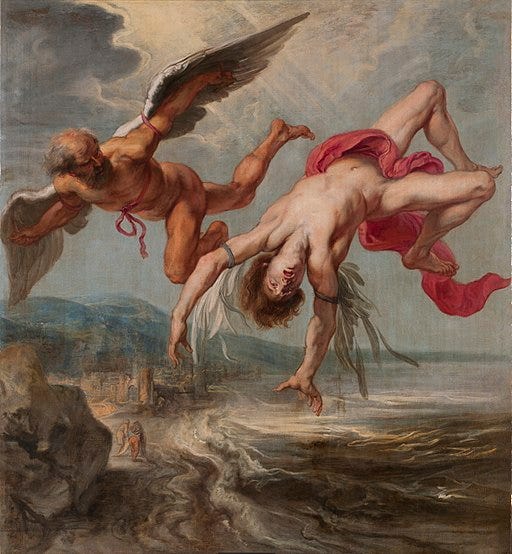
Daedalus was a famous inventor who was rumored to have built statues that could walk in circles. (You may have also heard another story about him building wings for his son Icarus.)
Lost on the Path to Truth…
At Stephanus 14c, Socrates states:
“For now, when you were close upon it you turned aside; and if you had answered it, I should already have obtained from you all the instruction I need about piety. But, as things are, the questioner must follow the one questioned wherever he leads.”
This highlights Socrates’ method of question and answer — known as the elenchus. He seems to be GUIDING Euthyphro toward an answer, but he claims that — as the questioner — he must FOLLOW wherever Euthyphro’s answer takes them.
Socrates is guiding without directing, teaching without instructing.
Unlike most Athenians, Socrates wasn’t interested in impressing others with his oratorical skills. He sought the truth, rather than popularity, power, or material possessions.
This made Socrates seem weird to the Athenians, who were used to speakers trying to make themselves look good by diminishing others. (This is probably another feature of Athenian democracy which Plato grew to detest.)
But, Socrates praised OTHERS, rather than himself, and they would end up looking foolish, anyway.
I think this might be why folks who are new to philosophy sometimes think of Socrates as the ancient equivalent of an internet troll — someone only interested in making others look stupid.
But, Socrates used the elenchus in an effort to educate his fellow Athenians about what should REALLY matter. To achieve this, he had to strip away the bad mental habits they’d developed through years of just following the crowd.
To illustrate the goal of the elenchus, consider the town in which I grew up — Jacksonville, Florida. With a city limit of over 840 square miles, it has the dubious distinction of having the largest land area of any city in the lower 48 states.
When I was learning to drive, my father worried I’d get lost in such a sprawling metropolis — so he devised a way of helping me learn to navigate that was very much in the spirit of Socrates’ elenchus.
He’d cover my eyes and drive me out to some part of town I’d never seen, then we’d switch seats and I would have to find my way back home from behind the wheel — after removing the blindfold, of course!
He’d guide me home without directing me.
If I asked him which way to turn at an intersection, he’d say things like, “What way do YOU think is best?” “WHY does that feel right to you?” “Look around, what do you NOTICE about where we are?”
This was obviously NOT the most efficient way to get home… but it WAS the most efficient way to teach me how to find my OWN way.
My father was preparing me for a lifetime of navigation without him. Socrates was likewise trying to prepare his fellow citizens for lifelong learning and inquiry — long after he was gone.
But, the elenchus requires a willing navigator.
In graduate school, I tried to help a friend with his horrible sense of direction by using my father’s method. Instead of blindfolding my friend, though, I invited him out for a drink in a part of town I knew he had never been. As we were ready to drive home, I used the excuse of having had a second beer to get him behind the wheel.
Being a good friend, and someone who never had more than one drink, my friend was more than happy to take the wheel. Whenever we came to an intersection and he asked which way to go, I would answer the way my father had answered me.
As you might imagine, my friend was not pleased, even after I revealed how I was trying to help him. He became frustrated, pulled the car over, and refused to continue unless I gave him clear directions.

This explains why so many of the Socratic dialogues end in what the Greeks called APORIA — which literally means “without a pathway,” but was used as a colloquial way of referencing a sense of wonder — as in “I wonder which direction we should go now.”
Euthyphro, like my friend in grad school, did not willingly join in this pursuit for truth, grew frustrated, and turned away.
The elenchus may be uncomfortable, but the goal is to benefit the one answering the questions, just as an unsavory tonic might fortify the health of the one who drinks it.
The driving analogy is ALMOST a perfect fit. There’s one difference, though.
My father KNEW the way home, but Socrates claims throughout the dialogues to not know the truth. As he puts it in the Meno: “…it is not from any sureness in myself that I cause others to doubt: it is from being in more doubt than anyone else…” (80c)
Scholars disagree on how to handle this.
Some say if Socrates really is a guide, surely he can’t be serious when he claims to be full of doubt! They call it Socratic irony.
Others say Socrates’ claims to ignorance really mean that pursuing truth philosophically can never lead to ABSOLUTE certainty about anything. They call it Socratic skepticism.
Finding One’s Own Way…
I’d suggest there’s a third explanation available to us hidden in the driving analogy, though.
It’s true that my father knew how to get home, but during our wanderings about the city he’d often express surprise that I’d stumbled upon a path — sometimes even a shortcut — of which he had been previously unaware.
So, even the guide can discover new insights through this sort of collaboration.
There’s something else that’s more important, though. On one particularly frustrating afternoon of driving around aimlessly, I asked my father why he would prefer driving all over town with me instead of just getting home quickly.
I’ll never forget his answer…
“Son, we’re not just learning how to get home, we’re also learning about EACH OTHER.”
I think this reveals the moral element in the Socratic elenchus that most folks overlook. The guide models patience, compassion, and cooperation… while the one being guided gets to practice listening, attending to details, and a little self-reliance.
Together, they build a bond of trust and mutual appreciation that is the bedrock of any healthy family.
Or, perhaps even a healthy democracy.
In Part 5 we’ll take at look at how Socrates answered the charges against him and why he chose not to flee from his punishment when we turn to Plato’s dialogues the Apology and the Crito.
See you there!