LODESTAR GAZETTE | NONFICTION
Finding my Way.
The connection between a 1951 movie, an old East German machine and the worlds of the future?
The movie, The Day the Earth Stood Still, the 1951 black and white version, has a lot to answer for. I first saw it when I was a teenager and it blew my mind.
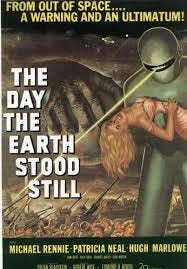
This is my favourite line, apart from Gort. Barada Nikto!
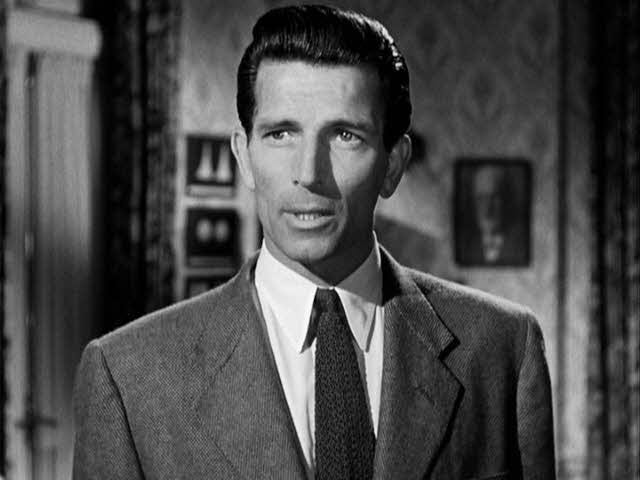
What, you might ask, is a reference to a 1950s Sci-fi film doing here. And, when will I get to the point?
Well, the real story behind that started in 1979.
That was the year I completed all the qualifying conditions to hold a Certificate of Competency as a Second Mate (Foreign Going) in the Merchant Navy. This meant that I was considered competent to keep the middle watch (midnight to four a.m.) when the vessel was at sea and to be responsible for the safe navigation of the vessel.
Back then, you needed a sextant, a chronometer, an almanac and a set of nautical calculation tables to define your position when out of sight of land. The almanac gave you the positions of celestial bodies, the sextant allowed you to measure angles, the chronometer showed the exact time in Greenwich and the tables enabled easy calculations in spherical trigonometry. Of course, now it’s all done by satellite and provided as a real-time readout of Latitude and Longitude, or shown on a moving electronic chart in the ship’s wheelhouse.
As was the custom, on passing my Second Mate’s, I bought my own sextant. My choice was a Carl Zeiss Jena Drum Sextant, made by VEB Freiberger Prazionsmechanik of Freiberg, East Germany. It was purchased from J D Potter Ltd of the Minories, London and cost me a month’s salary.
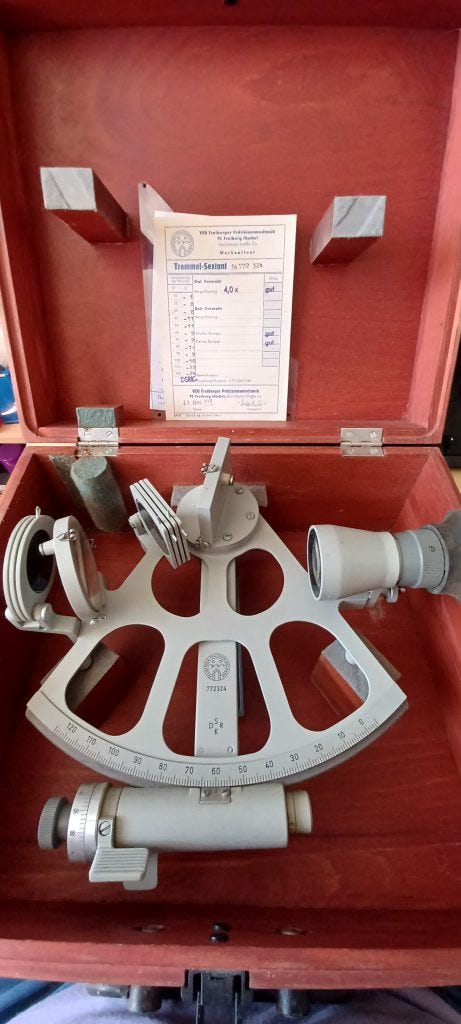
With that, I was all set. My trusty sextant helped me get around the planet (see where I’m going?) for many years.
Of course, astronomical navigation was only one aspect of the Second Mate’s job. Passage planning, the preparation and drawing of the vessel’s proposed courses on navigational charts was also a large part of the job.
Making sure that you avoided all the rocks, got within visibility of the important landmarks (to check your position) and took the least possible safe distance from A to B was the aim.
To reduce the process to its basics, you started planning on the smallest scale chart, then transferred the waypoints and amended your route as you zoomed in.
Moving on, when I was thinking about how my spaceships would get around the Galaxy (cue the reference from the film), I couldn’t really use the same sort of idea of a man with a sextant and a set of tables. So I went with the electronic chart option, the only real difference from the ones I was used to was that all the planning had to be done in three dimensions.

Here’s how Dave Travise did it, in an extract from Myra.
As navigator, it would be my job to plot the approach, so when I got to the wheelhouse I fired up the ship’s chart computer. There was the usual frustrating wait whilst it initiated and checked the secure link for updates, the technology was about ten years old, in other words obsolete, but it would not be replaced until spares were no longer available.
Unlike on newer ships, there was no voice interface, all the route planning was keyboard-based and there wasn’t even a calculation mode, the chart computer linked to a separate computer for that, with all the attendant potential for error and malfunction.
The standing joke was that the bad guys had better gear, and in border disputes were more aware of their position than we were.
The machine finally bleeped and I pulled the keyboard towards me. I typed in Oonal and the 3D screen built into the chart table showed it as a red dot. I zoomed in and rotated the picture until I had it centred; it was on the Rim at least sixty degrees away from our blue dot.
I adjusted the picture until I had both dots on opposite edges of the screen and using the menu illuminated the gravity field overlay.
Yellow spheres surrounded each star, showing the extent of the gravitational influence that would prevent our use of trans-light speed. As long as I plotted a course that kept out of the yellow, we could ignore Einstein and use the Padget Inverter to create a field that enabled what we called C+, faster-than-light travel.
After an hour’s steady work, I had produced a route and plotted a series of course alteration waypoints. They all needed joining up and that was where the number crunching started.
I saved the route and transferred the points to the computer, which calculated course, speed and engine settings before passing it back to the chart. As it worked, each point was joined by a green line. Finally, I had a route, which I saved in my files and the ships.
If you want to know why Dave was on the way to Oonal, you’ll have to read the whole story.
I’m Richard Dee and I write all sorts of stories. Find out more, join my mailing list and claim your free novella below
The Lodestar Gazette — Recruitment
Fancy yourself a storyteller or poet? We’re now open to all nonfiction — share your life, thoughts, or a good old moan about the modern world. The Lodestar Gazette welcomes new voices in creativity.
Jump into our mix and let your words cause a stir. Forget the frills — bring your humour and zest. We are also Hosting a Weekly Reading club for all members. If interested, please click on the Lodestar Reading Club in the Memos Below.