
Find Next 100x Crypto Gems With My Complete Guide To Tokenomics!
The health of a token is determined by the balance between its supply and its demand.
To find the next 100x gems you need to understand the economic design of a token.
This is called tokenomics.
Well-designed tokenomics is critical to the success of a crypto project.
It has to be clearly defined before the token sees the day. It’s implemented through smart contracts and is very difficult to change later.
For investors and traders, analyzing a project’s tokenomics is essential because well though out tokenomics is what separates projects with solid foundations from shitcoins.
Tokenomics essentially consists of two things: supply and demand.
The supply of the token is important because it provides liquidity and gives people the chance to buy and sell.
But too much supply can tumble the price of the token.
This is when the demand comes in as it allows the token to increase in value.
Let’s first look at the supply.
Supply
Most blockchain projects use either Proof-of-Work (PoW) or Proof-of-Stake (PoS) consensus mechanisms to create new tokens.
In a PoW system, miners deploy computing power to confirm transactions which releases new tokens into circulation.
PoS, on the other hand, requires node validators to lock away some of their tokens to vouch for their integrity. They can then validate transactions and mint new tokens.
When it comes to supply, we need to understand three terms:
1. Maximum supply
The maximum supply is the number of all tokens that will ever exist.
For Bitcoin, for example, this is 21 million tokens.
The maximum supply is defined in the project’s smart contracts and the whitepaper, and should - at least theoretically - never change.
The maximum supply is used to calculate the fully diluted market cap. This is the market cap a coin would have if all of its tokens were in circulation.
2. Circulating supply
The circulating supply are the tokens that are currently circulating in public hands, so that are being traded. For Bitcoin, this is currently 92% of its maximum supply.
The circulating supply is used to calculate the coin’s current market cap.
TIP:
If many new tokens come into circulation quickly, the supply will increase and the price will plummet.
If there is a big gap between the circulating and the maximum supply, you should investigate why and at what rate are new tokens entering circulation.
3. Total Supply
The total supply is the amount of all tokens that have already been minted minus any tokens that have been burnt or destroyed.
Bear in mind that the total supply includes the tokens that have already been minted but are not available for trading. These are tokens that are locked up in staking pools, reserved for rewards, a development fund, or something similar.
4. Emissions Schedule
Emissions are the releases of tokens over time and are represented in an emissions schedule (also called a token release schedule or a vesting schedule):
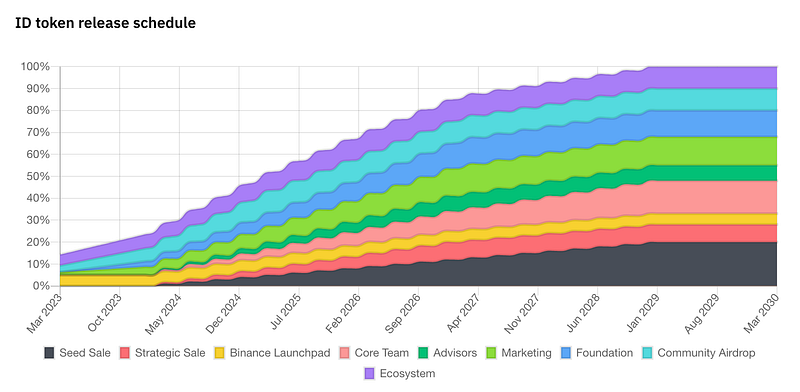
The token release schedule should be in the token’s whitepaper or on the project’s website, but this is not always the case.
For some projects, you can find this information on Messari or Binance research.
We saw that for Bitcoin, 8% of tokens still need to be minted. Bitcoin has a very slow emissions schedule as the last Bitcoin will be minted more than a hundred years from now.
Most projects today have much shorter release schedules, ranging from a few months to a few years.
TIP:
Token emissions are very important, especially for projects with a big gap between the circulating and the maximum supply.
You should always verify that new tokens will be released linearly over several years as this will counteract the potential inflation.
5. Token Allocation
The token allocation defines what percentage of tokens goes to what part of the ecosystem at the creation of the token and is represented in a pie chart:
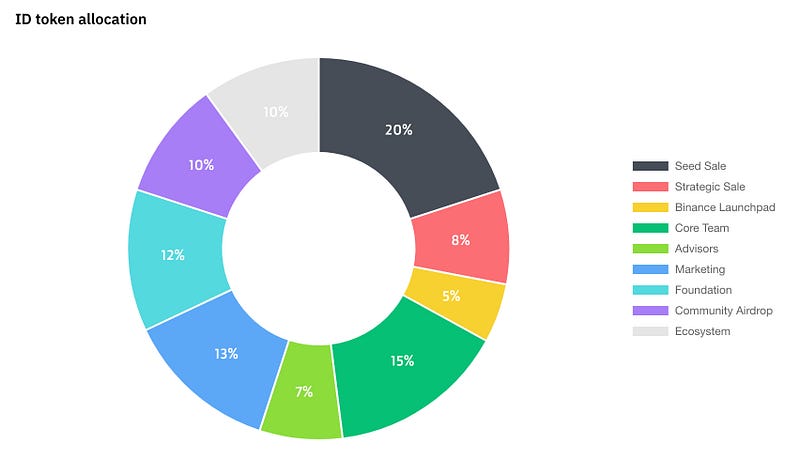
Token allocation is especially important for new tokens. If you’re considering investing during a presale or soon after the launch, then the token distribution is something that you should take a close look at.
TIP:
Common allocation categories are: Team, Advisors, Early investors (Seed, VS, Strategic, Angel), Public Sale (ICO, Launchpad), Marketing, Liquidity, Treasury (Reserves, Foundation), and Ecosystem.
Each project will have different needs and will distribute its tokens accordingly. But as a general rule of thumb, the team and the advisors together shouldn’t get more than 25% of the tokens.
At least 10%, preferably more, should go to the ecosystem, as these are funds that go to the community in form of staking rewards and airdrops.
Early investors shouldn’t get more than 25% and no more than 10% should be allocated to public sale and marketing.
As a project needs to be able to fund itself, the treasury should get at least 10%.
Liquidity are funds intended for centralized and decentralized exchanges and shouldn’t be higher than 20%.
Demand
The other side of the equation is the demand.
How do projects drive up the demand for their token and consequently its price?
1. Anti-inflation mechanisms
A crypto token can be either inflationary or deflationary.
Inflationary tokens will lose value over time due to an increase in supply.
On the other hand, the value of a token will increase if there are fewer tokens in circulation. This phenomenon is called deflation.
That’s why most tokens use some sort of a deflationary mechanism to increase their demand and value.
This can be as simple as having a capped supply like this is the case with Bitcoin.
But for tokens that propose yield farming, a capped supply is not an ideal option. They need to mint new tokens to pay out rewards to the active members of their community, such as stakers, liquidity providers, node validators, and so on.
How do they fight inflation? By decreasing the supply. These projects can periodically carry out buy-back and burn operations.
The founders buy back a certain number of tokens and send them to a so-called burn address. These tokens are thus destroyed as nobody can ever retrieve anything from a burn address.
The project can also collect fees for each transaction which are then instantly burnt.
This decreases the supply and has a deflationary, so a positive effect, on the price of the token.
TIP:
Especially for longer-term investments, always make sure that the project has at least one anti-inflation mechanism in place.
2. Incentive mechanisms
Incentive mechanisms consist of rewards given to users who hold their tokens for a longer period or perform tasks in the ecosystem.
These rewards can come from staking, providing liquidity, or any other type of yield farming.
This prevents selling as it incentivizes people to hold their tokens. And it also decreases the supply as the staked tokens are locked up and taken out of circulation.
Platforms often compete at who can provide higher rewards (expressed as APY or Annual Percentage Yield) to attract more users.
TIP:
You should be very wary of high staking APYs. For the project to pay out these high rewards, it needs to mint a lot of new tokens. This will drive up the supply and kill the price.
Yes, you will get high rewards, but as they will be paid out in the native token, they will be worth less and less.
3. Utility
Another thing that drives up the demand is the token’s utility but this can be tricky.
Logically, a project with a bigger and expanding utility will attract more users and generate more demand.
But human beings aren’t always logical. In the past bull run, we saw meme coins, not to say shitcoins, with zero utility doing 1000x.
TIP:
For longer-term investments, pay close attention to the project’s utility and its roadmap showing important past and future milestones.
4. Community
With this being said, gauging the energy of the community supporting the project is probably the most important part of your research.
Coins with no utility and poor tokenomics can perform extremely well if they have a cult-like following, like this was the case for Dogecoin or Shiba Inu, for example.
TIP:
The best way to assess the project’s community is on Twitter, Discord, and Telegram.
Get involved with the project on these platforms, see how many followers it has, how the team tweets, how much engagement their tweets receive, how administrators communicate in chats, and so on.
Bottom line
When you’re analyzing the tokenomics of a coin, you’re deciding if the project is sustainable.
Will its design allow it to keep a good balance between supply and demand in the long term?
Your job is to determine whether the economy of the coin will enable it to increase in value over time or will it lead it to a slow death.
To do this, you take into account the gap between its circulating and maximum supply, and consequently its vesting schedule and distribution.
Make sure the coin has incentive and anti-inflation mechanisms in place to retain and grow its value.
Finally, the best projects have real-world utility and are supported by an enthusiastic community.
PS: If you want to learn how to make a consistent profit from the Metaverse in 2023 and beyond, check out my free guide How To Make Your First $1000 In The Metaverse.
Join Medium using my referral link and get exclusive access to more stories like this one and to a wide range of quality content from thousands of writers for just $5/month.
Disclaimer: This content is for educational purposes only and should not be considered as financial or any other advice. Always do your own due diligence before investing your hard-earned money.
Subscribe to DDIntel Here.
Visit our website here: https://www.datadriveninvestor.com
Join our network here: https://datadriveninvestor.com/collaborate