
Find A Day Of Remembrance (DOR) Event To Attend
Japanese Americans want history to be remembered

These DOR events are to educate and remember
Day of Remembrance (DOR) events concerning the Japanese American community are held each year throughout the United States on or around February 19. These DOR events are reminders of what happened in America to the Japanese Americans and Japanese immigrants during World War II. Japanese Americans want to teach about and remember their history partly so that no one else will ever have to suffer the injustice of being innocently incarcerated in camps such as they were during the war years. This was an unfortunate period of American history which should not have occurred and should never happen again.
After President Franklin D. Roosevelt signed Executive Order 9066 on February 19, 1942, following the bombing of Pearl Harbor by the Imperial Navy of Japan on December 7, 1941, life became extremely difficult for people of Japanese heritage. Immigrants from Japan had come to the United States since the end of the 1800’s and early years of the 1900’s. Their children and grandchildren who had been born in the United States were American citizens.
Because of racism, war hysteria, and the lack of competent government leaders, all these people of Japanese heritage living on the West Coast of the United States were placed in camps. Most lived there in this confinement for the duration of the war.
The 120,000 persons affected lost their freedom, their former lives, and their dignity. They were forced to abandon their homes, friends, pets, farms, businesses, and possessions. They suffered greatly as they were incarcerated in the barbed wire enclosed camps. Armed military guards watched over them.
One of the first Day of Remembrance events for Japanese Americans was in the state of Washington on November 25, 1978. It was organized by the Evacuation Redress Committee and was held at the Puyallup Fairgrounds, where there was an assembly center holding people of Japanese heritage in 1942 until the camps were ready for occupancy. The University of Washington Department of American Ethnic Studies held a Day of Remembrance program in 1997. The state of Washington officially recognized the DOR since 2003.
Oregon held its first Day of Remembrance event on February 17, 1979. It was held at a former detention site, which had been the Portland Assembly Center in 1942.
In 1986 Governor George Deukmejian declared February 19 to be a Day of Remembrance in California. That came two and a half years before the Civil Liberties Act of 1988 (The Redress Bill) was signed on August 10, 1988. A Day of Remembrance ceremony was held in San Francisco’s Japantown in 2013.
Early Beginnings of DOR In California
The DOR actually had beginnings in California years before that. In the mid 1970’s, Paul Bannai and I were serving as California State Assemblyman. We were the first two Japanese Americans to serve in the Assembly. A staffer in my office came up with the idea to hold a Day of Remembrance around the date of the signing of Executive Order 9066 on February 19, 1942. We had never heard of any groups having a day such as that and had not heard the phrase “Day of Remembrance” before she came up with it.
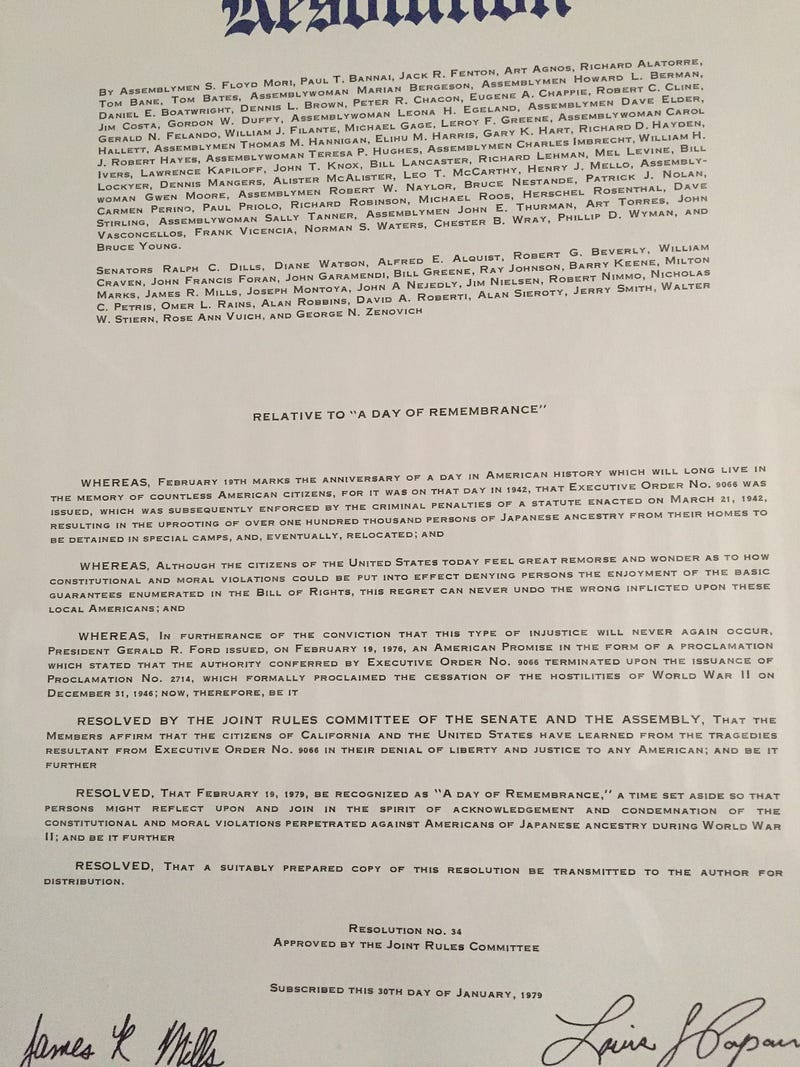
The executive order had been rescinded by President Gerald R. Ford on February 19, 1976. I had been privileged to be in the Oval Office at the White House when President Ford signed the rescinding order. My staff and I then embarked on the work of creating a Day of Remembrance. A resolution to hold a Day of Remembrance was passed by the California State Legislature in January 1979.
DOR events were held sporadically at first, but now they are an important part of the Japanese American Citizens League (JACL) and other Japanese Americans groups. Our history needs to be known and remembered.
There will be DOR events held throughout the United States on or around February 19 of this year. These events are open to the public. Because of the COVID pandemic, DOR events this year will be held virtually. That makes it easier to attend. Anyone interested in the subject matter should be able to attend a DOR event.
[Source: The Japanese American Story As Told Through A Collection of Speeches and Articles, www. thejapaneseamericanstory.com, Wikipedia]
Thanks for reading. We hope more people will learn about this part of American history by attending a DOR event. Information may be found at www.jacl.org.