Film Review — Wonka
Timothée Chalamet charms as a younger version of the legendary chocolatier, in Paul King’s joyous musical treat
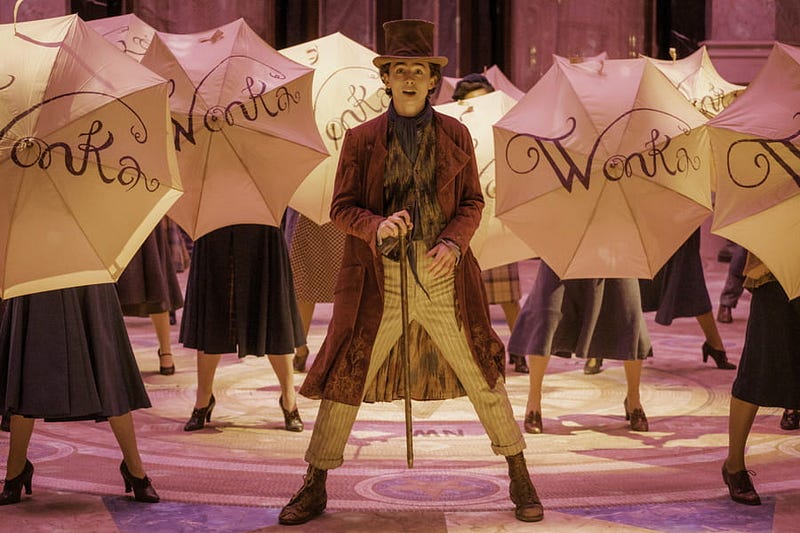
Forget Wish, Wonka is the film you need to take the children to see this holiday. Far exceeding my modest expectations, Paul King’s prequel to Roald Dahl’s Charlie and the Chocolate Factory (or more specifically, his prequel to Mel Stuart’s 1971 adaptation Willy Wonka and the Chocolate Factory, starring Gene Wilder) is a colourful, toe-tapping, hugely entertaining delight from start to finish.
King retains much of the look of the earlier film, most specifically Wonka’s costume and the iconic orange-skinned, green-haired Oompa Loompa design. Hugh Grant steals every scene he is in as Lofty, one of the aforementioned little people, or at least his head does (the rest of the body is CGI). But I’m getting ahead of myself. The plot involves the young, eccentric Wonka (Timothée Chalamet) arriving in a coastal city that feels vaguely Parisian, but sometimes uses Oxford locations (the Bridge of Sighs and the Bodleian Library both appear). He wishes to dazzle the world with his magical chocolate creations and go into business, but a trio of villainous rival chocolatiers (a cartel comprising Matthew Baynton’s Fickelgruber, Paterson Joseph’s Slugworth, and Matt Lucas’s Prodnose) conspire against him.
Furthermore, Wonka fails to read the small print on a hotel guest contract, and winds up paying off his debt in a pseudo-Dickensian washhouse, under the sneering eye of pantomime baddie Mrs Scrubbit (Olivia Colman). Here he meets the orphan Noodles (the wonderful Calah Lane), and others also ensnared by Mrs Scrubbit’s cunning small print. Their amusingly on-the-nose names are Abacus Crunch (Jim Carter), an accountant; Lottie Bell (Rakhee Thakrar), a telephonist; Piper Benz (Natasha Rothwell), a plumber; and Larry Chucklesworth (Rich Fulcher), an inept stand-up comedian. How will Wonka escape and become the legendary chocolate manufacturer he is destined to be? And how does Hugh Grant come into it?
Actually, I’m not going to spoil that part, as it is best discovered for oneself. What I will say is that Chalamet is excellent in the lead, singing and dancing his way through the film with a winning charm. He doesn’t have the darker edges Wilder brought to the role, and indeed unlike its predecessor, this film lacks the smattering of surreal nightmare imagery once considered perfectly acceptable in a children’s film (no subliminal chicken decapitations here). But that’s not really a criticism, merely an observation. It was a different time, and all that.
Rowan Atkinson has a fun supporting role as a priest also in cahoots with the cartel. Also, look out for another amusing bit part for King alumni Simon Farnaby (who also co-wrote the screenplay with King), as well as a touching cameo from Sally Hawkins. In addition to fine performances, this features some splendid new songs from The Divine Comedy’s Nick Hannon, complementing Jody Talbot’s music score. Woven into these are also reprises of a couple of favourite earworms from Willy Wonka and the Chocolate Factory. One will make you laugh, the other cry (out of sheer nostalgia, as much as anything). I won’t say what the songs are, as you can probably guess them easily enough.
At any rate, this is a colourful, sweet-centred treat for all ages. It isn’t in quite the same league as King’s Paddington films (2014, 2017), nor does it scale the impossible heights of something like Mary Poppins (1964), but then again, what does? Certainly, Wonka taps into the soaring spirit of the latter at times, and as I often say, it is always wonderful going out of the cinema feeling so much better than you did when you came in. The film certainly delivers on that front, and as such, unlike Disney’s could-have-been-written-by-AI Wish, it’s a deliciously joyous film with real heart. Do yourself a favour and go and see it.
The Dillon Empire beyond Medium