Film Review — Spider-Man: No Way Home
Does the third MCU standalone Spidey spectacle satisfy?
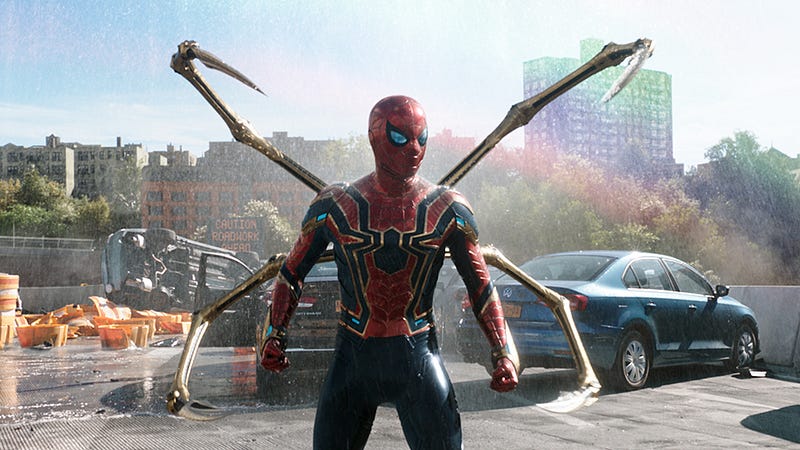
Spider-Man: No Way Home represents a culmination of sorts for the series. However, it is not, as some have erroneously claimed, the ultimate end for this iteration of Tom Holland’s Spider-Man as a regular fixture in the Marvel Cinematic Universe. This film brings the curtain down on a certain chapter of his life, but there remain intriguing potential paths the character could take in films to come.
I’ll say very little about the plot for fear of spoilers, suffice to say it picks up from an event depicted in the mid-end credits scene of the previous film, wherein Mysterio has one last sting in his tail by revealing to the world Spider-Man’s identity (via JK Simmons’s belligerent J Jonah Jameson, an alt-right conspiracy theory broadcaster in this version of the story). As a consequence, Peter Parker finds himself at the centre of controversy, with some believing him hero and some villain. In addition, his girlfriend MJ (Zendaya) and best friend Ned (Jacob Batalon) find themselves guilty by association, as all three have their college applications rejected. Desperate to fix this, Peter turns to sorcerer-not-quite-supreme Dr Strange (Benedict Cumberbatch) to cast a spell that will wipe the world’s collective memory of his secret identity. Needless to say, things go pear-shaped and there are some pretty catastrophic consequences.
Without getting into spoilers, it would have been very easy for No Way Home to degenerate into meta, self-referential fan service. Whilst there is some of that, and it is well-deployed (particularly in the final act), the film never loses focus on its central trio. The story takes some unexpected turns, providing interesting insight into Peter’s essential decency and desire to do the right thing, whilst still exploring his flaws and inexperience in the manner of all great Spider-Man stories. The cast are all very good, including certain actors I cannot mention, again for fear of spoilers. Visual effects are well up to scratch, and there are a few eye-popping action scenes well worth catching on the big screen. However, these are not overdone. Director Jon Watts and screenwriters Chris McKenna and Erik Sommers ensure the characters drive the narrative, without feeling the need to throw in huge fights just for the sake of it. Michael Giacchino’s score is another plus, as it has been for all three recent Spider-Man movies.
I need to see this again to decide where it ranks in my table of favourite Spider-Man films. My number one and two positions remain the first two Sam Raimi/Tobey Maguire entries respectively. However, this isn’t a Spider-Man film that can be seen without having seen the others. I also think I preferred the John Hughes-inspired high school-based shenanigans of Homecoming and Far From Home. By contrast, No Way Home most resembles a certain kind of (enjoyable) Doctor Who story from the classic 1963–1989 era, but I can’t cite episode titles, again for fear of spoilers. Suffice to say, Doctor Who fans of a certain age will understand what I’m getting at when they see the film.
In short, Spider-Man: No Way Home is a solid, satisfying, entertaining entry in the series, providing a suitably grandiose closure to one set of films (those with “Home” in the title), whilst keeping the door open for more. Yes, there are flaws in the fairly nonsensical plot, if you think about it too hard, but why do that? My suggestion is to go with it, as the film delves into its central theme of second chances with humour and heart, in the best traditions of Spider-Man.
This article was originally published at Simon Dillon Books. For more about me and my writing on Medium, please click here. For a list of my published novels and other works, please click here.


