Film Review — Saltburn
Barry Keoghan and Rosamund Pike are on splendid form in Emerald Fennell’s arch but compelling gothic drama
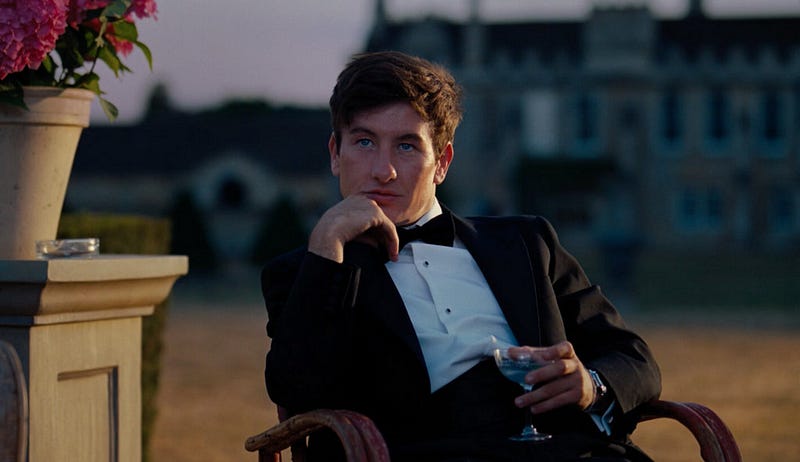
Films about horrible rich people can be horrible, but they can also be thoroughly compelling. In the case of Saltburn, writer-director Emerald Fennell doesn’t introduce us to a single person we’d ever want to know socially. That said, I daresay many of us have crossed paths with entitled upper-class twits of the variety depicted herein. I suspect if we’re honest, we share a certain morbid curiosity as to their pampered lifestyles and often staggering ignorance, in a slow-down-to-look-at-a-car-crash sort of way. All of which makes them a fascinating subject for drama.
But despite looking a little like satire, Saltburn isn’t really a serious study of class difference. Rather, it is a ludicrously overripe gothic tale of obsession. Oxford University scholarship student from Merseyside, the aptly named Oliver Quick (Barry Keoghan), finds himself on the outside looking into a world of wealth and privilege, often shunned from parties and functions of those from more moneyed backgrounds than his. However, after crossing paths with and befriending silver spoon-fed Felix (Jacob Elordi), he is invited back to the latter’s grand family estate, the titular Saltburn, to spend the holidays, circa the hot summer of 2006.
Here, Oliver is treated like an exotic toy; a plaything for the amusement of the toffs, soon to be discarded. The sneering butler Duncan (Paul Rhys) also looks down his nose at Felix’s guest. But whilst Felix’s appalling relatives go about their snooty business, Oliver insinuates himself into their confidences in parasitic, Tom Ripley-esque fashion. He seduces Felix’s bulimic nymphomaniac sister Venetia (Alison Oliver) and flatters Felix’s shallow, easily manipulated mother Elsbeth (Rosamund Pike). The latter becomes particularly taken with him.
Less easily manipulated is Felix’s cousin Farleigh Start (Archie Madekwe), who constantly tries to socially sabotage Oliver, reminding him of his place in the pecking order. But Oliver finds unsettling ways to retaliate, including sexually. Secrets, lies, and betrayals ensue, leading to a dark finale with rug-pulls that may surprise some. Personally, as a connoisseur of this kind of gothic nonsense, I found it easy enough to predict. But that didn’t stop me from enjoying it immensely.
Shot in 1:33 Academy aspect ratio, Fennell and cinematographer Linus Sandgren craft an intricate labyrinth, literally and figuratively, making splendid use of reflective surfaces, corridors, staircases, and hedge mazes in the Saltburn mansion and its grounds. It’s also fun for those familiar with Oxford to play location spotting in the first act of the film. Performances are strong too, especially from the chameleonic Keoghan who is one of the most exciting actors working today. His chemistry with Elordi is both arresting and skin-crawling.
In the supporting cast, the always wonderful Rosamund Pike is magnificently stuck-up. Richard E Grant plays to type as posh aristocrat Sir James Catton (Felix’s father). Also, Fennell’s lead from Promising Young Woman (2020), Carey Mulligan, turns up in a memorable bit part, as Elsbeth’s depressed friend, hilariously listed in the cast as “Poor Dear Pamela”.
Speaking of hilarity, watching this proved another occasion when I was the only one in the cinema laughing at the dark humour inherent in the story. Everyone else seemed to be taking it deadly seriously, so I did my best to suppress my mirth. But even the barbed choice of songs provoked a certain amount of guffawing; Farleigh acidly bullying Oliver into performing a rendition of Rent by Pet Shop Boys during a karaoke night, for instance. Scathing and cruelly amusing.
On the subject of the soundtrack, Fennell’s choices are perfect. A brooding score by Anthony Willis is complimented by an eclectic pop mix reflecting the period including Bloc Party, Girls Aloud, Arctic Monkeys, Sophie Ellis Bexter, Chicane, Tomcraft, Mason vs Princess Superstar, Arcade Fire, and MGMT. In addition, there are classical pieces used to splendid and ironic theatrical effect, such as the anthemic Zadok the Priest by Handel, and the melancholy hymn Lord of All Hopefulness by Jan Struther.
Saltburn won’t be for everyone. It will prove too arch for some, in the dialogue, gothic imagery, and narrative in general (again, I stress that everyone in this film is thoroughly unpleasant). But I confess, I found it utterly absorbing, with splendid performances, fabulous direction, great use of locations, and a darkly funny, subversive streak that often knowingly leans into cliché with a wink at the audience (the gothic font used for the credits is a case in point). Indeed, I think Saltburn is a much better film than many critics have given it credit for, and I’d go so far as to say I preferred it to the more critically revered Promising Young Woman.
The Dillon Empire beyond Medium