Film Review — May December
A knotty, thought-provoking drama featuring strong performances from Julianne Moore and Natalie Portman
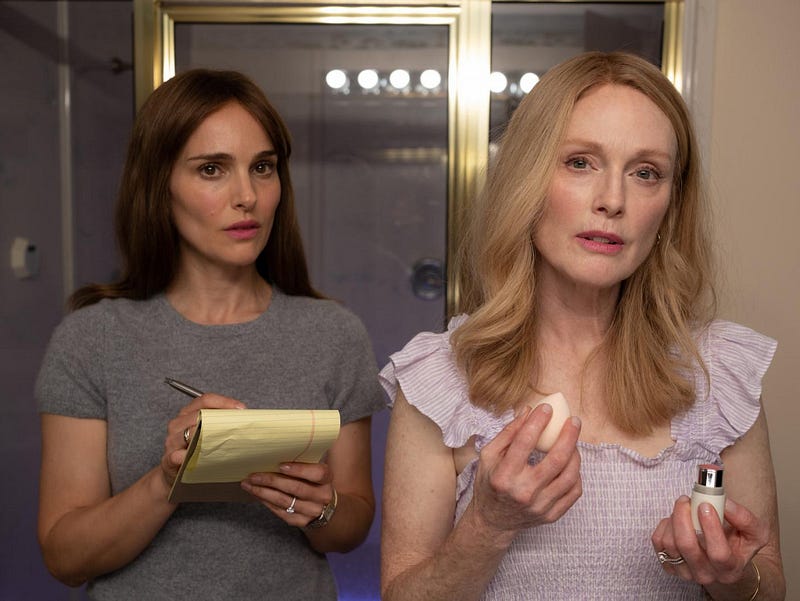
Todd Haynes’s latest is an unusual but fascinating drama concerning an actress researching her next role; a sex offender who, following a prison sentence, married the young man she slept with. May December wades into morally murky areas and some fascinating shades of grey, whilst carefully steering away from unnecessary melodrama with an undercurrent of dark humour, allowing the viewer to make up their own mind.
Natalie Portman plays the actress, Elizabeth, who hopes her role in the film will be “truthful” and give her career the boost she feels it needs, after starring in various TV series she doesn’t much care for. To conduct her research, she arrives at the Californian home of Gracie (Julianne Moore) and Joe (Charles Melton), 24 years after their scandalous age-gap affair began (in a pet shop, of all places). Joe was thirteen at the time, and the story was plastered all over tabloid newspapers.
Elizabeth and Gracie are outwardly polite, but there’s a brittle tension beneath the surface; an unacknowledged clash with each determined to get the upper hand on the other. Gracie urges Elizabeth to “be kind” but as the past is inevitably dredged up, Elizabeth’s research tactics become increasingly Machiavellian and manipulative, in a way that is comparable to how Gracie manipulates and mummies Joe. Elizabeth finds herself drawn to him, but how far will she go in her research? Will she take advantage of his emotional vulnerability?
Portman and Moore are both excellent in their respective roles, with the former even providing something of a meta-commentary on the nature of shooting sex scenes, and how they can gradually feel “real” despite the presence of the crew. “Are you pretending to feel pleasure or pretending not to feel pleasure?” she muses, whilst giving a talk on acting to high school students. The scene is important because it underlines her subsequent striving for authenticity, which one might argue goes a bridge too far. In many ways, her character is as predatory as her research subject.
As for Moore, her character remains astonishing naïve as to the nature of what she’s done. She appears to be in a state of arrested development, often behaving like a little girl rather than an adult woman who understands the serious power imbalance in her relationship with Joe. “You seduced me,’ she tearfully insists, when Joe starts to question whether he was ready for what they got into when he was thirteen.
Charles Melton is also excellent as Joe; a 36-year-old man seemingly lost in his wife’s shadow, having pretended everything is wonderful for the last two decades. He seems to love Gracie, but the collateral damage of their affair, which comes into sharp focus via Elizabeth’s research, forces him to confront painful truths about the knock-on effect of the age gap. For instance, Joe and Gracie have three children; one already at college, and two about to graduate high school. More awkwardly, the children from Gracie’s first marriage are the same age as Joe. One of them, ill-tempered musician Georgie (Cory Michael Smith), has been particularly messed up by everything that happened.
This eschews the lush, Douglas Sirk-homage colour palette of Far from Heaven (2002) and Carol (2015), with cinematographer Christopher Blauvelt and Haynes instead opting for a return to the realism of the latter’s earlier film Safe (1995). Marcelo Zarvos’s strident piano score provides an interesting counterpoint to this visual choice, and Samy Burch’s screenplay isn’t above a little knowingly overripe, soap opera dialogue (“Don’t touch the bait,” the pet shop owner tells Elizabeth, as she visits the place where Joe and Gracie first had sex). At the same time, these elements are contrasted with a sadness that imbues the entire film. Ultimately, these are all very broken people.
It’s not without flaws. A butterfly metaphor feels a little on the nose, for instance. However, on the whole, May December is agreeably knotty, thought-provoking, and well worth a look for those who enjoy grappling with difficult subject matter.
The Dillon Empire beyond Medium