Film Review — Godzilla Minus One
Takashi Yamazaki strips Godzilla back to its original Japanese postwar nuclear trauma metaphor to thrilling and poignant effect
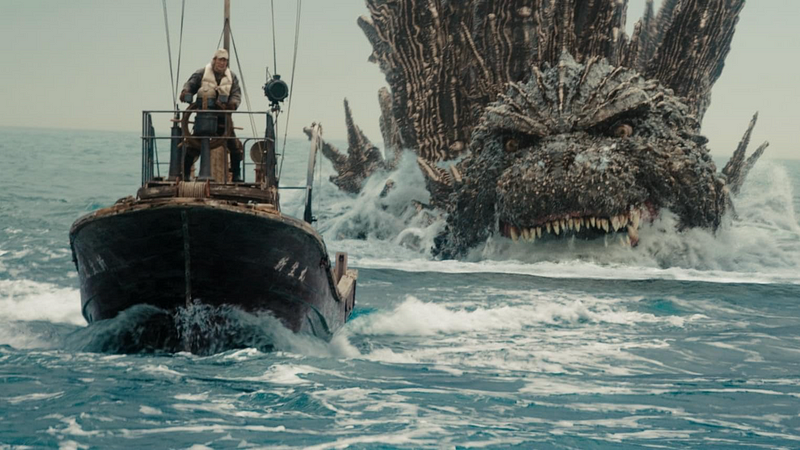
On the evidence of this, Godzilla Minus One would have been a better film to pair with Oppenheimer in an unlikely double bill, rather than Barbie. Director Takashi Yamazaki takes the titular giant lizard back to basics, building a surprisingly poignant story about Japanese postwar trauma around the giant monster attacks. Here, Godzilla is once again a metaphor borne of a national psyche still scarred from the horrific nuclear attacks that ended the Pacific war.
The plot revolves around kamikaze pilot Koichi Shikishima (Ryunosuke Kamiki), who returns home disgraced after World War II having disregarded orders to commit suicide in battle. This decision weighs heavily upon him, even as he forms a family of sorts with homeless bombing survivor Noriko (Minami Hamabe), and an orphaned baby Akiko (not her daughter). Koichi subsequently takes a government job clearing mines from the seas, but they discover something big and terrifying in the ocean; something that Koichi encountered before when it was a lot smaller, on an island of mechanics servicing kamikaze crews.
As well as containing plenty of monster action set pieces, this works brilliantly because we care about the characters. It seems ridiculous to say a Godzilla film almost moved me to tears, but astonishingly, that was the case here. Compelling themes of courage versus cowardice, honour, healing, and a collective national rediscovery of the value of human life, amid the traumatic aftermath of the Japanese defeat by the Americans, gives this film a powerfully redemptive charge. The performances are heartfelt and moving; in particular, the screentime dedicated to Koichi’s anguish over his actions gives the film considerable punch.
Nor does this skimp on monster action when the need arises. Utilising a brilliantly redesigned Godzilla that blends the classic design with gnarlier features, this monster looks like it’s built from molten rock. The vivid VFX colour palette of blue, grey, and black during the seabound sequences is so well judged, that it enables the CGI to look more like tactile miniature shots with skilled forced perspective. One scene recalls the barrel/harpoon moment in Jaws (1975), but with mines. It’s an edge-of-the-seat gem, paying homage to Spielberg’s classic, and creating something wonderful in its own right. The city destruction sequences when Godzilla reaches land are also remarkable, with both realistic heft and old-fashioned spectacle.
In contrast with the sharp satire of government bureaucracy seen in Shin Godzilla (2016), this film has a more direct distrust for the government and the military; appropriate in the aftermath of World War II. Instead, it celebrates, with shameless but effective, blunt instrument sentimentality, the unity of ordinary people in their efforts to defeat Godzilla. It’s a collective moment of regaining a modicum of national pride and dignity on the battlefield, since, as Koichi puts it, his war isn’t over yet. In lesser hands, this would have come off as mawkish and corny, yet somehow it plays as genuinely sincere.
If you want to be churlish, a couple of the surprises late in the film are implausible and predictable. But they are entirely satisfying. Besides, this is a monster movie with bite, featuring an unstoppable antagonistic force bent entirely on irrational destruction, as befits the nuclear metaphor. It’s set to a pulsing score by Naoki Satô, who eventually quotes Akira Ifukube’s classic theme from the 1954 original in the thrilling final act. As such, with decades of both Japanese and US Godzilla films, Godzilla Minus One is a fitting 70th anniversary feature, and one of the very best in the series.
The Dillon Empire beyond Medium