Film Review — Everything Everywhere All At Once
Cult status pretty much guaranteed, but this relentless creative cacophony lost me around the halfway mark.
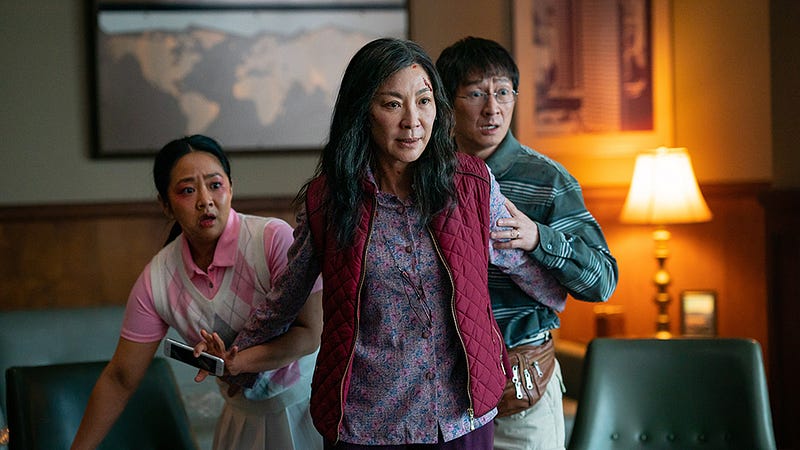
For about an hour or so, I thought I’d wind up loving Everything Everywhere All At Once. It features an agreeably high concept scenario, a tour de force central performance from Michelle Yeoh, inspired direction from Dan Kwan and Daniel Scheinert (who made Swiss Army Man), plus a surplus of offbeat humour. But in the second half, offbeat turned to insufferable. I spent the final twenty minutes inwardly begging for the film to be over. Why? I’ll come to that in a moment.
The plot concerns Evelyn (Yeoh), introduced in a cacophony of Uncut Gems-style stress amid the laundromat she runs with her husband Waymond (Ke Hey Quan, best known for child roles in The Goonies and Indiana Jones and the Temple of Doom). Her life is a maelstrom of tax audits, customer demands, spousal arguments that could lead to divorce, and alienation from her lesbian daughter Joy (Stephanie Hsu). She’s also trying to throw a Chinese New Year party to impress her traditionalist father (James Hong), who once disowned her for marrying someone he considered unsuitable. Amid the claustrophobic setting of her home and workplace, Evelyn seems perpetually overwhelmed, her dreams and ambitions crushed by the grind of daily life.
It’s a fool’s errand attempting to describe the sci-fi sensory overload that follows, as projected consciousnesses of other versions of Evelyn, Waymond, and other characters from parallel universes begin to cross dimensions. Their mission is to stop an all-consuming evil threatening the entire multiverse. A plethora of metaphysical martial arts mayhem ensues amid trips to peculiar alternative realities. In essence, it’s the same premise seen in Doctor Strange and the Multiverse of Madness. But although this is the second parallel universe film I’ve seen in as many weeks, the execution of that premise could not be more different.
In addition to the positive elements mentioned earlier, I particularly enjoyed Jamie Lee Curtis’s delightfully deranged turn as a no-nonsense tax officer, who also exists in hilarious multiverse variants. As reality fragments with increasingly bizarre results, the film becomes an all-out assault on the senses. For a time, it works well. Some of the gags are laugh-out-loud hysterical, riffing on everything from 2001: A Space Odyssey to Ratatouille and In the Mood for Love.
The central message of Everything Everywhere All At Once can be summed up thus: Latent internalised homophobia will unleash destructive nihilism that could destroy the fabric of reality in the face of a godless universe where nothing really matters. Or rather, to apply the metaphor properly, it could destroy family relationships. In much of the first half, this message is delivered with wit, invention, and hilariously bonkers surrealism. In the second half, it slowly becomes a thudding bore, grinding on at intolerable length. What began as inspired becomes dramatically obvious, preachy, and eye-rolling. The jokes become tedious. For instance, a running gag involving hot dogs I initially found hilarious winds up flat out annoying. Crasser elements involving dildos and a did-they-really-go-there BDSM gag also failed to raise a smirk as the film ground ever onward. Ultimately, I just wanted the damn thing to stop.
Themes of generational trauma reminded me of Encanto, but just as that film didn’t work for me, nor does this one. For all its existential musings, this isn’t as profound as it thinks it is, nor does it know when to quit. Perhaps that is the point. After all, it is entitled Everything Everywhere All At Once. The film is meant to be relentless. The problem is, I didn’t find the sentimentality of the latter movement relentless in a good way. By the end, I thought a better title might be Everything Interminable All At Once.
This isn’t a film I’ll forget, and yes, it is almost certainly destined for cult status. Many people will love this. Many will find it funny and poignant. Some will consider this review the ramblings of an old cynic who deserves to be castigated for not being able to stomach right-on touchy-feelyness at such protracted and ultimately sermonising length. But whilst there are, objectively speaking, outstanding elements within this tornado of a film, I won’t lie and say I liked the overall effect. My patience with power-of-love platitudes was exhausted long before the end credits rolled.
This article was originally published at Simon Dillon Books. For more about me and my writing on Medium, please click here. For a list of my published novels and other works, please click here.


