Film Review — Blackberry
Matt Johnson’s fictionalised take on the rise and fall of Blackberry is a sharp, well-observed tale of ambition, innovation, and hubris.
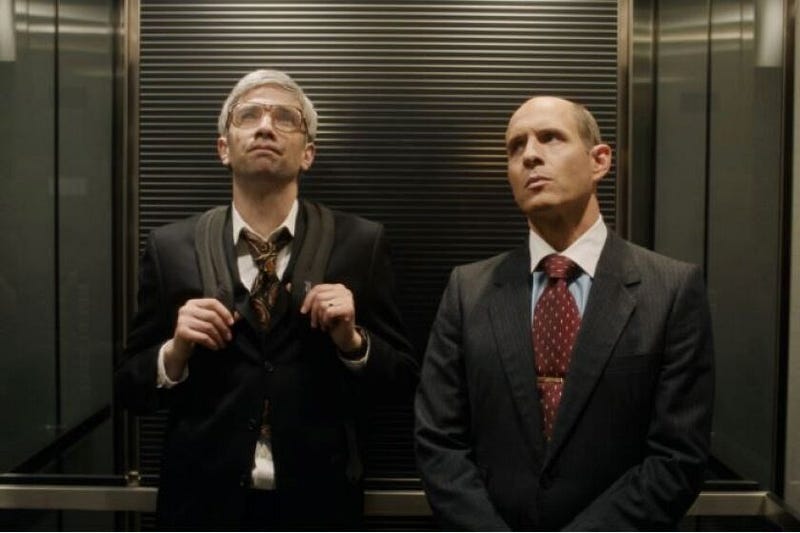
There’s a scene early in Blackberry, just before Research in Motion (RIM) CEO Mike Lazaridis (Jay Baruchel) and his co-founder best pal Doug Fregin (Matt Johnson) do a product pitch to businessman Jim Balsillie (Glenn Howerton), when Mike is irked by the white noise coming from an intercom device. While they wait, Mike takes the device apart and stops the white noise. It is later explained that when the China-manufactured device was invented, it was deemed “good enough”, and that because of this, intercoms around the world now emit that low-level white noise.
This incident defines Mike’s mindset at the start of this fictionalised account, directed and co-written by Matt Johnson, of the rise and fall of the Blackberry devices, in Waterloo, Ontario between 1996 and the early 2010s. Mike’s character arc is the key one, as he gradually transforms from mild-mannered perfectionist nerd to learning the corporate game, compromising with things that are “good enough” to ultimately catastrophic effect. Helping him in that endeavour is the brash, opportunistic, utterly ruthless Jim; a man who thinks their product pitch was the worst he ever saw, but who also believes in the potential of the prototype Blackberry and knows where it could go with the right corporate strategy.
Pushing back against this is Doug. He distrusts Jim and finds himself increasingly dismayed as the working culture at the company is transformed. Excited engineering innovation with long hours willingly given (punctuated by movie nights) give way to his department of imaginative square pegs being increasingly squeezed into corporate round holes, whilst barked at by bullying overlords. “I’ll keep firing until this room is not full of little boys playing with their little penises,” snarls Jim’s appointed COO Charles Purdy (Michael Ironside); a comment directly followed by an amusing cutaway to one of the female members of Doug’s department.
What ensues is a fact-based tale of ambition, greed, strained friendships, corruption, and hubris, told through a darkly comic lens. It deftly emphasises the often-hilarious clash of cultures between the nerdy, creative computer engineers, and the money people. Performances are excellent, especially from a ferocious Howerton who chews scenery with a greed-is-good aplomb that reminded me of Michael Douglas in Wall Street (1987). Baruchel is a fine contrast, whose quiet genius demeanour makes immediately clear just why his engineers are so loyal to him. In many ways, these undisciplined but groundbreaking engineers represent something of a golden age of nerddom. It’s a joy seeing them so enthusiastic about both their project and their beloved computer games, TV series, and films (snippets of everything from Star Trek to Dune, They Live, and Raiders of the Lost Ark can be glimpsed in various montages or scene backgrounds).
Matt Johnson directs with a verité sensibility, emphasising a documentary tone with handheld cameras, and a certain chaotic claustrophobia in the rollercoaster ups and downs of the narrative. The screenplay, by Johnson and co-writer Matthew Miller, is sharp and well-observed, adapting the source book Losing the Signal by Jacquie McNish and Sean Silcoff to good cinematic effect. On top of this, the pop songs on the soundtrack are well chosen, even if they are a little on-the-nose at points (Elastica’s Connection opens the film, with The Kinks’s Waterloo Sunset playing over the closing credits).
Blackberry emerges as a strong piece of work, and to my complete surprise, one of the best films I’ve seen this year. It isn’t unflawed. For instance, certain timeline leaps indicate key footage may have been left on the cutting room floor. But it rattles along in a consistently absorbing fashion, weaving a satisfying and familiar rise-and-fall narrative. As such, it more than earns my recommendation.
(Originally published at Simon Dillon Books.)
The Dillon Empire beyond Medium
For a full list of my published novels, click click here.
For more on my novels and other projects, click here for my blog.
For my Patreon page, click here.