Film Review — Anatomie d’une chute (Anatomy of a Fall)
Justine Triet’s riveting, ambiguous courtroom drama features a stunning central performance from Sandra Hüller
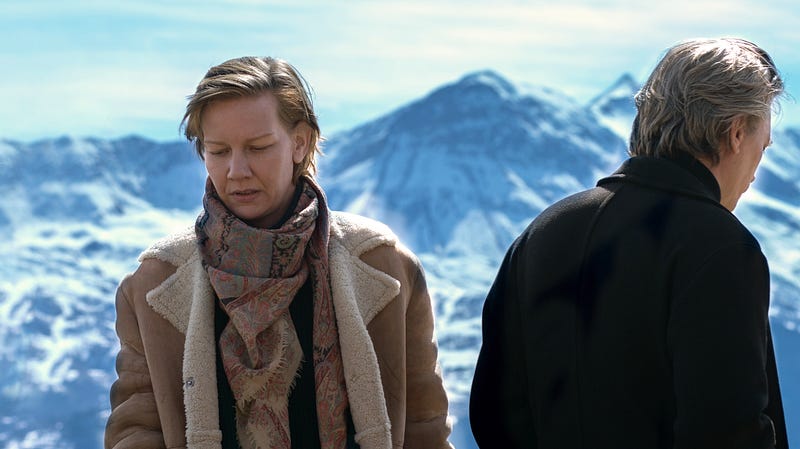
If you insist on clear-cut resolutions, Anatomy of a Fall isn’t the film for you. The mystery element of whether a death was accidental or deliberate takes a back seat to complex, cerebral interrogation of ambiguous forensic details, and whether a blind child can be considered a reliable witness. It’s also a meditation on the misleading nature of memory, grief, guilt (legitimate or false), marital strife, and parental responsibility.
I’ll admit that at first, I slightly rolled my eyes upon learning protagonist Sandra (Sandra Hüller) is a successful, well-regarded author, as it’s such a cliché in French cinema these days. Sandra is German, but now lives in an Alpine chalet with French former teacher husband Samuel (Samuel Theis). He has literary aspirations too, though has become creatively frustrated, with much of his time occupied with renovating the chalet, in the hopes of turning it into an Airbnb, thus alleviating financial strain on the couple.
The film opens with Sandra being interviewed in her chalet, but they are thwarted by the sound of loud music, which Samuel plays whilst insulating the upstairs, possibly in a petulant attempt to sabotage the interview. After sending the interviewer away, Sandra tries to nap. At the same time, their blind son Daniel (Milo Machado Graner) goes for a walk with his guide dog Snoop. But upon his return, he discovers his father lying dead in the snow, having apparently fallen from the top window. Was it an accident? Suicide? Or was he deliberately pushed?
The cops wind up thinking the latter, and Sandra faces trial. Her lawyer Vincent Renzi (Swann Arlaud) is an old friend (and possibly an old flame who still fancies her, though that’s never made entirely clear). Amid the ensuing legal proceedings, the dismal state of Sandra and Samuel’s marriage is dredged up, with all the simmering resentments that have bubbled away concerning Samuel’s bitterness over having been blamed for the accident that caused Daniel’s blindness, and his anger over frustrated ambitions, for which he blames Sandra. Her prospects for acquittal wind up balanced on a knife edge, with her grief-stricken son’s testimony, which contains crucial memories, having the potential to make the difference either way.
At two and a half hours long, this kind of teasing ambiguity would become tiresome in lesser hands. However, writer-director Justine Triet, and co-writer Arthur Harari, skilfully deflect frustrations over not knowing the truth by exploring marital relationship dynamics, and the importance of context when overhearing secretly recorded arguments when horrible things are said that aren’t necessarily meant. This isn’t so much about the death of a man, but the death of a marriage.
At the same time, the forensic details aren’t neglected. Police stage recreations of the fall, depicting with grim fascination how certain inconsistencies in testimonies may be explained. But never with absolute certainty. In metaphorical terms, the film grapples with the very human dilemma of having to believe something one way or the other in the absence of absolute proof. This doesn’t just apply to the question of how Samuel died, but it can be applied to every belief whether personal, political, or even spiritual.
Perhaps the biggest factor relegating the central mystery to secondary background detail is the strength of the performances themselves. Sandra Hüller is as brilliant here as she was in the wonderful Toni Erdmann (2016). Her character seems sympathetic, pragmatic, sensible, and plausible, yet she sometimes lies. We believe her lies, precisely because she is so plausible. What’s more, we remain sympathetic, because when admitting the lies, she explains why she lied, and that also seems entirely plausible.
At the same time, there’s vulnerability and pain inherent in Sandra’s interactions with Daniel, especially when they are rigidly supervised by the court-appointed Marge Berger (Jehnny Beth), present to ensure his testimony isn’t coached. The language dynamics also convey this vulnerability, with the German Sandra sometimes asking to speak English rather than French in court, as she doesn’t feel he can adequately express herself otherwise. Yet the switching of languages adds another layer of ambiguity. Is her English speaking merely a mask?
In the supporting cast, Milo Machado-Graner deserves a special mention as the conflicted Daniel, in whose hands the fate of his mother seems to rest. His interactions with Snoop threaten to steal the show at a few points, and his performance is often heart-wrenching. Although fiercely intelligent and determined to face the truth (however unpleasant), the film never loses sight of the fact that he is still a child, and as such provides the greatest call on audience sympathy.
To reiterate, Anatomy of a Fall won’t be for everyone. It is too low-key and downbeat for more action-oriented tastes. Personally, I found it riveting, and it could well wind up on my best films of 2023 list.
The Dillon Empire beyond Medium