
Fictional Truth and Truth Through Fiction
Oscar Wilde once said,
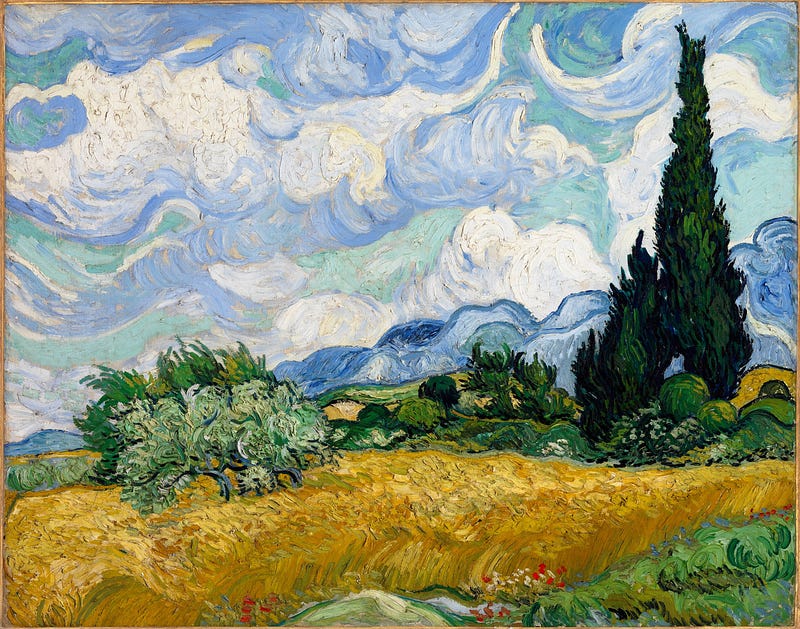
There had been no fog in London before Whistler painted it. Surely, too, there had been fewer cypresses in Province before van Gogh.¹
In 1888, Vincent van Gogh arrived in Aries to paint the South of France and help other people see it. Initially, he got acquainted with the province through literary works such as Madame Bovary, which helped him understand its mid-class life. Just as literature helped Van Gogh understand the character of the South, he believed that every great painter’s mission was to enable people to see particular aspects of the world more clearly.
Before Vincent van Gogh, the South of France was pained by many other, mostly realistic painters of whom Nietzsche would say:
Completely true to nature! — what a lie. How could nature ever be constrained into a picture? The smallest bit of nature is infinite. And so, he paints what he likes about it, And what does he like? He likes what he can paint.²
Nietzsche knew that painters don’t reproduce but select and highlight. Similarly, literature — be it historical or speculative fiction, selects and highlights, as its version of reality brings out valuable features of it.
All this had me thinking about truth and fiction.
As a writer, chances are you spill ink over topics that are mostly eternal. Someone before you has already written about love but that would and should not stop you from doing so, as well. There are so many love stories in the world. Which fictional love story depicts what happens in real life? None and all. The truth about love is that there is no one simple truth. That’s why we won’t tire to read about love stories. Or, as a matter of fact, to experience them.
But what is the role of truth in made up stories and how can we discern it?
I think we need to differentiate between truth in fiction and truth through fiction. The former help us understand what’s going on in the narrative, while the latter aims to make sense of what stories can tell us about states of affairs in the real world.
Fictional Truth
Truth in fiction or fictional truth is the truth of coherence. Whatever plot you might have, the story’s coherence resides in the way its parts relate to one another. It’s about world building.
Should it be a Tolkein kind of meticulous world building? Not necessarily. Sometimes leaving uncharted bits is what makes a literary work stand out. It’s what captivates the reader, as it ignites their imagination.
Certain things in a narrative are taken to be true in virtue of what’s explicitly said. This is a world we share with trolls and elves. Or this world is a flat disc carried by turtles. While other things are derivatively true because they can be deduced for what’s already known. The competent reader can fill in the gaps of the unstated background.
Fantastical worlds are believable not because they represent reality (even though they could) but because they are coherent.
This is not a how to build fictional worlds piece, but I think that as writers we should ask ourselves two fundamental questions:
- In a given narrative, what principles determine the unstated background propositions that are true in the story?
2. Which bits of the narrative and why are incomplete or deceptive?
The answer to the first question is the thread that will run through the tapestry of the story and will make it coherent. Especially in genres like science fiction and fantasy, creating a detailed world will serve as a bedrock for inner references.
Similarly, in any genre, creating a detailed profile of your characters, will make them more compelling. It will also help you create a believable character arc.
The answer to the second question will help authors create the most compelling structure for the narrative. For example, how are you going to communicate the rules that govern your fictional world? Readers rely on the narrator to follow the story. As a writer would you chose an omni-narrator or the limited and not so reliable first person point of view?
In Nabokov’s Pale Fire, for example, the narrator deceives us because of self-deception. But the narrator could be deliberately misleading their audience, as in the case of Humbert Humbert in Nabokov’s Lolita.
The events in the story may be true to the rules governing it, but is the narrator reliable, ignorant, deceptive, or self-deceptive? Are they speaking ironically or metaphorically? What kind of a reading experience do you aim to achieve with your choice of narrator?
Truth Through Fiction
Even though we don’t read fiction to learn facts about the real world, we can definitely learn a lot from it.
Suggesting that we can obtain knowledge from made up stories often implies that they somehow reflect the actual world. But how can a free floating creation of the imagination have the necessary reference to human experience?
A story may have trolls or magicians as protagonists and it may be set in a world whose order is unlike that of the one we live in, yet still explore themes such as friendship, courage, and the fight against discrimination. This is what the truth of correspondence is all about. We can use the lens of fantasy, or science fiction, and figurative language to address important questions.
This year I got acquainted with the ancient Chinese philosopher Zhuangzi, or Chuang Tzu, and his legacy. The book he wrote the Zhuangzi is the second most influential Daoist text after Laozi’s Tao Te Ching. The Zhuangzi uses dialogues, parables, and anecdotes to transmit important philosophical truths about the nature of reality. I fell in love with Chuang Tzu’s philosophy and style. It’s accessible, yet it makes you think. It’s intuitive, fun, and easy going, much like the philosophy it teaches.
People are natural storytellers and the best way to make them listen, understand, and act has proven to be through storytelling. Politicians, activists, and marketeers know that. I reckon, authors and parents know it, too. No wonder we teach children about morality through fables.
I think both Van Gogh and Nietzsche were right. The former is right about artists (and authors) helping people see aspects of the world their selective focus might miss upon. While the latter is right that our artistic creations are not exactly true to nature, for it’s too grand to fit on a piece of paper, or to be carved out of marble. In fact, the Truth is often elusive and easy to manipulate. Yet that shouldn’t stop authors and artists of showing us a truth, their truth.
Sometimes we write stories drawing from our life experience. Other times we bring new experiences to our readers. Fiction doesn’t have to summarize facts for us to make us see some truth about the world. Instead, it can be like a Van Gogh painting.
If you like what you’ve read, you can support me by clicking on the Follow button — a guarantee you won’t miss out on my new articles.
Thank you!
References:
¹ De Botton, Alain. The art of travel. Vintage, 2008.
² Ibid.