
FEYNMAN — 4 Super rules from the legendary physicist to learn anything.
“Man’s mind, once stretched by a new idea, never regains its original dimensions.” — Oliver Wendell Holmes
The day I learned about Professor Richard Feynman (American theoretical physicist and Nobel Prize winner in 1965). I was inspired by the Genius method to learn anything.
This genius method is called Feynman Technique.
An innovative teaching strategy that emphasizes clarity to develop deep understanding and explain complicated concepts clearly.
What he noticed is that a lack of in-depth comprehension is sometimes covered up with complexity and jargon.
I used to call this Feynman Razor
If someone uses a lot of complexity and jargon to explain something to you, they probably don’t understand it.
Feynman Technique is a learning framework that requires you to develop a deep understanding of a given topic which involves four key steps: (1) Setting the Stage (2) ELI5 Rule (3) Assessment & Learning (4) Organizing, Conveying & Reviewing
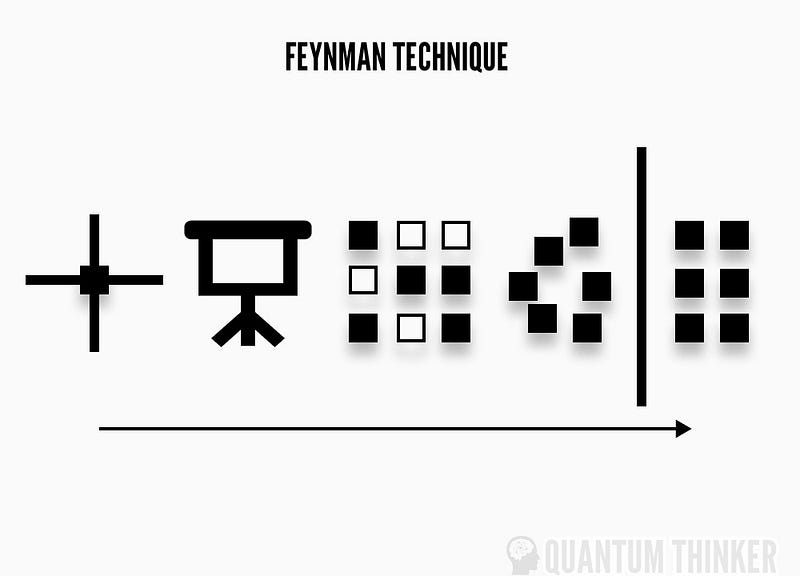
1. Setting the stage
What topic would you like to study?
Start with a blank page.
Write down your topic at the top and everything you know about it.
Read and study the subject.
Add new knowledge or ideas as they evolve.
2. ELI5 Rule
Here’s where it becomes special….
Try to explain the subject to a person who doesn’t have a basic comprehension of it such as 5 years old kid.
Write down all of your knowledge about your subject on a blank piece of paper but act as though you are educating a young child.
Write in plain English!
3. Assessment and Learning
Were you able to explain the topic to your kid?
Where are you mad?
Where did it turn into jargon?
This is a gap in your understanding!
Read more and study to complete them.
4. Organizing, Conveying, and Reviewing
Transform elegant, simple language into a clear and compelling story or narrative.
Pass it on to a few others…
then iterate and revise accordingly.
Review a new and deeper understanding of the subject.
Remember: Simplicity is beautiful.
Feynman skill is a powerful framework for learning anything.
I mean anything mean anything. 😎
We can also deduce some principles from Professor Richard Feynman’s life:
1. Curiosity makes most people uncomfortable because they resist change.
Curiosity usually calls into question the basic assumptions of convention.
Challenges, of course, threaten people’s beliefs and generate resistance even when those beliefs are wrong.
2. Curiosity stirs up controversy by challenging conventional wisdom and conventions.
Feynman continued to rethink questions and shift focus during his time at MIT, providing unique perspectives and answers.
“If everyone is defining a problem or solving it one way and the results are subpar, this is the time to ask, what if I did the opposite? Don’t follow a model that doesn’t work. If the recipe sucks, it doesn’t matter how good a cook you are.” — Tim Ferriss, 4-hour week.
3. People like to learn by rote rather than understanding.
Feynman tells the story of an MIT student and an Einstein student who couldn’t put the theories they already knew into practice.
Feynman concluded that many people prefer to memorize because they do not want to understand.
“Change is the result of all true learning.” — Leo Buscaglia.
4. We understand that anyone can have good ideas.
Early on, Feynman, like everyone else, was often underestimated.
He realized that empowerment doesn’t make you insightful, understanding can come from anyone.
5. The best minds prefer challenge to submission.
The famous physicist Niels Bohr called Feynman “… the only guy who’s not afraid of me and will say when I’ve got a crazy idea…”.
The best minds see the lack of criticism as a problem.
6. T-shaped people (Polymath) use both depth and breadth of knowledge.
Feynman was a deep and broad thinker.
This allowed him to see synergies as an interdisciplinary professional while also being successful as a skilled physicist.
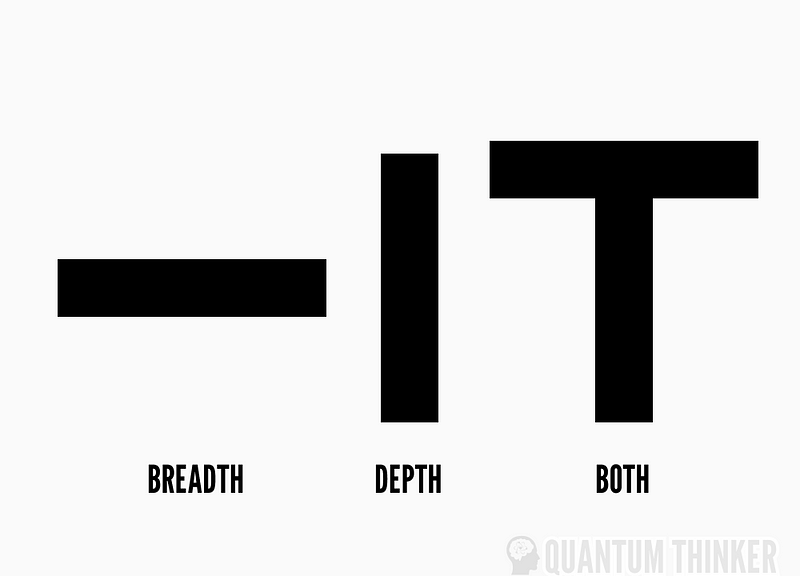
7. Be curious and experiment with what you like, even if your mind has no end.
After working on the atomic bomb, Feynman suffered from burnout.
He decided to return to the fun experiment without thinking about the ultimate goal.
These experiments led to work that won him a prestigious Noble Prize.
“Anyone who stops learning, whether at twenty or eighty, is old.” — Henry Ford.
8. The more you learn, the more opportunities you create for yourself.
Feynman was a physicist, but his curiosity led him to
- paint,
- learn new languages,
- pick up a few musical instruments,
- leading to unique performances,
- exhibitions, and tours.
This condition also extended to his chosen profession.
9. Don’t be afraid to fail.
Feynman’s willingness to fail has led to his multidisciplinary and professional success.
Each setback was an opportunity to learn and grow from what didn’t work.
As per him, I guess that’s why children learn new languages quickly.
“An expert is someone who has made all the mistakes that can be made in a very narrow field.” — Niels Bohr
10. Be an explorer. Everything is an experiment.
Feynman saw life as a series of experiments, where he could try new things and learn from the results.
Rather than defending inherited ideas, he even questioned established ideas.
If the assumptions are false, he has discovered something.
If they held out, he understood them better.
Conclusion
Intellectual curiosity is the foundation of innovation and learning. There is no excuse as the information is readily available.
“An investment in knowledge pays the best interest” — Benjamin Franklin.
If you want to learn something, READ about it. If you want to understand something, WRITE about it. If you want to master something, TEACH it.
Thanks for reading…
Thanks for reading and before you go…
If you want more weekly updates like this on Medium, please click ‘Follow’.
For daily intellectual visuals, follow my social media accounts| Facebook | Twitter | Instagram | LinkedIn | Pinterest | Reddit |


