
Feminism or Ladyism? or Sojourner Truth Spoke for All Working Women
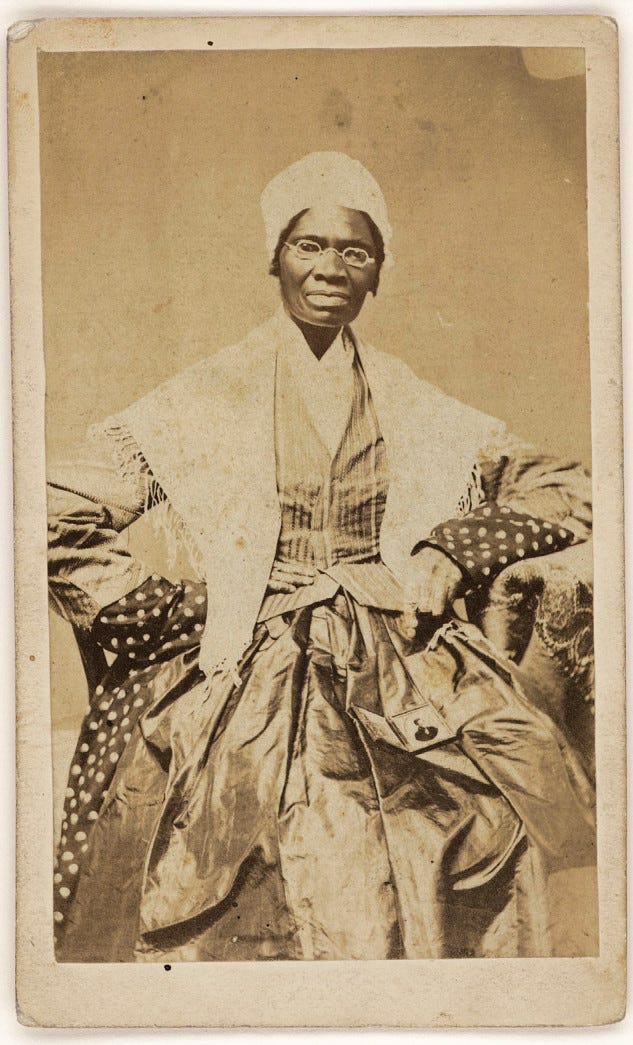
In 1851, at the Women’s Convention in Akron, Ohio, Sojourner Truth made her “Ain’t I A Woman” speech. Writers of the time remembered her words differently—this is from the most-quoted version:
That man over there says that women need to be helped into carriages, and lifted over ditches, and to have the best place everywhere. Nobody ever helps me into carriages, or over mud-puddles, or gives me any best place! And ain’t I a woman? Look at me! Look at my arm! I have ploughed and planted, and gathered into barns, and no man could head me! And ain’t I a woman? I could work as much and eat as much as a man — when I could get it — and bear the lash as well! And ain’t I a woman?
Because she was black, some people think she was only talking about black American women, but she clearly wasn’t talking about rich black American women like the widow C. Richards, who owned 152 slaves. Mrs. Richards was helped into carriages and over mud-puddles and given the best place in her social circle.
Sojourner Truth was talking about all working-class women, whether white or black, free or slave: They ploughed and planted, and gathered into barns, and worked and ate as much as a man when they could get it, and in too many cases, were beaten and whipped with impunity by fathers and husbands. No one helped working-class women into carriages or over ditches or gave them the best place anywhere. They owned no carriages to be helped into, and the closest they came to the “best places” was serving the people there.
So the answer to Sojourner Truth’s question is yes, she was a woman. She just wasn’t a lady.
The divide between ladies and working women has always been wide. Eleanor Marx saw it in the 1890s:
There is no doubt that there is a women’s question. But for us — who gain the right to be counted among the working class either by birth or by working for the workers’ cause — this issue belongs to the general working-class movement. We can understand, sympathise, and also help if need be, when women of the upper or middle class fight for rights that are well-founded and whose achievement will benefit working-women also. I say, we can even help: has not the Communist Manifesto taught us that it is our duty to support any progressive movement that benefits the workers’ cause, even if this movement is not our own?
If every demand raised by these women were granted today, we working-women would still be just where we were before. Women-workers would still work infamously long hours, for infamously low wages, under infamously unhealthful conditions; they would still have only the choice between prostitution and starvation. It would be still more true than ever that, in the class struggle, the working-women would find the good women among their bitter enemies; they would have to fight these women just as bitterly as their working-class brothers must fight the capitalists.
Sojourner Truth never used the word “feminism” because it had not reached North America in her day. The French utopian socialist Charles Fourier coined it in 1837, but it stayed in French circles until the turn of the 20th century when Dora Montefiore wrote:
I cannot help regretting that the word “feminism” has crept into the debate. It is a word of which we have no need in England, and which we might very well have left in its native land, France, where it was coined by men to express the contemptuous lack of understanding of the Boulevard for a phase of strenuous belief on the part of some French men and women, that woman possessed other functions and aspirations outside those of sex; in a word, was a human being as well as a female. It is a lop-sided expression, and leads to lop-sided thinking, just as the term “masculinism” might do, if used in a similar connection. Where education, professions, political rights and public duties are concerned, there is no necessity to emphasise sex; we all meet on the common ground of human beings, having common human interests. In 1897, when speaking at the Women’s Congress in Brussels, I made a similar protest against the word “feminism,” suggesting that we should substitute for it “humanism,” as the advancement of humanity, and not of one sex over another, was the aim and object of the women at that time assembled in conference. The late Madame Potonié Pierre, one of the most large-minded among the French workers in the cause of equal rights for women, felt the justice of my plea, and wrote several articles in the same spirit; but the word “feminism” proved too attractive to the esprit gaulois, and it still reigns supreme in French bourgeois circles, and threatens to invade England.
Obviously, Montefiore and Pierre lost that fight: the word “feminism” is attractive to many privileged women today. It lets them pretend they have common ground with the working women they exploit. But the fundamental nature of feminism is more easily understood if you think of it as ladyism, the right of ladies to enjoy all the privileges that had been reserved for gentlemen.
Ladyism already has a few names. Socialists dismiss it as bourgeois feminism; capitalists endorse it as lean-in feminism. The opposing form of feminism has been called socialist feminism, but Montefiore was right. For socialists, the goal is for us all “to meet on the common ground of human beings”. Different forms of equality do not need special names. That is part of the answer to Why Is “Feminist” So Unpopular With Women When Nearly All Want Equality?