
Feeling Unfulfilled? A Peak Experience Can Help You Become Better.
And it’s easier to have one than you think.
“I had loved not as I should
A creature made of clay”
“On Raglan Road” Patrick Kavanaugh
When was the last time you had a peak experience?
Tell me you’ve had one. Tell me you know what I’m talking about. It’s not the dopamine rush of success, the longed-for test results, the smile from the beautiful stranger on the subway platform. As wonderful as those things are, the peak experience is something more.
In psychology, a peak experience is an altered state of being. It’s a rapturous state that transcends words. It changes the face of reality. And it may have little to do with what’s going on around you, the circumstances you find yourself in. It’s the way it feels that counts.
Peak experiences are always rare. And they can’t be manufactured. If they could, they would be worthless. But sometimes, you can put yourself in their path.
Although they can technically happen anywhere, you’re probably not going to have one in the office cubicle or the factory floor. You need to be out in the world, on the fringe of some horizon where cool earth meets empty air. Under the trees or under the stars or at the foaming edge of the wave.
Maybe you’ll be alone. Maybe you won’t. Maybe you’ll hold someone’s hand in yours, and neither of you will say a word. You won’t need to.
It’s more than happiness. It’s more than joy. It’s rapture. It’s bliss. It’s eternity. And long after the magical moment passes, peak experiences continue to change your life.
It’s St. Teresa pierced by a burning spear. It’s mathematician Andrew Wiles suddenly solving Fermat’s Last Theorem. It’s Dimitri Mendeleev seeing at once the totality of the periodic table, including all the elements yet to be discovered, in a dream one night.
It’s being in love. Wildly, deeply, recklessly in love, the love that you lose yourself in, that warps time and space and lets you dissolve completely through a crack in reality.
You don’t need to change the course of history as a result of your peak experience. You only need to let it change you. Because when you do, you’ll take a huge step toward the person you could be. The very best version of yourself. And when you do, you’ll find that it changes more than just you. Interconnected as we all are, your peak will pull up everyone close to you, too.
Peak experiences can make you less ego-driven, less neurotic, and more comfortable with the emotional nakedness that love requires. They can make you, quite simply, more capable of loving others.
Open the cap. Let the bottle drink the night.
The ground is uneven. The parched lawn, day by dry day, reveals uneven bumps, strange swellings, inexplicable ruts. Like that town in Spain, the church tower that emerges once in a while from the water as the reservoir gets low. The past coming back and back and back, though never quite in the same way.
Careful. A mole made a hole there that I never filled. Lightless tunnels run together underfoot, the hollow filaments of a net spread throughout the neighborhood. It’s safer underground, perhaps. But then you’d never see the stars.
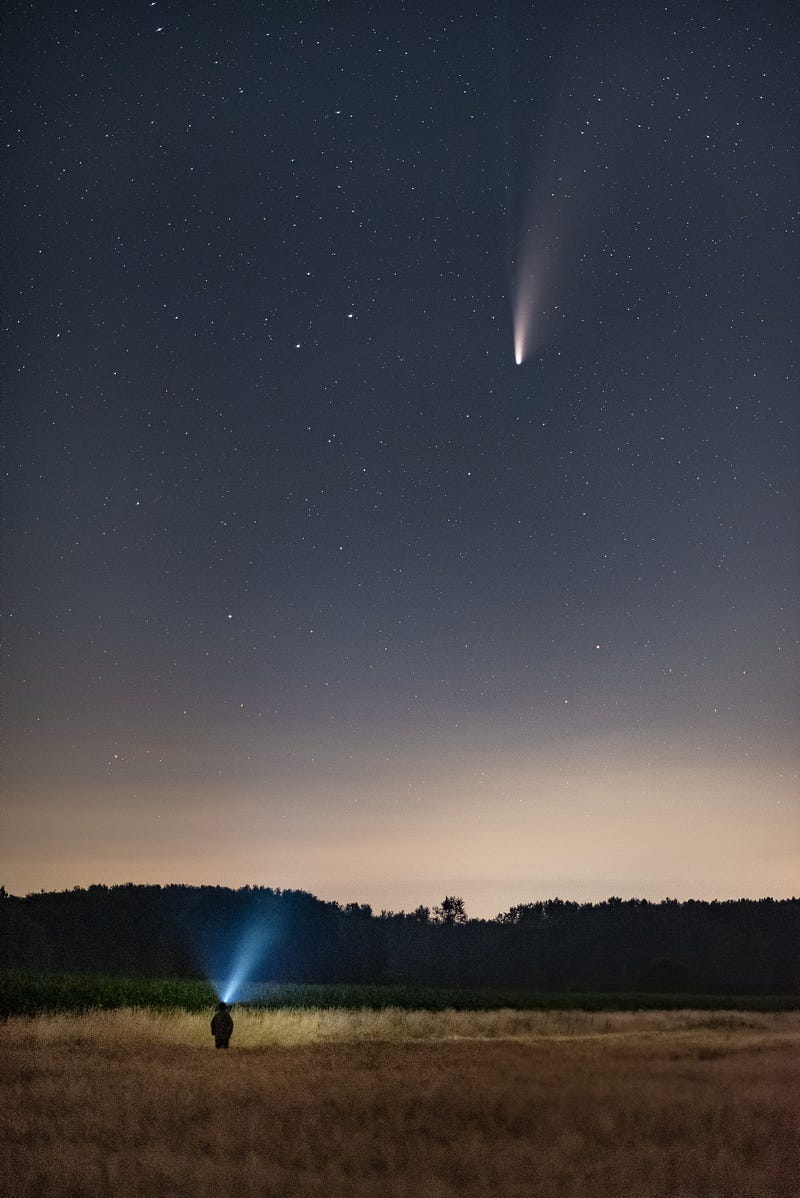
There’s one.
The minute you see it it’s gone. A bright chunk of ice and rock that traveled for a billion years to burn up in our atmosphere as we swing blindly through the cloud of debris.
We follow the same course every year, or one just like it. Never the same river twice. All orbit really means is that we fall together, a spiral rather than a circle, forever tumbling through nothing without feeling it.
And every 133 years or so, the comet Swift-Tuttle swings through our solar system to leave more chunks of itself behind and light up the August sky until it’s clotted with dismissed wishes.
This is the peak experience. And even if I hoped to find it when I came outside under the moonless sky, there are never any guarantees. You can’t manufacture mountains. We’ve tried. There’s a certain impressiveness to human endeavor done well, when we manage somehow to rise at least a little above the muck. But falling stars don’t care about your wishes.
I make them anyway.
You probably know about Abraham Maslow’s hierarchy of needs.
A handy little pyramid built by the psychologist to elucidate the things people need to be happy. Down there at the bottom, in the wide base, you’ll find the basics. Food. Shelter. The physical demands every organism has.
And up at the top? Self-actualization. The fulfillment that comes with doing all that you are capable of, whether that’s a little or a lot. The experience not of some grand and universal meaning to life, but that the individual’s life has some inner meaning.
Not everyone reaches the top. We all fall somewhere along the way. But a key to self-actualization is the peak experience. In Maslow’s view, these are the most beautiful moments of life. The moments of rapture that form the very peak of our existence on this earth. The joy that makes life worth living.
Researcher Gayle Privette breaks down a peak experience into three different characteristics.
1. The experience must feel significant, and will often have ongoing significance in a person’s life.
2. The experience must generate a positive sensation of fulfillment.
3. There must be an element of the spiritual. A feeling of interconnectedness with the world. An insight into the interdependence of a universe that only exists because it grew our eyes to look at itself.
Now, when was the last time you got anything worth nearly as much from checking your dismal online stats?
I always preferred fiction anyway.
In Nabokov’s Ada, or Ardor, the titular character divides the world into Things, Ghost Things, and Real Things. Real Things are rare and precious, but can sometimes occur together. When they do, they make a Tower.
Call it a Tower. Call it a peak experience. Call it psychosis, if you want. You wouldn’t be the first.
But the components, tonight, are this: whiskey glass. Memory. Falling stars. The house silent behind me, and the pen awake in my hand. The fire burning low. Bright stars dripping from the sky. The music in my headphones.
“With her own name there
And her own dark hair…”
But my love’s hair is the color of flame, the color of the stars streaking like molten fire through the sky. My grandfather’s sky, and his grandfather’s too. A seahorse-shaped cloud blocks half the stars, but in the other half, the darkness still tumbles, gravid with the spores of life.
And each meteor leaves a fast-fading tail behind it, pointing back as all tales must into the distant past. Far enough away that the space between us can be tracked in microseconds.
How do we not fall to our knees in the face of this magnificence? How do we keep our feet in the star-streaked storm?
By forgetting. By ignoring. By wooing the clay until our wings fall to the floor.
We love the notifications, that little green dot, that faint falling star of hope that maybe this is what you wanted all along. Maybe it’s finally your time. Maybe the happiness you’ve convinced yourself lies out there waiting to be conquered has finally surrendered to your clutching claws.
You know better, of course. We are all adults here. But the hedonic dopamine rush has us all in its grip. Until a stray flash comes barreling out of the scar-tissue cloud that decays pink against the royal blue and reminds you that an entire internet’s worth of fear and fury and deliberate misunderstanding means less than that momentary and doomed brilliance.
Stars. Alcohol. Music. Memory. And one more Real Thing.
The young woman sleeping on my sofa used to lay her hot infant head on my shoulder while I sang this song to her, the one playing now on my headphones.
Everything has its gravity, we ourselves as much as the stars and the black holes and the nebulae where the slow solemn music starts all over again. I had no idea when I moved across the world that seventeen years later, I would be here. That she would be here, starting her new life just as I started mine.
It doesn’t mean much set against the cold blackness between stars. But doesn’t that infinite chill make what little warmth we can gather matter more?
Everyone searches the sky for the star that shines just for them. But these stars aren’t coming to meet us. It’s our blind blue Earth that is crashing into them.
There are no easy lessons in that dripping sky. No 7 Tips To Make You a Better Anything. There’s just the light and the dark and the tiny trace of heat we shed into the ether.
That’s enough.


