
The 5 lessons video games taught me & how they helped me live a happy, fulfilled life
Can we learn about leadership, persistance and overall hapiness through gaming?
“What am I doing with my life? Can’t I GROW UP already, stop playing games and be cool like everyone else?”
The question above used to be my thought pattern whenever I compared myself to people around me. As a video-games lover, I often felt ashamed when anyone asked me: “Hey, what are you up to?” I did neither sports nor had I many girlfriends. And I was afraid of getting the weird looks from people around me by admitting my passion.
Now, with proper hindsight, I finally understand two things:
- Passion is nothing to be ashamed of whether it’s for fishing, sports or video games.
- Overtime games taught me many things neither my parents nor my teachers at school were able to show me. And they’ve put me way ahead of my peers and friends in certain areas of life.
Ivan Dimitrijevic states in his article for Lifehack.org that once we come to understand certain truths of life, we can apply our findings to different areas. Adding we usually praise sports or art for developing our potential and that it’s gaming we view as not that beneficial.
This observation (besides other things) inspired me to think about my history as a passionate gamer and appraise lessons I learned playing video games.
💡 Lesson # 1: There’s more to it than having fun
The very first introduction to video games happened to me at the age of 3. My dad used to have a computer in the living room, and now and then he had let me play Tom & Jerry.
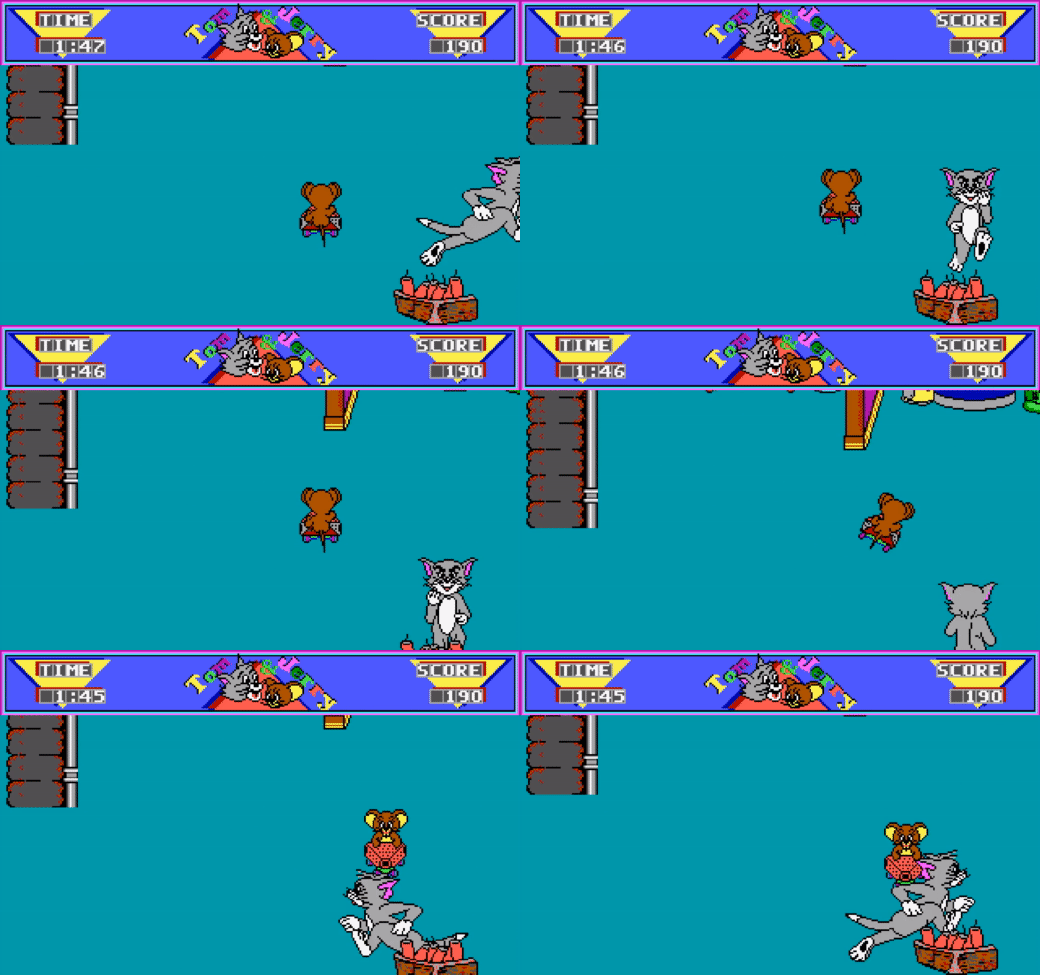
I briefly recall not only the game was fun, but also things had different names than in my native language. Even at the age of 3, I was already able to understand what do English words like Milk, Tomato, Cat or Mouse mean. So I started saying these words out loud just for fun even when I had a regular conversation with my parents. Naturally, they didn’t understand.
⏩ Fast forward to the age of 9.
It was my very first English lesson at school. Kids were sitting at their desks waiting curiously for what‘s about the come.
Our teacher Mrs Barak reached for a small purple ball and said:
“This is a…”
“ … ball,” I finished.
“Correct,” she said, obviously surprised. “And what can you do with the ball?” asked Mrs Barak while my classmates silently sat there not knowing the answer.
I raised my hand and replied: “You can throw it to me, and I can throw it back to you.”
This time Mrs Barak just stared at me without a word. I could say, even back then, it wasn‘t usual kids knew how to communicate on such a level.
Just a couple of lessons later I realized I might have known some words which, even Mrs Barak, couldn’t recognize.
That’s when I knew there was much more to video games. I understood they were directly responsible for laying strong foundations of being able to communicate in a foreign language.
💡 Lesson # 2: Challenge wipes out boredom forever
17 YEARS LATER
“How long exactly have you been playing Diablo 2?” asked a friend of mine when we sat over a beer on a Friday evening.
“About 15 years?” I replied.
“How could you even stick with a goddamn game like this for so long?!” he gasped, almost chocking with beer foam while trying to find any sense in what I‘ve just said.
I thought about it for a second and then I’ve just said: “I don’t think I’ve ever finished the game.”
“Not in the entire 15 years? You gotta be LAME, bro.”
Now the conversation above is an example of two different gaming approaches. I’m used to diving deep into games I love. I see infinity possibilities in how the game might be played and finished. Plus I purposefully look for more difficult circumstances, so I can test (and develop) my skills. That means there is no way for me to ever finish the game.
My friend, on the other hand, enjoys skipping from one game to another once he gets bored with the previous. And he hates losing, so he plays solely offline and on the lowest difficulty settings possible.
Let me say there’s nothing wrong with any of these approaches. Everybody has THE RIGHT to enjoy games in a way they like the most. The thing is, despite my point of view seeming to be a bit extreme, it has some benefits as well.
The entire point of purchasing a game is to challenge yourself to grow beyond your current set of skills. When you immerse yourself in a game, you view each obstacle as an opportunity for growth.
- Matthew Jones paraphrasing Nicolas Cole in his article 10 Life Lessons Millennials Learned From Video Games (That Older Generations Don’t Understand)
What is the player’s purpose in Diablo 2?
Briefly explained: you choose one of seven fighters. Once you do that all your job is to:
- Slay demons (either in melee combat or via arrows and spells)
- Get experience, level up your character & get better gear
- Become stronger
Now to answer my friend’s question: how can we, Diablo 2 lovers, stick with this game for years or even decades?
Most people who played the game once or twice and then moved on, don’t understand. Quite often, I’ve been part of conversations where they said things like:
❓What exactly are people chasing in this game?
❓ Why are they not moving to a “more useful” hobby?
❓ Are these people sane? Do they have jobs or families?
At this point, I could only imagine why most fans still play this game even after almost 20 years. But instead of guessing, I’ve decided to do a quick research in one of the largest Diablo 2 Facebook Communities.
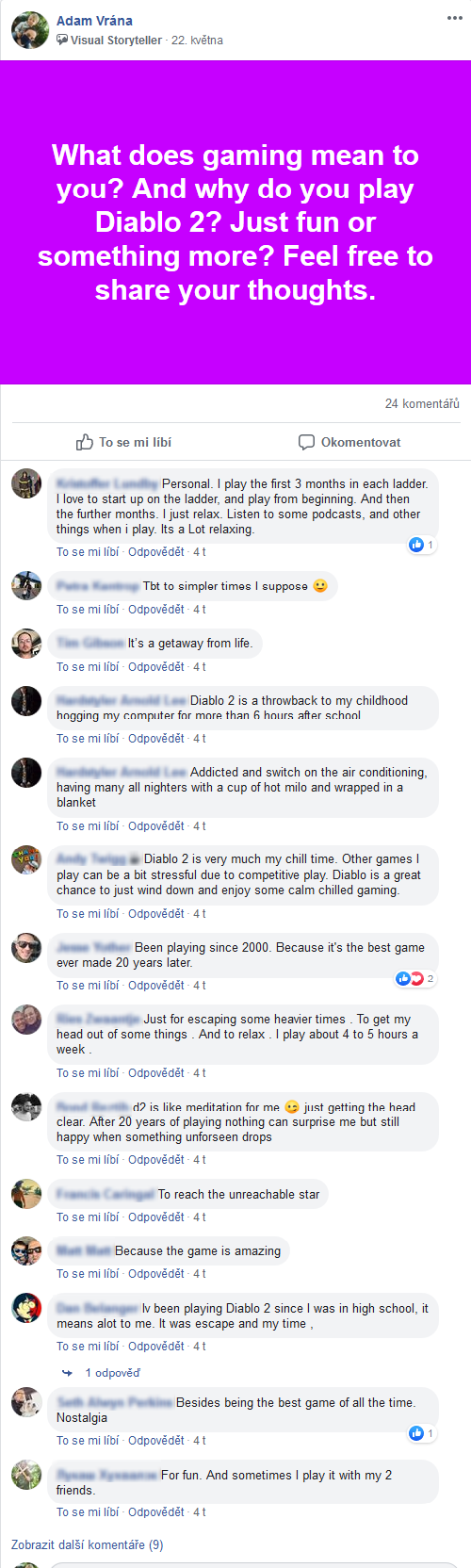
From the answers, I find the reason pretty obvious. For some of us, the game serves escapism purposes. For others, playing Diablo 2 is just a fun thing to do. And that alone has a bunch of different sub-reasons (relaxing, seeking challenges etc.) which either work or don’t work depending on how much of a fan you are.
Why do I play Diablo 2?
As a 9-year-old kid, getting the Diablo 2 original copy from my dad was one of the best moments of my childhood. I didn’t know it immediately as I didn’t trust the demonic cover of the gaming box on the first sight. However, once I installed the game, I got hooked.
At high-school, Diablo was all about escapism. Back then, I dove my-self deep into fantasy literature and even wrote a couple of my own stories, most of them based particularly on World of Warcraft and Diablo.
Around age 20, my approach for Diablo completely changed. I mean it still serves me as an escape from reality, which sometimes seemes too harsh. But, no matter how crazy it sounds, I’ve started seeing something new in Diablo. It became a place for testing my abilities and for learning new things. Even though opening a book would probably be a better idea, through constant repetition, Diablo has taught me some of the most valuable life-lessons most adults struggle to embrace.
- PERSISTENCE ➡️ Since high-school, I play Diablo solely on HARDCORE. It means, when I’m creating a new character, I check a small box on the character screen, which ensures once my character dies, I can’t play the game with it anymore. It’s DEAD FOREVER. Just imagine: you put months or even years into developing your character. And then you make a single mistake, and all is lost. You have to start all over again. And again and again. Until the game is beaten and your hero gets his well-deserved Guardian status. Like anything in life, success usually doesn’t come on a first attempt. You gotta fail a couple of times until you figure out the way to achieve your goal.
- EMBRACING LOSS & STARTING OVER ➡️ Losing your hero might be as difficult as losing a beloved person or pet. I can’t say laying to rest a couple of virtual characters is that serious matter, but it still hurts. All we can do about it, however, is to learn how to accept it and move on.
- THE JOURNEY (NOT THE DESTINATION)️ EQUALS HAPPINESS ➡️ I’m aware this statement sounds like a cliché. But it’s always the same: achieving my end-goal, meaning finishing the game successfully, always brings me temporary joy (according to psychologists, this is called Hedonic Adaptation). What makes me truly happy is coming up with new and more difficult challenges and staying on the journey of discovering new possibilities in the game.
Sometimes you fail miserably, die, or even scratch everything and start all over from level one with a new character. Once you get into this mindset of “failure is merely a teaching tool,” you’ll start to apply it to other aspects of life without even realizing it.
— Ivan Dimitrijevic in his article 7 Life Lessons I Learned Playing Video Games
💡 Lesson # 3: Realizing what does it take to be a good leader
I‘ve always found it easy to look down at my teachers, parents, or superiors, and criticize them for how bad they manage.
It was until I became a Guild Master in World of Warcraft (in the era of Burning Crusade expansion), where my guild conquered a few of the most difficult challenges in the entire game.
What does playing World of Warcraft have to do with being a leader?
World of Warcraft (commonly known as WoW) is a multiplayer RPG where you interact with hundreds to thousands of players in real-time.
Each one of them chooses their race, class, level up their heroes, get better at various professions and make gold by selling items in auction houses.
I’m not going to explain what the game is entirely about, as it would make for another article. If you feel like you need to understand the game mechanics further, CHECK OUT THIS VIDEO ⬇.
One of the things you can do in this game is to gather in groups of 10 to 25 people and use your combined effort to conquer bosses and collect their bounty. And that’s what leadership is needed for in this game. As for defeating bosses, you, as a leader, need to:
- Get everyone online in a prescheduled time on a prescheduled day.
- Make sure your group is well balanced (meaning it consists enough tanks, healers & damage dealers).
- Ensure responsible team members have done all necessary pre-boos raid preparations (e. g. potions craftings).
- Study the boss mechanics in advance so you can set up your tactics and explain it to the rest of the team.
- Think about various crisis scenarios and be ready to coordinate your team-mates when things get hard.
The duties listed above are just an example of World of Warcraft being a great management simulator. Operating a guild is obviously very similar to operating a real business. There is no money involved, but that doesn’t diminish the value of the leadership lessons you can get from the game.
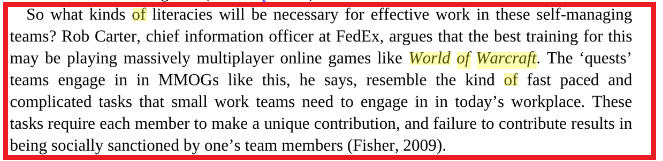
Which lessons have I learned from World of Warcraft in terms of leadership?
- LEAD BY EXAMPLE ➡️ If I want anyone to act or perform adequately in certain situations, first, I need to make sure I’m the best example possible. Not just for guildmates: this has worked for my editorial staff I operated with a couple of years ago, and it works with my children as well. It has been proven by various studies, that leading people by example usually has a positive effect on team cooperation.
- LISTEN & NEVER ARGUE ON AN EMOTIONAL LEVEL ➡️ Having a constructive conversation is always inspiring. But to achieve that, both sides have to listen to each other. Otherwise, an emotional argument will spark, and when it happens, the following conversation usually leads to not being able to solve the issue.
- ASK FOR HELP IF NEEDED ➡️ My guildmates were mostly willing to take care of certain obligations. But I often discouraged them, being convinced I can manage things better. That was a false assumption from my side. Leaders need help from people around them. Without good people, leadership becomes purposeless.
“The greatest leader is not necessarily the one who does the greatest things. He is the one that gets the people to do the greatest things.” — Ronald Reagan
💡 Lesson # 4: The importance of seeking solitude
For the first two years at high school, all I wanted was to fit in.
Suddenly I stopped caring once I turned 18.
There was this everlasting drama goin’ on in my head that I can’t talk about my hobbies and share my passions with others because I would get marked as weirdo (in better cases).
But then, one day, a game-changing idea has sparked while I was playing World of Warcraft with my Tauren Warrior named Dushu, and he re-entered this beautiful uninhabited starting zone called Mulgore:
💭WHAT IF I AM JUST ON MY OWN LIKE DUSHU RIGHT NOW? 💭
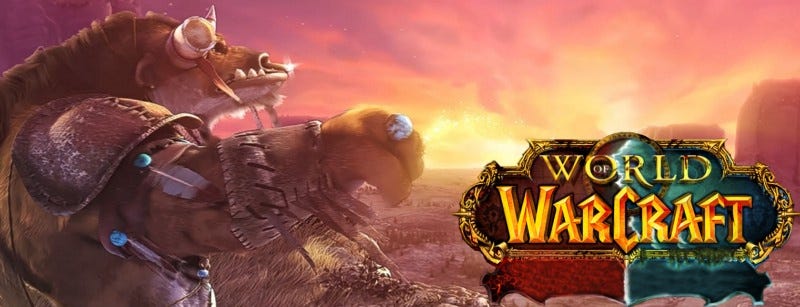
According to the study published in Journal for the Theory of Social Behaviour, solitude might promote freedom, creativity, intimacy and spirituality. I remember testing this out by coming back from school one day, packing a couple of books, a bottle of water and some cigarettes in a backpack, and going into woods. It was at this moment I felt such freedom, joy and self-worth I have not experienced my entire life.
I was just sitting at the glade staring at trees, casually writing notes to my notepad, opening books to read a few pages and lit a cigarette now and then. There were no people around to worry about, just me, doing things I loved. That day I became complete, all thanks to the solitude and inspiration I got from World of Warcraft.
If you’re lonely when you’re alone, you’re in bad company. — Jean-Paul Sartre
💡 Lesson # 5: It’s all about balance
Having a passion for video games (or anything else for that matter) is an incredible thing. However, with anything I ever did, I realize I need to take all things in moderation.
I have to acknowledge some of the worst days of my life were those I’ve spent 18+ hours inside World of Warcraft, hunting for brighter armour or fancier looking sword. How could I spend any time dealing with my real-life problems if all I was doing was gaming all day long?
Once realizing this, I’ve made a turn. Solitude, gaming and reading non-fictional, mostly philosophical books, have helped me finding joy in facing my reality and slowly recrafting it to my desired image. It took me years of systematic patient work. But right now, I feel like I have everything I’ve ever wanted from life. Although different people might say, I have nothing at all.
I’ve seen in my own eyes what giving up to the virtual world involves. A person close to me rejected the idea of a well-balanced life and let himself become a children-adult living with his grandparents (in his mid-thirties), playing games all day long, eating frozen pizza and getting tantrums about running out of soda.
No obstacles? Wrong direction. Life is supposed to be difficult. It’s supposed to be challenging. And it’s supposed to get harder as you progress. That’s just the way it is.
— Neil Herndon in 15 Lessons About Life We Learn From Video Games
I believe it’s anyone’s right to take a step back from their problems and relax for a while. Although we need to learn how to live in this world instead of hiding away from it inside fictional worlds.
Nevertheless, as for using video games as a means of temporary escape, I’m all for it. Now that we all understand the benefits & lessons gaming might bring into our lives besides shame of admitting how much we love them.


