
Feedback Loops in Game Economics
Empowerment, deadlocks, and a small mathematical analysis
A game's economy is an internal system within a game responsible for all the mechanisms related to the game's resources [1]. In the game’s economy, the term resource is very open and comprises concepts from collectible items (such as coins) to the player’s journey itself. In general, a resource is any concept that can be measured numerically [1]. (For a more in-depth analysis on resources, refer to this previous article).
Resources are handled by the game's economy using 4 basic mechanisms (or 4 pillars), which are: Sources, that create resources out of nothing according to a production rate; Drains, which eliminate resources from the game permanently; Converters, that convert resources into others of different types according to a conversion rate; and, Traders, which trade resources among different entities in the game, such as Players or NPCs [1]. (For a more detailed study on the 4 pillars, refer to this previous article).
This article discusses how the relationship between these mechanisms can either empower or weaken a player's progress through mechanisms named feedback loops. Moreover, it is possible to study and improve games by understanding these concepts, especially balancing and adding features.

While Sources and Drains are mostly responsible for creating and destroying resources, Converters, and Traders are usually responsible for controlling how resources are balanced and distributed within the game. Notice that this is not necessarily balancing the game itself, as resources have different values.
Converters transform resources, reducing or increasing their amount in the game world. Therefore, they can be used to achieve a global resource equilibrium. The conversion process can control the number of existing resources of each type. Multiple resources can be converted into just one, such as the coins in Super Mario, which are converted from 100 coins to 1 life.
Contrarily, traders move resources' ownership from different entities. The number of resources in the world is the same, but each entity's resources are changed. Therefore, traders can be used to achieve a player's resource equilibrium. In Torchlight 2, two players can trade different types of gems, for example, distributing them among themselves. Both resources still exist in the game but are now dispersed among the entities.
However, in these chains of production, all mechanisms involved are subject to the influence of each other’s and their own, especially concerning both types of resource equilibrium. To illustrate these points, let us analyze some mechanisms in the acclaimed real-time strategy game Warcraft 3 (2002).
Mechanisms Influencing Other Mechanisms
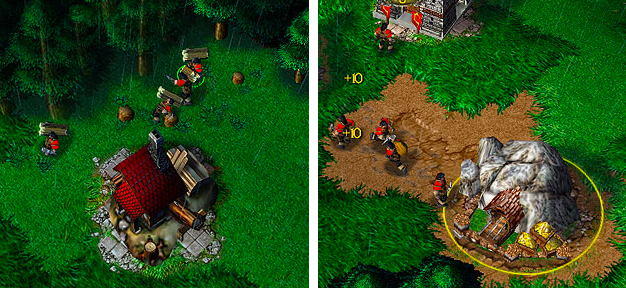
In Warcraft 3, human peasants can harvest lumber, and it can later be used to produce other resources, such as military troops and upgrades.
The rate at which peasants harvest lumber can be increased by acquiring the Improved Lumber Harvesting upgrade in the Lumber Mill. Therefore, this upgrade influences the production rate of lumber being harvested. Hence, the game has a mechanism (purchasing the upgrade) influencing another mechanism's production rate (harvesting lumber with peasants).
Mechanisms Influencing Themselves
Gold is another important resource in Warcraft 3 that can also be harvested by peasants. During the early game, each peasant can harvest 10 gold from the gold mine, and new peasants can be recruited for 75 gold each.
Consequently, gold is being harvested and later used to increase the rate of its harvesting. The same mechanism that produces a resource uses it to influence its own production rate. This scenario is called a feedback loop.
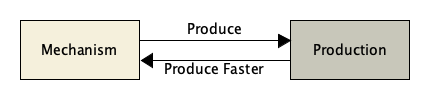
A feedback loop happens when the result of one mechanism influences the game in a way that it will, at some point, impact its own rates, as seen below:
Feedback Loops
In other words, a feedback loop is a process of feeding back the results (not necessarily the production) of a mechanism into itself.
Not all mechanisms are linked to feedback loops, though. This is usually the case for mechanisms that do not feed others with their production.
For example, using a Potion of Healing in Warcraft 3 converts it into health points for a character. Yet, this process does not affect the health recovery conversion rate, nor the drop chance of (healing) items.
Alternatively, a feedback loop can span over various mechanisms before being fed back into the initial one. Depending on the size of the game's economy, this process might encompass multiple feedback loops for many mechanisms.
Differently from the basic economy mechanisms (sources, drains, converters, and traders), which are subject to the game designer's interpretation (whether a mechanic is a Drain or a Converter, for instance), feedback loops are a mathematical concept and are independent of interpretation. They are a result of the relationship between the mechanisms of an economy.
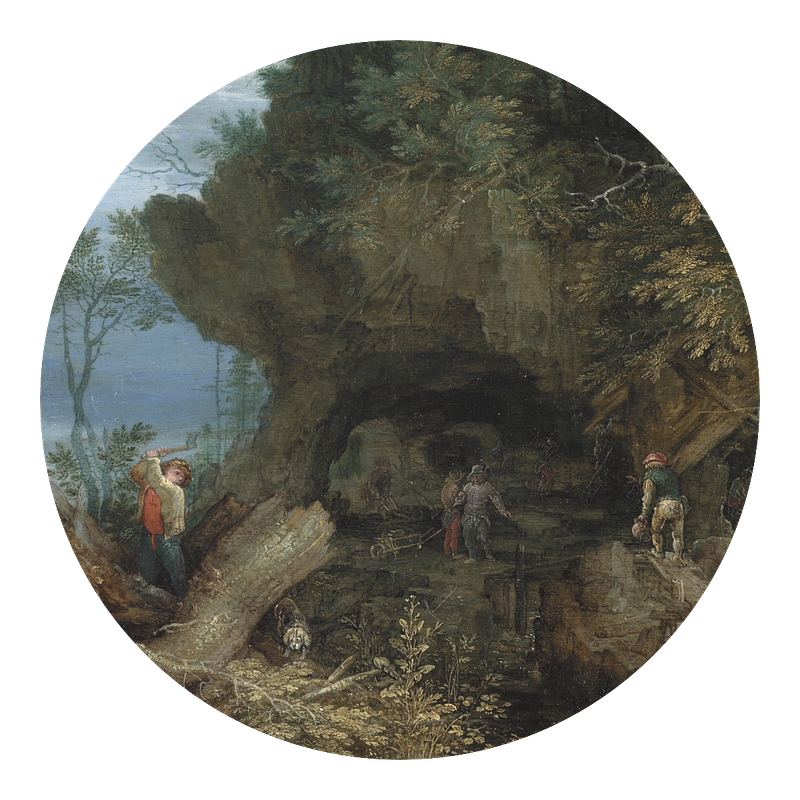
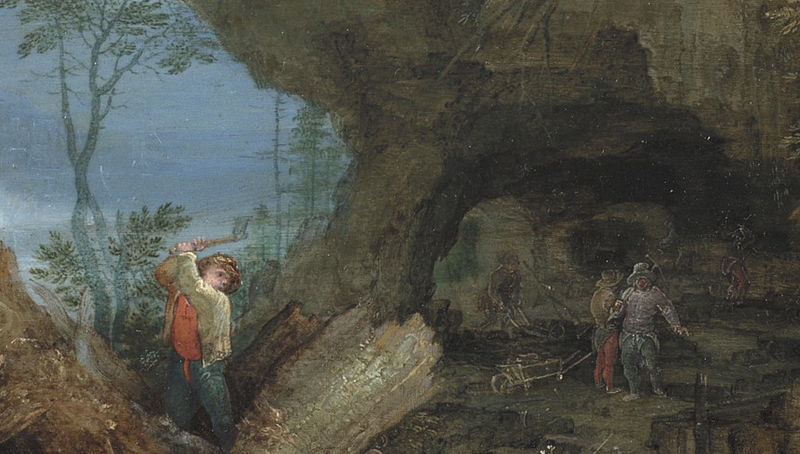
To better understand the notion of feedback loops and its related concepts, the following section introduces and expands the concept game Mountain Core, designed by the author of this article, inspired by the great artwork by Roelant Savery that illustrates this piece.
Mountain Core
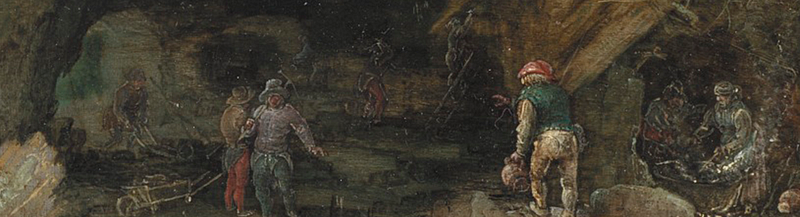
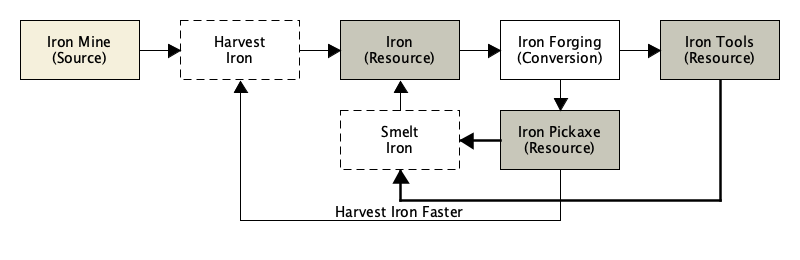
Mountain Core is a multiplayer turn-based game in which players harvest resources, such as Iron, from a mountain. Iron can be used to make iron devices, such as Iron Pickaxes and Iron Tools. The mountain has a limited number of resources, and it is depleted when there are no resources left.
Iron Pickaxes are used to speed up the Iron Harvesting process, constituting a feedback loop. This feedback loop will be called the Pickaxe-Loop.
Iron Tools, on the other hand, are the game's main goal. The first player to reach a certain number of Iron Tools win.
Both devices require Iron to be forged. When a mechanism is stopped (or cannot be activated) due to the lack of resources, we have a deadlock [1]. The only way to break a deadlock is to supply it with the necessary resources.
Iron devices can be smelted back into Iron to prevent deadlocks in the game, but at a reduced rate than initially used to create them.
With these concepts, we have the following game economy:
Analysis of a Feedback Loop's Impact
Considering the concept game, this section analyses the Pickaxe-Loop impact using arbitrary values and formulae for the economy's mechanisms.
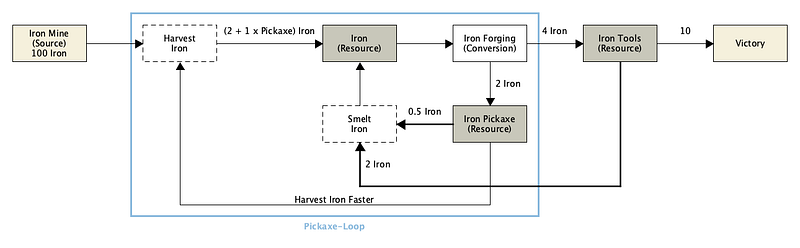
Let us assume that the Iron Mine has a reserve of 100 Iron. Harvesting grants 2 Iron per turn, plus 1 Iron per Pickaxe. Forging 1 Pickaxe requires 2 Iron, and Smelting 2 Pickaxes grants 1 Iron back (Pickaxes must be smelted in pairs).
Additionally, the goal is to collect 10 Iron Tools. Each one of them requires 4 Iron to be forged, and Smelting grants 2 Iron.
The diagram below shows the game economy using these values. Notice how the Pickaxe-Loop, highlighted in blue, is shaped as a cycle:
The following chart shows the amount of Iron harvested in 10 turns using two different strategies: not forging Pickaxes and forging new Pickaxes every time possible (when there are at least 2 Iron available).
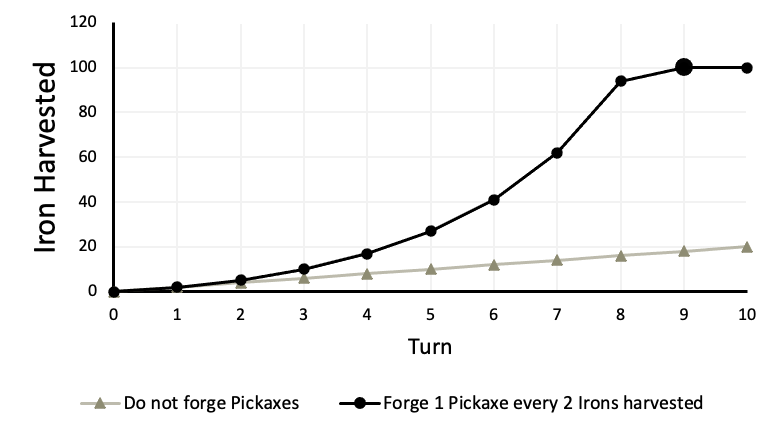
Forging Pickaxes for faster harvesting is a positive feedback loop because it strengthens its effect [1]. As shown in the chart above, this feedback loop quickly outperforms the other strategy. By the 9th turn, the mine is already depleted (100 Iron were harvested). This process also grants the player a sense of empowerment due to its rapid growth and progress.
Since the game's objective is not to deplete the mine but to collect 10 Iron Tools, this strategy might not lead to victory.
Using the "Do not forge Pickaxe" strategy, a player would harvest 20 Iron by the end of 10 turns, which can be used to forge 5 Iron Tools. Moreover, there are still 80 Iron left to be mined from the mountain.
In contrast, using the "Forge a Pickaxe every 2 Iron Collected" harvests 100 Iron, but all of them were used to forge 50 Pickaxes. Smelting them results in 25 Iron that can only forge 6 Iron Tools. It is 1 Iron Tool more than the other strategy, but the mountain is depleted already. It is a deadlock.

Rethinking the Values and Viable Strategies
The initial analysis showed a possible scenario given the arbitrary numbers chosen. By changing them, different strategies can become viable, i.e., can lead to victory. For example, to make the "Forge a Pickaxe every 2 Iron Collected” viable, there are a couple of alternatives:
- The smelting conversion rate of Pickaxes could be changed from 2 Pickaxes to 1 Iron to 1 Pickaxe to 1 Iron. Thus, 50 Pickaxes would convert into 50 Iron, which later converts into 12 Iron Tools (and 2 Iron).
- The winning condition could be reduced from 10 to 6 Iron Tools.
- The cost of the Iron Tools could be reduced from 4 Iron to 2.5 Iron, which would convert 25 Iron into exactly 10 Iron Tools.
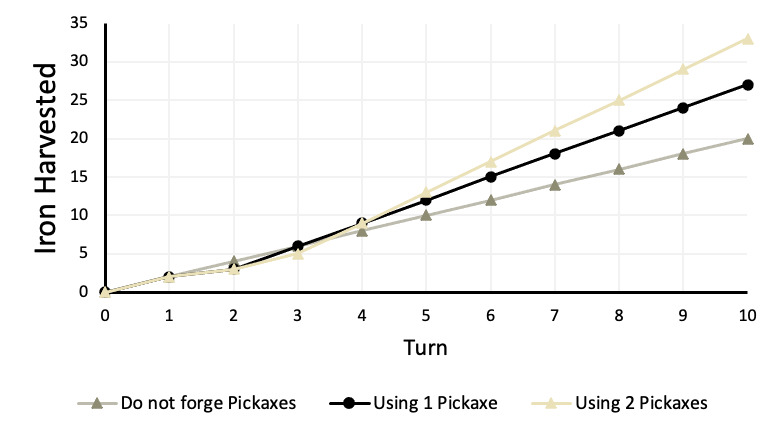
On the other hand, accumulating Iron is not viable at all. There are no mechanisms that enforce the player into doing it. Besides, any strategy with at least 1 Pickaxe will outperform it, as seen in the chart below:
Limiting Growth
Another issue with the current setup is that accumulating Pickaxes can quickly get out of hand. As a matter of fact, the current strategy of generating one Pickaxe whenever it is possible results in an exponential equation. In other words, it grows very, very fast, as seen in the chart below:
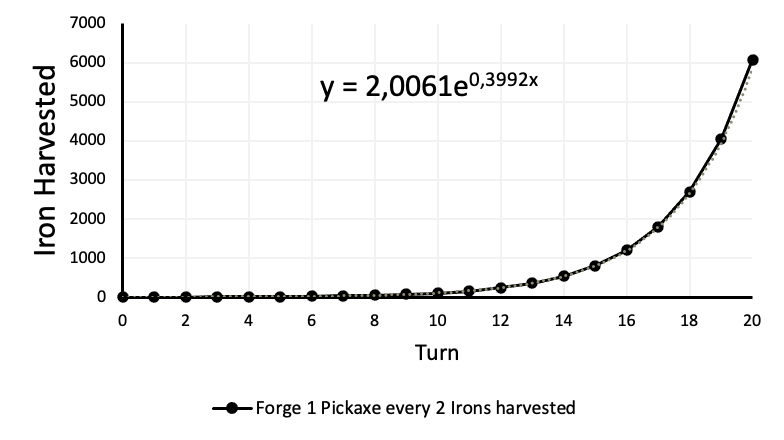
As seen previously, this strategy can harvest a mountain with 100 Iron in 9 turns. Likewise, for mountains of 1.000 and 10.000 Iron, this strategy can harvest them in 14 and 20 turns, respectively. There is simply no way another strategy (or even just not using Pickaxes) can outperform it.
In this case, a good solution is to recur to a negative feedback loop that weakens the effects caused by the positive feedback loop [1].
Mountain Core already has a simple negative feedback loop in the form of the smelting system. When devices are smelted, some Iron is lost. As Iron is later used to make more tools and then smelted again, more and more Iron is destroyed, weakening the player's resource pool.
However, the smelting mechanic does not solve the Pickaxe-Loop problem. To solve it, it is necessary to either add new features, such as limiting the number of Pickaxes available (not a negative feedback loop) or increasing Pickaxes' cost over time. The following chart shows the impact of the latter:
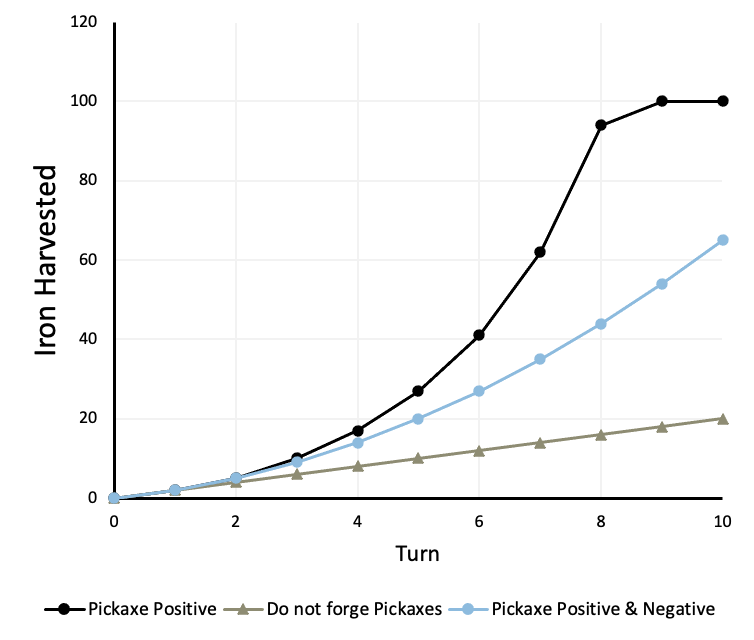
The blue line ("Pickaxe Positive & Negative," that is the strategy under the effects of both positive and negative feedback loops) in the chart above shows the number of Iron Harvested by increasing Pickaxes' cost by 1 every time 1 Pickaxe is forged. For example, after forging 3 Pickaxes, a new one will cost 5.
Although continuously forging Pickaxes still seems a viable strategy, it is now the exact opposite. At the end of the 10th turn, 65 Iron were harvested, and 10 Pickaxes were forged. Given each Pickaxe pair still grants only 1 Iron, smelting them all will allow the forging of only 2 Iron Tools. Far below the 5 acquired from not forging Pickaxes at all.
Randomness and Considering New Mechanics
Due to the positive and negative feedback loops, the game's economy now has a more interesting dynamic. While previously creating Pickaxes was a matter of simply accelerating the harvesting process, it nows has a negative side effect to be considered. Every investment in speeding up the process impacts future steps and reduces the returns from the smelting mechanic.
However, it is still possible to use economic values and calculate a perfect strategy. Given the formulae and mechanisms, charts can be plotted, and equations can be proposed to determine the exact number of Pickaxes, turns, and other factors to achieve the winning condition as fast as possible.
Perfect strategies break the dynamism of a game. The players no longer need to plan or experiment, as they will likely lose if they refuse to play the perfect tactics. And for that, the easiest approach is to add randomness.
As options do not have a precise outcome anymore, the possibilities open up for strategies to become viable, given the circumstances. It also adds to the element of risk in the game. For example, if the Pickaxe has only a random chance of increasing its value when forged, players can feel more inclined to take the risk in doing so or not. It is no longer a matter of finding out Pickaxes' precise number, rather than being lucky enough to get there.
Simultaneously, when faced with the need to add randomness, the game designer can also opt to simply add other mechanics to expand on the number of possibilities. Players could use the Iron Tools to steal Iron from each other, which would foster the game's competitive and random element. A player can no longer play a perfect strategy if others can interrupt it.
Alternatively, to increase the appeal of the accumulating Iron strategy, a new random-based mechanic could be created. For instance, as players accumulate Iron and do not forge Pickaxes, there is a random chance of one Cute Dog to visit the players and grant them a free Iron Pickaxe or extra Iron.

With positive feedback loops, the game designer can motivate the player, granting a sense of growth and empowerment. At the same time, they can create more dynamic scenarios, disrupting the balance in the game. [1]
Contrarily, negative feedback loops balance the game. They reduce the effects accumulated by the other mechanisms and stabilize the economy. By doing so, they also even up the strategies, making them viable, at the cost of demotivating and undermining the player's growth. [1]
Either should also be studied via the lens of the resources global equilibrium and the player's resource equilibrium, as they influence both states. It is easier for a game designer to make adjustments to the mechanics when the resources are seen in an equilibrium state.
Moreover, by analyzing the feedback loops, it is possible to better plan and understand the game and find parts that need balancing or require adjustments. Additionally, opportunities to add new mechanics are spotted, which is a significant outcome.
Adding new mechanics to a game will certainly make all its aspects more complex: more thought needs to be put into teaching it to players, more art needs to be done to show it, more code needs to be implemented, and more mechanisms are included in the game's economy. Ultimately, the game becomes harder to make, maintain, and balance.
Therefore, using this sort of analysis can save time and money during the game's development, as it points to where and what changes need to be made. More specifically, it can pinpoint which and how the game’s mechanics can be improved to create a sense of balance and fun.
Thanks for reading 😊. If you want to know more about me and my work, you can join me here. Also, if you are new to Medium and want to support me, consider joining using my referral link.
References
[1] Adams, E., & Dormans, J. (2012). Game mechanics: advanced game design. New Riders.