
TK Some nice catchy title that also makes me sound smart
How do you write?
Do you do it like Roger Ebert used to, arriving at the office barely an hour before his deadline, and then type in everything in sequence, no typos, no changes, perfectly on the first go?
Or do you rewrite, move stuff around, leave unfinished strands and abandoned sentences, and keep your story in a constant state of messiness until it barely comes together just a minute before publishing?
Somehow, I bet you’re the latter, not the former.
There’s a publishing tradition of writing TK as a placeholder in your story. Anything that you can’t think of at this moment, or that would require breaking your flow, gets a TK so that you remember to come back to it later. For example:
TK nice title
He reached out to John Lastname TK.
I found this photo in 1978. TK VERIFY
Why TK? The origin is murky, but it is believed to be a version of to come, intentionally spelled out in a different way and capitalized so it is easier to spot and impossible to appear organically in writing. Before publishing, the editor would look over the article to make sure no TKs are left. (Although sometimes they’d miss some.)
Today, we’re launching a feature on Medium that builds on this tradition and we hope helps in your writing process in a small way. From now on, whenever you type in TK, a yellow indicator will appear on the margin, and Medium will warn you if any TKs are left before publishing.
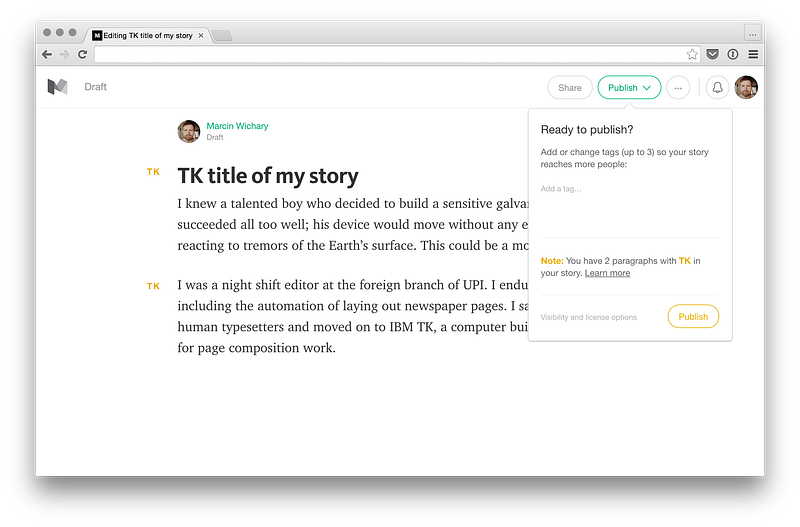
So, TK away! (We won’t tell anyone.)


