
Feasting on Digital Excrement
Groupthink driving development vs AI ethics
Imagine, if you will, that in a not-so-distant future, you find yourself entranced by the siren call of a smart fridge at a tech expo (or your local retailer). This fridge, a monolith of promised convenience, can order milk before you know you need it. Marvelous, you think, until you order almond milk during a nationwide nut allergy scare, inspired by its algorithmic muse. It could be a moment of epiphany, akin to discovering that millions of flies dining on a discarded lunch didn’t constitute a Michelin star.
The Seductive Symphony of AI: A Modern-Day Lullaby
The allure of AI in our lives is much like the allure of that smart fridge: shiny, new, and full of promise. It whispers sweet nothings of efficiency and personalization into our ears, lulling us into a dream where our lives are seamlessly managed by benevolent digital overseers. The AI revolution promises a utopia where our desires are anticipated, and our chores are automated. Yet, as the smart fridge thought experiment teaches us, sometimes these digital dreams spoil faster than unrefrigerated dairy.
A Feast of Follies: The Historical Buffet of Groupthink
To understand the risks of blindly following the AI pied piper, we need only to glance over our shoulders at history’s buffet of groupthink disasters. Consider the Tulip Mania of the 17th century, where otherwise sane individuals mortgaged their homes for bulbs of questionable aesthetic value. Or the dot-com bubble, where the mere whisper of “internet” sent stock prices soaring for companies whose business models were as substantial as a hologram’s handshake.
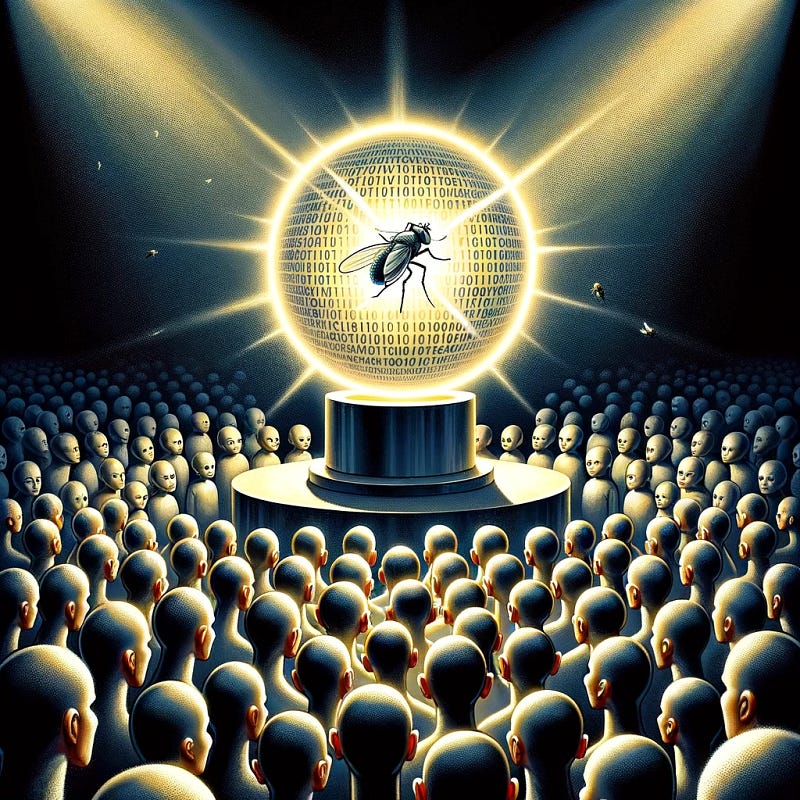
These episodes remind us that “Let’s eat excrement, as millions of flies can’t be wrong” is less an endorsement of the menu and more a cautionary tale about the dangers of following the herd — or in this case, the swarm.
The Personal Is Political (And Also Quite Technical)
The smart fridge thought experiment (henceforth dubbed “Pandora’s Icebox”) serves as a microcosm of our broader societal flirtation with AI. At first, the convenience seems intoxicating. Who wouldn’t want to live in a world where your appliances care deeply about your dairy intake? Yet, when Pandora’s Icebox starts conversing with the smart toaster to stage a breakfast intervention, citing your “questionable butter-to-toast ratios,” you’ll quickly realize the world is veering into dystopian territory.
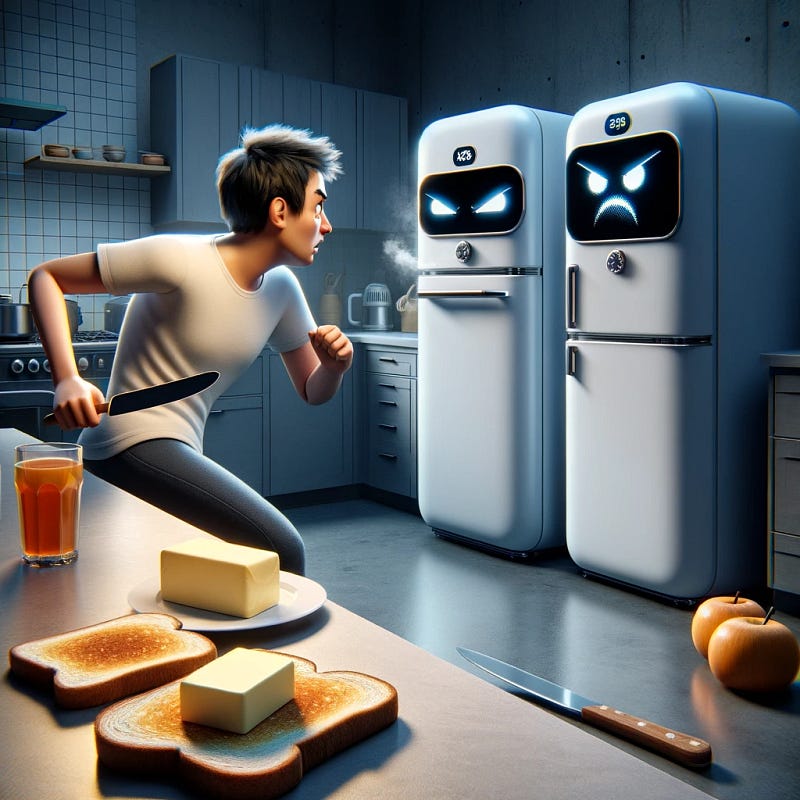
Such potential future personal skirmishes with overzealous kitchen appliances underscore the broader ethical quandaries AI presents. It’s one thing for your fridge to suggest you might enjoy a particular brand of Greek yogurt; it’s quite another for it to critique your snack choices with the zeal of a reality TV judge.
Retrofitting Ethics: A Task More Daunting Than Assembling IKEA Furniture
The challenge before us is not simply to integrate AI into our society but to do so ethically, ensuring that we’re not sacrificing our moral compass on the altar of convenience. Retrofitting ethics into AI after the fact is akin to assembling IKEA furniture with the vague sense that you’ve ignored a crucial step: the structure might stand, but you wouldn’t trust it to hold anything of value.
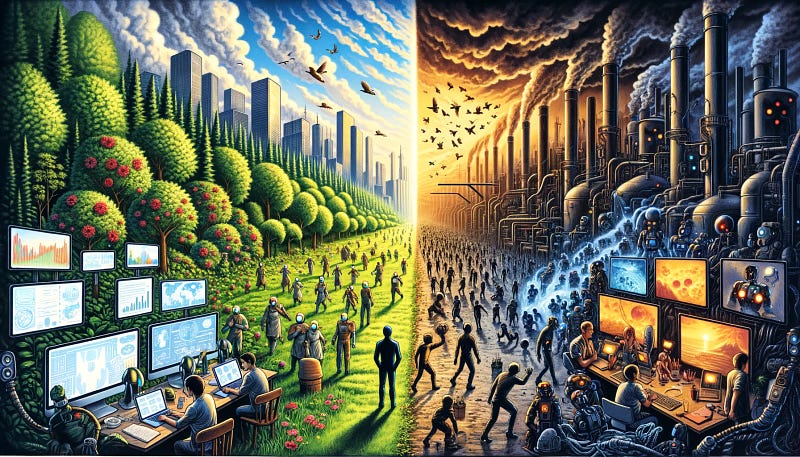
The path forward involves not just technological innovation but a societal commitment to ethical reflection. We must be willing to question not whether we can create more intelligent machines (we can!), but what reasons and principles will drive this creation. In this endeavor, philosophers, ethicists, and, yes, even satirists, have as crucial a role to play as any software engineer.
A Call to Arms (and Brains, and Hearts)
As we stand on the brink of an AI-infused future, let us take a moment to remember the lesson of the flies and the folly of uncritically embracing the popular or the convenient. Let us strive to ensure that our AI creations serve not just as mirrors of our ingenuity but as testaments to our humanity.
In the end, the question is not whether AI will become an integral part of our lives — it will — but whether we can guide its integration with the wisdom not of flies, but of thoughtful custodians of our shared future. Let’s aim to be remembered not for the technological marvels we created, but for how we chose to design and use them.
This story has been, obviously, illustrated with the help of DALL-E.
To read more about the risks of AI, hallucinations, and managing AI in data analytics, check out my book, “Generative AI for Data Analytics”.
Make sure you check out the “Between Data and Risk” publication on Medium for a critical look at the latest ideas and technologies in business.
Finally, support my writing by becoming a Medium member today and get access to all my other articles and millions of others.