
Fear and Understanding
David and the Lion’s Den, chapter 20
“David, Liebchen! You are forgetting Wednesday is garbage day?”
Hilda’s voice reached me like a beam of light limping through muddy water. I barely heard her from my perch on the sofa where I was immersed in my writing.
Once she got my attention, though, I jumped like a jack-in-the-box. “Oops! Right. I’ll just run the bags down now.” Ever since my confrontation with Richard, I’d been feeling guilty. I was trying to be as helpful to Hilda as I could. And as cheerful.
My enthusiasm betrayed me, though. I got tangled up in my own feet and knocked into an etagere full of china and tchotchkes.
I adjusted an angel figurine as Hilda laughed at me. “Not so fast with the feet, Jung, or we are maybe having more garbage than we were thinking.”
“Sorry. I don’t know why I’m so clumsy lately.” I felt myself blushing. “I hate being in your way up here, but the weather …”
It was too cold and rainy to write in the park.
“Don’t be silly. It’s lovely having a man underfoot.” Then she clucked. “Oh! Such a silly thing for me to say, nein? I hates clichés.”
I didn’t ask her which cliché she meant.
“Can you stop by D’Agostino, please, when you take the garbage down?”
I was glad to. Running errands for Hilda was like doing penance. I needed it.
She held out a glossy coupon. “Breast of veal. On special today. And apples for the stuffing.”
“Anything else?”
She reached for her purse, but I waved her off. “Hilda, you know I buy the groceries.”
“Yes, Liebchen, but I was thinking of a nice bottle of wine. You let me buy it, nein?”
“Nein,” I parroted. “Oops, I mean sure. If you want to.” I couldn’t afford the kind of wine Hilda liked.
“Gut! So, you will stop, please, at the little shop across from the grocery? Ask Frederick for that nice Austrian Riesling he knows I like.”
It was a setup.
I walked out of the wine shop an hour later, plastic bags weighing down both my hands, struggling to pull my hood up against stinging rain.
“Help you with that, young man?”
Richard was standing right outside the exit, sheltering under the green striped canopy. Waiting. I stopped dead, not knowing what to say or how to react. I opened my mouth, half expecting an apology to to fly out all on its own.
“Hilda,” I stammered instead. “I thought it was odd she wanted wine on a weekday!”
He didn’t answer, just reached up and pulled a couple bags out of my hands. “Buy you a coffee?”
“Look. Richard. I’m sorry. I’ve been… I dunno.”
He pulled up his collar. “You’re sorry you can’t have coffee with me?”
“God, no! Jesus, I can’t do anything right today. I mean I’m sorry about …” I pointed toward the park.
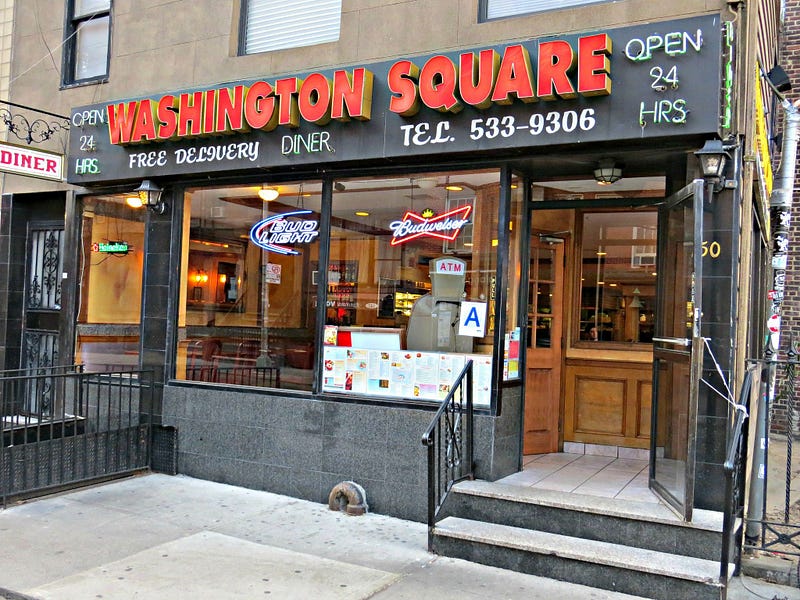
“Well, so am I, if that helps. Come on.” He jerked his chin toward the Greek diner on the corner.
“I didn’t mean anything by it,” I told him a few minutes later as we got settled into a red vinyl booth. “I was mad. At myself. At the world. At everything. I didn’t mean to get personal.”
“Isn’t personal kind of the point?”
I cocked my head, trying to make sense of his question.
“We’ve been neighbors for what, about a year?”
“Sure. About that,” I agreed.
“And we’ve become friends?”
“Of course.”
“Then shouldn’t we be personal with each other? I know I kind of shocked you with everything, but I’m surprised at you. Really.”
“Look, I’m not… I’m still getting used to everything. I’m like literally not in Kansas anymore, OK? I’m trying to be open minded, but sometimes …”
Richard’s reply was stiff. “That’s hard for me to understand.”
I eyed him wordlessly, grateful our waitress chose that moment to clink down our cups and saucers.
“David, I’m old,” Richard sighed as she hustled off. “I spent my whole life doing what I was supposed to do. I didn’t have a choice. Not like the choices you have.”
“Choices? You think I’m here painting dying people because I have choices? You think I really chose to be here in the middle of this?”
“I’m here too, David. Maybe some things are easier for you than me, though. Have you thought of that?”
I didn’t answer.
“I went to college. Joined the army. Fought in a war. Came home, got married, went to work, had kids, bought a house. I did every damn thing I was supposed to do to make me happy.”
“Yeah? And?”
“Nothing. I felt absolutely nothing. I just watched from outside. I watched my friends fall in love, fall out of love, cheat on their wives, trade them in for younger models, then get tired of them too.”
“And you didn’t ever cheat?”
“Of course I did! My whole life was one big paint-by-the-numbers cheat. I cheated every day of my life just by pretending to be me. Sometimes, rarely, I’d take an extra long lunch and cheat for real. Cruise some rough trade in Central Park. Ten minutes of being me.”
“Why’d you stay? Why so long?”
“Choices, man. We didn’t have them then. What was I gonna do in 1948? Move to Greenwich Village? For what? Besides, my wife depended on me. My kids. I don’t know. I did what I had to do.”
“And now?”
“After Danny graduated, I had a crisis. A breakdown.”
“God, you sound like an Updike novel.”
“That boring?”
I shrugged.
“Updike never could have written the next part. I had some problems. The IRS was after me.”
“Oh, right. That’s how you met Hilda.”
“I started spending nights in the City. Told Muriel I had to work late in Hilda’s office on our case. Sometimes I even did. I was drinking a lot.”
“That’s when Carla started?”
He nodded. “You know the club you dropped me at?” He named it. “It’s been there for years. I went with this guy I’d been seeing. He took me as a joke. Sort of.”
I picked up my coffee. It was already cold.
“Something happened that night. I was… it was like my eyes opened. I’d been thinking about suicide. I’m not sure I was serious, but I was thinking. My boredom was so overwhelming that I don’t think I could have actually stirred myself long enough to find the right drugs, or buy a gun, or whatever. I might have.”
“That’s terrible, Richard!”
“Didn’t feel terrible. Just heavy and fatiguing. I just wanted it all to stop, you know?”
I did.
“But that scene at the club!” he went on, steely grey eyes locked onto mine. “It woke me up. It zapped electricity through me. I made me look inside myself and see myself. My real self.”
“I don’t understand.”
“I know you don’t. I’m not asking you to.”
“But…”
“But, nothing. You know who helped me shop for my first skirt?”
“No idea.”
“Hilda.”
Of course.
“You think she understood?” he asked me, peering down over that long nose of his. “Of course she didn’t. Not deep down. Not really.”
“So …”
“So, what’s so damn important about understanding people? I retired. I set my wife up in comfort, and I moved here. I think she was relieved. We have lunch sometimes.”
“And you need the money so much that you had to … you have to … whatever you call it?”
He laughed. Long and hard. Yeah, the money helps. You know I keep another apartment over on 6th Avenue? By the Limelight? Just a studio with dungeon equipment. I pay the rent with the fees I charge.”
I gulped cold coffee.
“But mostly I charge because charging makes it more real. The money makes it more than a game.”
I shook my head “Wow. Rabbit never ran that fast. I can see it all in an Updike novel now. Somebody pitch this! Elderly female Holocaust survivor shops for spiked heels and velvet handcuffs with retired Madison Avenue exec who gets off selling B&D services in a Manhattan pied-à-terre.”
The more I thought about it, the more I grinned. Then I started to laugh. I couldn’t stop myself.
“That’s the spirit,” Richard chuckled. “Life is ridiculous! I stopped looking for any meaning deeper than that years ago.”
“What about love?” I protested.
“This from you?”
“What’s that supposed to mean?”
“Pushing people away is what you do best, isn’t it? Have you ever let anybody get in really close?”
“I’m only 24!”
“Oh, right.Forgive me. Crazy of me to imagine that a guy in his early twenties would ever fall in love. Ridiculous, huh?”
I almost cut the conversation off right there, but Richard looked so comical staring me down that I started to laugh again. I let go and trusted him. “OK, OK. You’re right. But, I don’t know. It’s hard. I mean, my painting, it …”
“What?”
“It fills me up. It consumes me from the inside. Does that sound stupid?”
“Maybe. Why do you paint?”
“Why do you go to that club?”
“Touché.”
“The more I paint, the more I understand people.”
“And that’s important?”
“Shouldn’t it be?”
“Maybe. Does it really work?”
“I’m not as sure as I used to be.”
He looked at me for a long time and then asked me a question I still think about. “What are you afraid of?”
I didn’t understand. “With respect to? Love? Painting? Dying of AIDS? Going to prison?”
“All of the above. None of the above. Your choice. You’re afraid of something. I’ve seen it in your eyes since the day I met you.”
I drank half my coffee before I answered. “Shouldn’t I be afraid? Isn’t everybody afraid?”
“Maybe. Why didn’t you ever give Howie a chance?”
I had to blink twice before my eyes would come back into focus. “Excuse me? Where did that come from?”
“Just an honest question. Are you too afraid?”
“A chance? Howie’s my friend! We spend the whole summer together. Howie’s great.”
“A chance to be more than friends. He obviously likes you.”
“Oh, give me a break. I’m not Howie’s type! Besides, what would he… Why would he?” I was spluttering.
“OK,” Richard laughed. “Enough for today. Let’s get this food up to Hilda before she files a missing persons report.”
I helped him on with his coat. “I really am sorry, you know.”
“I figured,” he said, arranging his scarf and throwing a five on the table. “Next time, why don’t you just pick up the phone and say so? We’re friends. There’s nothing to be afraid of.”
I grabbed a mint as we passed the cash register and popped it in my mouth as we stepped into the street. It tasted sweet and fresh as we walked the two blocks back to Washington Square.
You just read chapter 20 of a character-driven mystery set in Greenwich Village during the worst of the HIV Plague Years. David, Jill, Hilda, Richard, and Howie — and Raphael — are walking a path that leads to intense friendship and love, to the creation of gorgeous but wrenching art, and to the unraveling of a series of horrific events that nobody sees, not even as they happen. Because sometimes what you’re looking at isn’t what you see.