
Visual Frameworks for..
Generative AI Decision Making in your Organisation.

The productivity and efficiency gains in using Generative AI are easily identifiable — task automation and text summarisation as two examples. However, for organisations the difficult decisions lie in identifying utility and data strategy.
If you’re enthusiastic about Generative AI but unsure of its implementation this post provides visual frameworks to identify organisational use cases and an overview of Data operating models. This is followed by a summary and next step actions.
Digital, Data and Design Institute at Harvard
The Digital Data Design Institute at Harvard brings together over 30 faculties to address pressing business issues related to digital transformation and data proliferation.
The institute operates 13 labs focused on areas like business model transformation, organisational change, algorithms, ethics and societal impact. They collaborate with business schools, companies, and other organisations to research and develop business solutions.
Their YouTube Channel has a range of videos. Two specific videos were used for this post:
- “Developing a Generative AI Strategy for your Company” and
- “From Data to AI”
Relevant visual frameworks from both videos have been extracted to discuss Generative AI’s utility and Data / AI operating models. Each visual has timestamps, the full videos are included in Reference Links.
For clarity, I have no connection to the Digital Data Design Institute other than as a subscriber to their YouTube channel.
Developing a Generative AI Strategy for your Company
Firstly, let’s introduce the YouTube personalities.
Professor Shikhar Ghosh discusses how companies can think tactically about introducing Generative AI into their organisations.
Drew Morgan is the General Manager of Tesseract Rentals, he joins the talk later to showcase practical usage of Generative AI in his organisation.
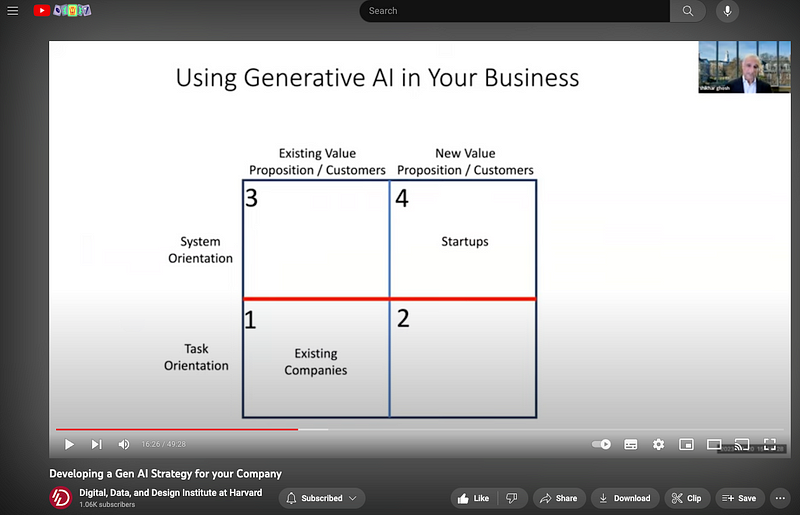
The quadrant has horizontal system and task orientation and vertical descriptors for existing and new value.
Professor Ghosh explains that in evaluating Generative AI’s usage, most organisations first detail applicable tasks. The example used was Customer Service:
- How can Generative AI improve the customer service function?
- What customer service tasks should be prioritised for both existing and new customers?
Typically, once all tasks have been identified organisations then look at systems orientation. In this context, systems orientation relates to the organisation’s processes, specifically how Generative AI can transform the organisation- potentially leading to new products / services and business models.
Narrowing Our Company’s Focus
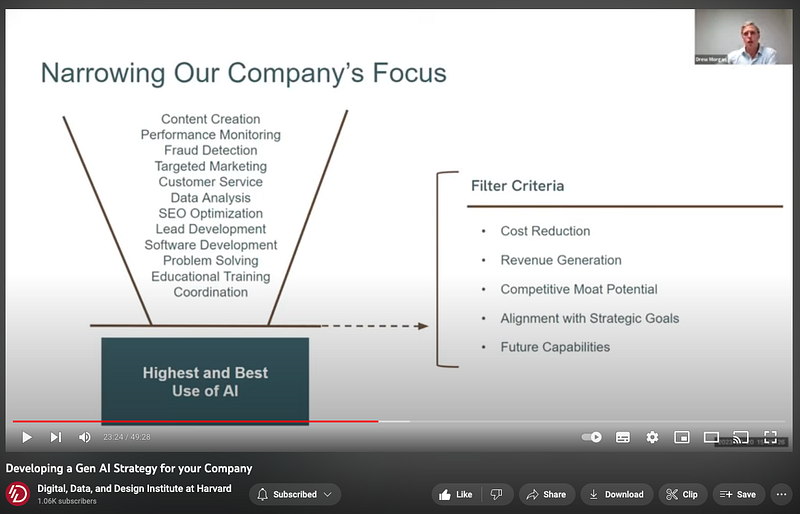
Tesseract are the #1 fastest growing Airbnb Management Company in Virginia. They have 50+ employees and manage 15K reservations per year.
In the video, Drew Morgan outlines Tesseract’s AI use cases beginning with “Content Creation” and ending with “Coordination” before presenting Tesseract’s “Filter Criteria” — their decision making criteria.
The use cases and filter criteria are generic enough to be applicable for most organisations. Later in the video, Drew outlines specific AI opportunities for Tesseract — see Summary.
From Data to AI: Maximizing Organizational Value Through Effective Operating Models
Samir Sharma is the CEO of datazuum, a boutique consulting firm based in London. In this talk, Samir highlights the critical link between data, AI, and organizational value. Beginning with the below quadrant on organisational strategy / operating model.
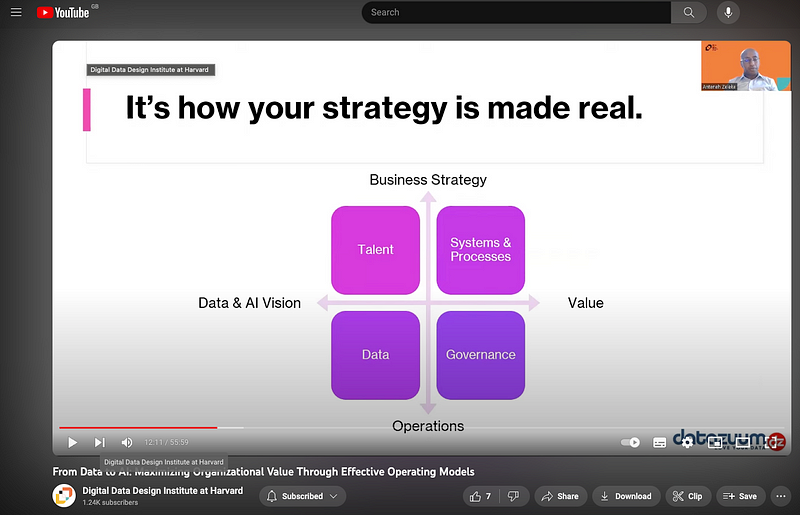
Samir provides an operating model definition:
“An operating model is a collection of capabilities primarily focused on people, processes and technology.”
The quadrant shows four inner capabilities — Talent, Systems & Processes, Data & Governance. The interaction between the inner quadrants and the outer components — Business Strategy, Value, Operations and Data & AI Vision- affects the operating model.
Simplistically, an organisation’s strategy to utilise Generative AI will fail if they do not have the talent, supporting processes, data or clearly defined accountabilities and responsibilities.
Samir proceeds to outline 4 major operating model types. These are included in the image below, bullet points for each model follow.
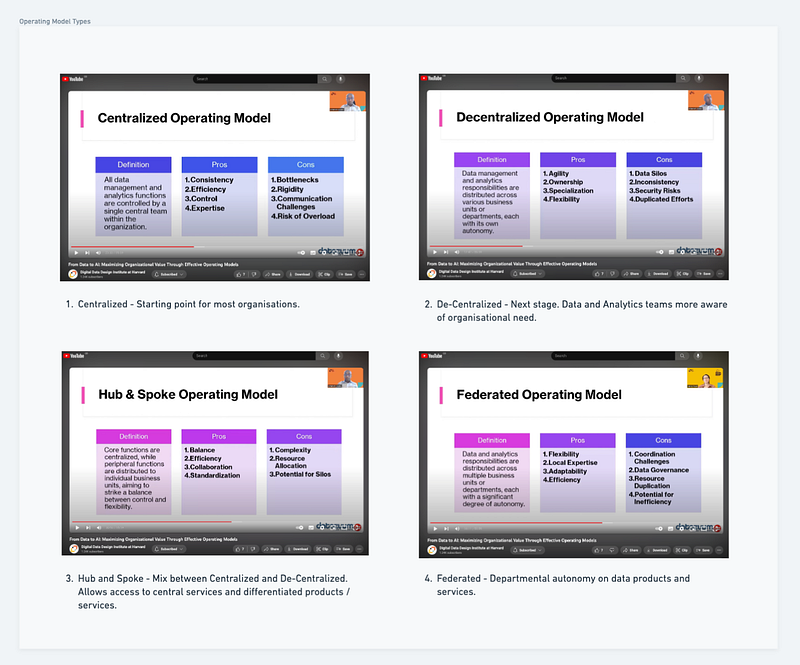
Centralized Operating Model @ 23.33
- Starting point for most organisations
- Small Centralized technical team
- Can become overstretched — leading to bottlenecks
- Poor communication between centralized teams & business functions
Decentralized Operating Model @ 17.47
- Next stage from Centralized Operating Model
- Technical team more aware of organisational need
- Quicker response to organisational requests / needs
- Data Silos — departmental data siloed from the rest of the organisation
- Mix between Centralized and Decentralized operating models
- Access to centralized services and differentiated products / services
- Complexity — managing central and decentralized products / services
- Requires more technical resource
Federated Operating Model @ 33.11
- Parallels with DataMesh
- Departments have greater flexibility and autonomy
- Duplication / Effort— similar products & services operating in silos
- Inefficient resource management
Summary
Identifying Generative AI use cases is difficult. Sequoia in their article — Generative AI’s Act Two — reflect on Generative AI’s first year. They acknowledge the productivity and efficiency gains, explosion of apps, but also the current task based nature of Generative AI.
In Sequoia’s view the next phase of Generative AI will look at solving entire problems (system orientation) as opposed to task based. They provide examples as well as an updated Generative AI market map — highly recommended article.
Tesseract had identified use cases, leading to the below evaluation criteria.
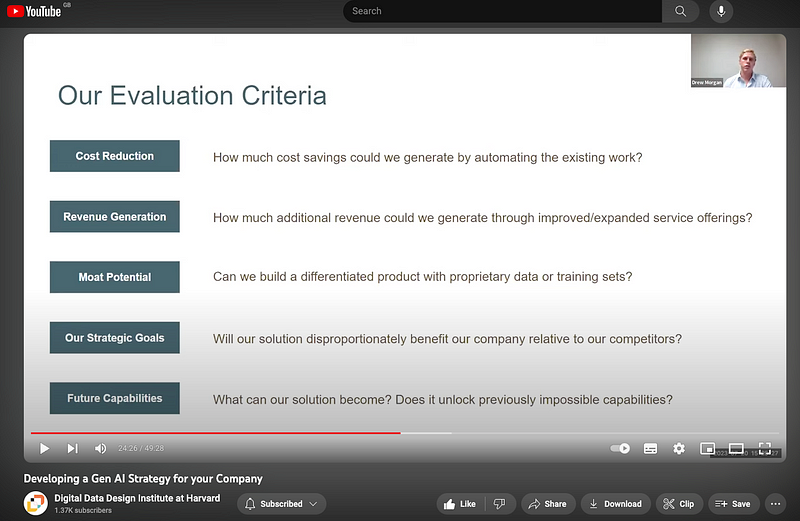
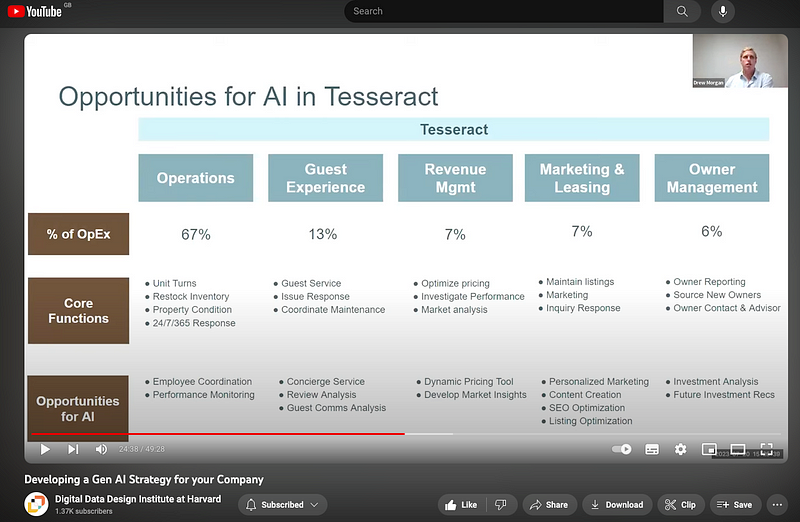
This lead them to identify specific opportunities for AI at Tesseract. I particularly like how they’ve identified % of OpEx spend along with the opportunities to highlight potential gains and new services— “Employee Coordination” and “Concierge Service” — see below.
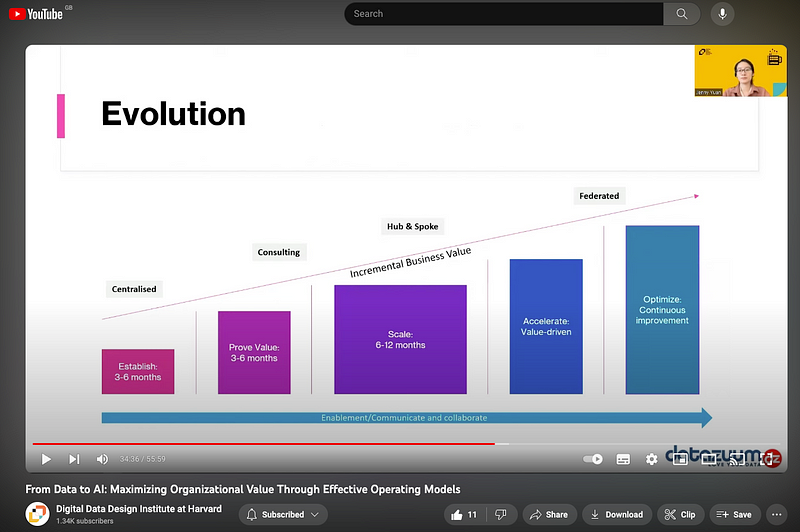
Samir in his video provided an operating model definition and described four operating models. Operating models like companies grow and evolve, the below screenshot shows a typical evolution from Centralised to Federated operating models.
Ok, we’ve covered identifying and operating models. What are the risks, what other factors should be considered?
Towards the end of their article — Generative AI Unleashed: Charting the Enterprise Future- Forbes identify a number of technological and people risks. The article is embedded for your reference, below is an abbreviated list.
Technological & People Focused Risks:
- Complexity in integrating data systems with business processes
- Legal and Compliance risks if there isn’t supporting Governance
- Harmful applications could erode consumer trust — Reputational Risk
- Ensure there’s adequate safeguards to avoid exploitation — Cybersecurity
- Develop strategies to attract and keep organisational talent
- Upskill and support employees through the Generative AI process
Actions
In the same way Tesseract looked at the AI & Generative AI opportunities, the next step actions are:
- Map Task and System Orientation utility
- Rank Filter Criteria use cases
- Operating Model Identification
- Risk Management
Firstly, identify the tasks that Generative AI can manage, automate or improve productivity, before evaluating systems, entire processes or business functions ripe for AI & Generative AI.
Ranking the use cases will help prioritise against organisational need. As we’ve seen, operating models evolve, each have their own pros and con’s. Understand your existing model and whether this will aid or hinder your Generative AI use cases.
Lastly, consider the wider technological and people based risks inherent in new projects.
Reference Links
The full videos used in this post are included below.
If you enjoyed the post, clap for it, highlight and share your perspective.
Subscribe to DDIntel Here.
DDIntel captures the more notable pieces from our main site and our popular DDI Medium publication. Check us out for more insightful work from our community.
Register on AItoolverse (alpha) to get 50 DDINs
Join our network here: https://datadriveninvestor.com/collaborate
DDI Official Telegram Channel: https://t.me/+tafUp6ecEys4YjQ1