
Seeing Blackface in Public Is Worse Than I Expected
Blackface endures because White people have a fascination with our bodies
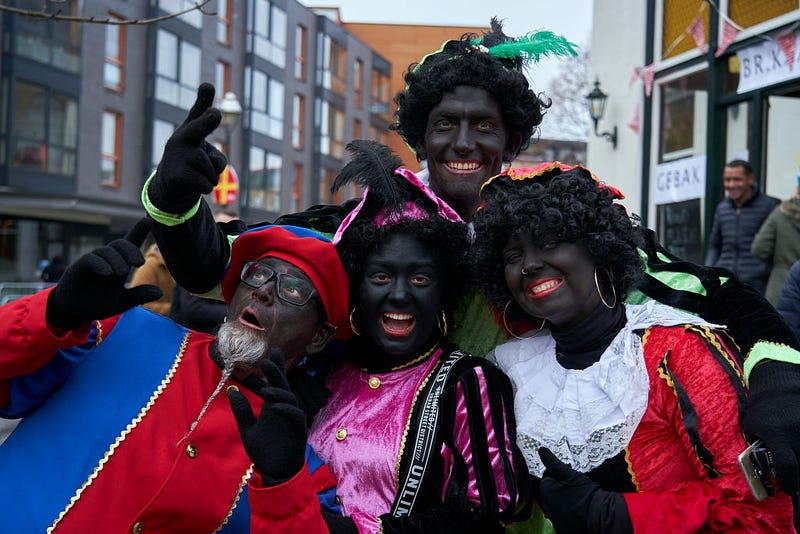
I was visiting my cousin and her partner in the Netherlands at the start of the holiday season when she told me about the Zwarte Piet (Black Pete) celebrations. Her explanation happened through a circuitous route. She gifted me with a welcome basket, and one of the items was a large, chocolate candy in the shape of my first initial, while she talked to me about Dutch traditions. Until this time, I didn’t know the history of Zwarte Piet. All I knew was that still in the 21st century, Dutch people dressed in blackface during Christmas and called it tradition, though the custom is becoming a controversial subject. My cousin, who had read many of my articles on race and gender in America, wanted to know if I was interested in going to one of the celebrations in the center of town with her partner’s family. She was interested in getting my thoughts on the experience in real time. I wasn’t going to let my biracial cousin go by herself, so I agreed. I devoured that entire chocolate in one sitting.
The legend of Sinterklaas is different from our American version of Santa Claus. Instead of Santa Claus arriving at homes from the North Pole with his 12 reindeer, Sinterklaas arrives via boat with his Black servants, one of them being Zwarte Piet. While Sinterklaas travels on the roof, Zwarte Piet slips in through the chimney to put presents in children’s shoes. There are many different theories about Zwarte Piet. During the Middle Ages, the story was that Sinterklaas traveled with a devil on a leash as a form of enslavement. Some argue that this is Zwarte Piet’s origins. The juxtaposition of Sinterklaas’s Whiteness and Zwarte Piet’s Blackness were supposed to be representations of light subjugating darkness, or goodness being able to control and contain evil. Then toward the end of the 19th century, Sinterklaas’s Black company transmuted into a Black servant styled as a “16th-century page.” At the same time, in 1850, there was a children’s book called Saint Nicholas and His Servant, though no name is attributed to the servant. Others believe that Zwarte Piet’s origin story is an Ethiopian slave who St. Nicholas frees. Nevertheless, there is a power hierarchy in place. Sinterklaas tells Zwarte Piet what to do. Zwarte Piet carries presents in one hand and a whip in the other, and Sinterklass tells him which child deserves one over the other depending on their behavior. In fact, some Dutch parents use Zwarte Piet’s presence as a warning to not do wrong.
I didn’t know exactly what to expect when I went to these Dutch celebrations, but I was curious. I had only seen blackface in videos and photographs from the earlier part of the 20th century, or as White celebrities’ Halloween costumes, which they’d always apologize days later for their ignorance. They respected the character who they were trying to imitate, which is the same reasoning that Dutch people use with regards to Zwarte Piet.
It was a rather cold day with overcast skies, and the narrow streets were filled with families with excited and impatient children. At first, I saw White children with black paint as one long streak in the middle of their foreheads. That wasn’t so bad, I thought. Then there were plenty of White children whose faces were bare, but they were jumping up and down, incessantly asking their parents when Zwarte Piet would be arriving on the steamboat. It seemed as if the main attraction wasn’t even St. Nicholas himself, but the ancillary character. We moved closer toward the riverbank to wait for the steamboat to arrive, and then I was ambushed: Several volunteers were dressed in blackface, and they were walking up and down the grassy path to distribute candy to the children and engage in casual conversation. Their faces were painted black and so were their necks. I couldn’t detect a spot of whiteness anywhere on their bodies. Besides that, they wore thick, dark, curly wigs, and fire-engine-red lipstick. I prayed that none of them would make eye contact with me. All the while, the children were exuberant over these blackface characters. They didn’t just honor Zwarte Piet, they worshipped him. Meanwhile, I was standing still, emotionless and confounded. I looked behind him and noticed that Black parents and those of color stood further back near the restaurants and bars and wondered if they did this purposefully. There was a clear spatial segregation between those who spectated and those who happily joined in the occasion. I wondered why they came in the first place, but then I could’ve asked myself the same question. Because often as a Black person, like many others, I’ve been in situations where I’ve deprioritized my comfort for the sake of collective revelry, to uphold tradition, and to deceptively believe that I was a part of something larger and stronger than how small and marginalized I felt in the moment.
Watching blackface as a Black American woman in a country that partook in the transatlantic slave trade was one of the most disorienting experiences of my life.
I departed from the crowd to use the bathroom, and my world felt imbalanced. My gait was off and everything seemed to be leaning to the side. I didn’t know if I needed to catch my breath, get a glass of water, or eat more chocolate. Luckily, when I returned to the riverbank where my cousin, her partner, and his relatives were, the celebrations were coming to a close. We returned to their apartment, and I retired to their bedroom where I rested for hours, though I awakened with not the slightest bit of clarity of what I saw. When I thought of the young children who exalted the White Dutch people in blackface, I figured they were too young to understand. But then what about the children who were in blackface themselves? What about the children who weren’t in blackface at all but had a black streak instead? What were their parents telling them? And why weren’t there any real Black people a part of this presentation? Watching blackface as a Black American woman in a country that partook in the transatlantic slave trade was one of the most disorienting experiences of my life. It is one thing to hear about blackface and its ills in historical contexts. It’s completely another when blackface is still considered normal in other parts of the world, where blackness is a celebratory costume.
I’ve tried to process that day many times within the past week when so many White creators and White-dominated companies are removing episodes where their White actors are in blackface. I know these are desperate attempts to right wrongs and cover their asses from social media uproars. But I also know that blackface will not stop because White people have a fascination with our skin and our bodies. It’s not so much that they want to be us, but they want to wear us. I put your face onto mine because subordination is alluring to me. I paint my face in hopes that I gather a semblance of Blackness because I want to know what it’s like to be low, to be humiliated, to be in servitude like Zwarte Piet. The tradition is not so much Christmastime, but more so White people’s centuries-long relationship with erotic humiliation in that they have this titillating desire to wrap themselves in our skin to add a kind of spice and danger that their lily-white lives could never afford them.
We as Black people see dehumanization. They see veneration because we caught their attention, not understanding that gaze leaves no room for us to be multidimensional, living, breathing individuals. This is why we don’t know much about Zwarte Piet. This is why we don’t have a definitive idea of who he is and where he came from. He is an invention of whatever White people want him to be, and therefore, they can manipulate and distort his image however they please, like blackface. To upend this tradition would be to upend their imagination, and so much of their White Dutch identity depends on these stories that they tell themselves about each other—and about us.